
文書の過去の版を表示しています。
 このページはまだ完全には、翻訳されません。翻訳の完了を支援して下さい。
(翻訳が完了したらこの段落を削除して下さい)
最 初 に
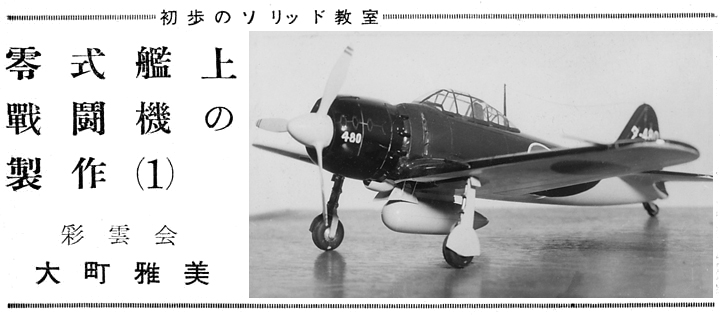
皆さん、今月は零式鑑上戦斗機を作りましよう。世界的にも有名なこの機体には、ソリッドフアンならば日本人であらずとも一度は必ず作って見たい竜欲にかられるものと思います。 平凡な型態ながら、実にコンパクトにまとまり、外国機には見られぬ日本独特な匂がいたします。机の上に是非一機飾り度いものですね。 さて、製作にあたつて考えねほならぬ事は、本機に於ての工作上の難所とも云うべき、エンジンカウリング附近を如何に上手くまとめるか‥…と云う事ですが、他機と異り非常に複雑です。私のクラブでもスケールは1/50が圧倒的ですが、作品を見ましても1/50の「零磯」は仲々苦しい工作がなされているようです。 そこで、初歩の方々に、もうしあげたい事は縮尺を1/30~1/40に選んだ方が工作上無理もなく、座席内部も、こまかくイジレますし無難ではないかと思います。 私も1/50、1/40、1/30と各種を試作して見ましたが、1/40が適当なように感じます。なお各種の改造型がありますが、52型により解説いたします。 材料は、槍を使用します。良く乾燥した、目の通ったものを選択してください。
胴体の工作
第1図を参照くだされば、大体おわかりの事と思いますが、各自の設計図より写した型紙を、先ず側面より、材料に印しますがこの場合鉛筆でやりますと、バッキリ白立ちませんし、ズレたりしてどうしても不正確になり勝ですが、マジックインキと云うのがありますのでこれを使用すると正確にゆき、脚カバーなどを形取りすも場合も便利です。
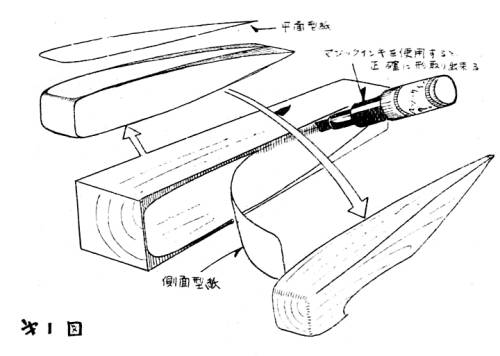
この胴体の型取りの場合、風防やキヤノピー前の少し高くなった部分は含めません。「写戦」は平凡な到ながら、「零戦」らしく仕上るのは仲々困難です。しかし大部分はこの胴体のやわらかな曲線にあるようで細心あの注意を払って工作してください。
側面をノミ(一寸幅位いのノミで、グサリグサリとやりますと簡単です)。削った後、図面にもう一度合せて若干の誤差はぺ-パ一を使用して修正し、次に平面の型紙を使用し同じく削り出します。
平面も出来ましたら翼のはめ込む部分を、鋸、ナイフを利用して彫りましよう。注意事項としてはエソジンの丸味のつけ方で、削り過るとやっかいです。前面に有る空気取入口も留意の事。
次に前回解説した「F4U」をご覧になった方はおわかりでしょうが、座席は第2回のごとく工作してください。
1/50スケールならばとも角、1/30位いですと、相当大きくなり従ってスペースも出来ますから、座席横のフラップ操作桿などを付けると面白いと思います。
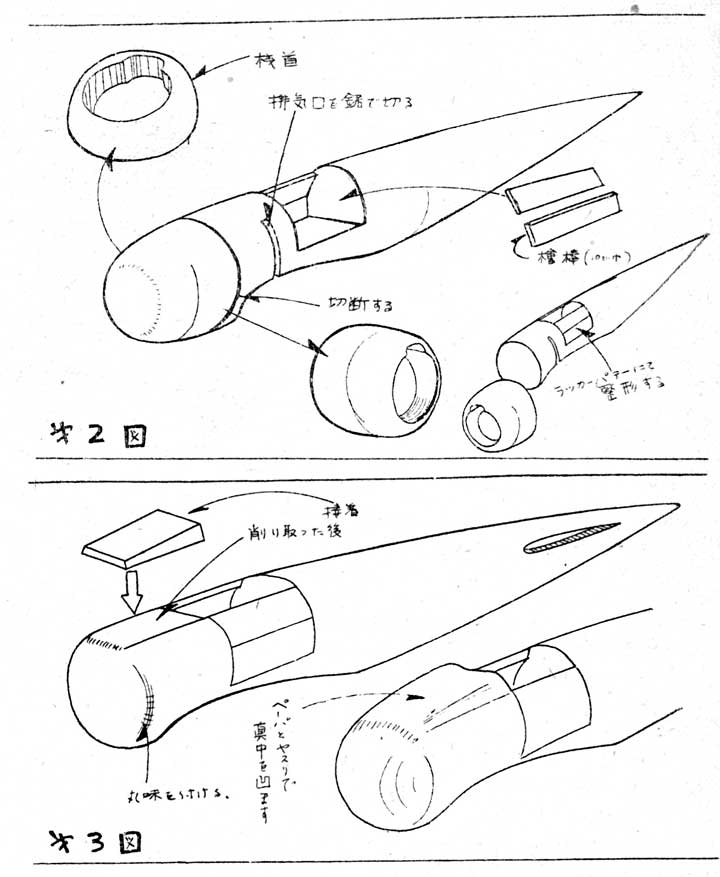
檜棒を2~3枚寸法に合せて接着剤で接着し、其上を削り、隙間などはラッカーパテーを塗り、乾燥後ペーパーで整形します。
次にエンジンの穴掘り工作として約1/30で10ミリ程度切断し、彫刻刃の丸刃を利用して、ドーナツ型に真中をくり抜きます(空気吸入口も考慮の上)。そして、私独特の工作法かも知れませんが、エンジンの部分を切り落します。理由は製作されればお判りになると思いますが、この部分は非常に工作がしにくいからです。
それでエンジンと機体とは別に工作を進め最後に接着いたします。それから胴体に有る排気口を鋸で図のごとく切れ目を入れます。
第3図はキャノピー前の凸出部の工作ですが、豊富な「零戦」の写真などから充分検討の上作業してください。機体前面に丸味を受ける事もお忘れなきように!。
Wing Construction
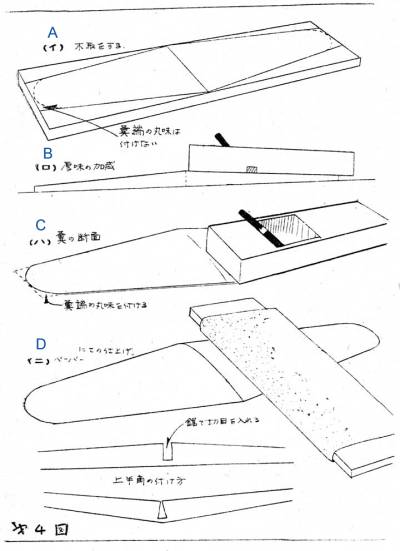
Figure 4 illustrates the wing procedure. If your stock allows, it is easier to carve the left and right wings from a single board.
Choose hinoki free of knots with straight, even grain. In step (A), transfer the template to the wood. For ease of planing, do not round the tips yet. In (B), set the tip shapes and the wing-root thickness. In (C), carve the airfoil section—study the profile carefully before rough shaping.
After that, round the tips. Note that the shape varies with distance from the fuselage; this step rewards close attention. In (D), finish the surface with fine-grit sandpaper. Take care not to over-thin the trailing edge and watch for any twist.
To form the dihedral, you can either saw a relief cut as shown or simply separate the left and right wings.
A note on commercial solid-model kits: some provide wings with the wing-root fillets carved integrally. This removes the need to add separate fillets later, but it makes planing difficult—often a challenge for beginners.
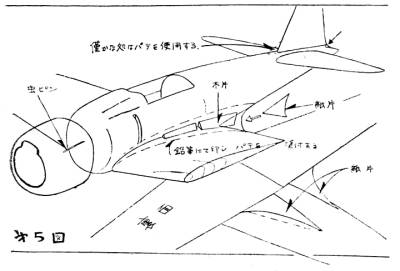
As seen in Figure 5, the alternative approach described here offers a cleaner path.
Fillet Construction
At 1:50 the fillets can be formed almost entirely with putty. At larger scales such as 1:30, they become prominent. In that case, use thin wood shavings (e.g., plane shavings) and glue them in place as in Figure 5. Beforehand, cut triangular paper patterns from your plan and glue them to the underside of the fuselage as guides.
When dry, apply lacquer putty in small amounts. Because drying takes time, leave it two to three days.
To accelerate drying, prick numerous small holes in the putty with an awl to create a honeycomb effect. Be warned: if you paint over the fillet before it is fully dry, the finish may wrinkle later—patience is essential.
Make the tail surfaces (horizontal and vertical) by the same method as the main wings. Attach them with bamboo skewers as dowels into pre-drilled holes, taking care to avoid any warp. Fill minor gaps or uneven curves at the joints with lacquer putty and fair them in.
Canopy Construction
Let us move to the canopy. When plastic sheet is hard to obtain, readily available vinyl sheet is a workable substitute. Note, however, that ordinary adhesives do not bond vinyl well; use an adhesive formulated for vinyl. Also, lacquer paint on vinyl frames can rub off more easily.
That said, unless you intend the canopy to open and close, it will not be handled much; vinyl is generally suitable when plastic is unavailable.
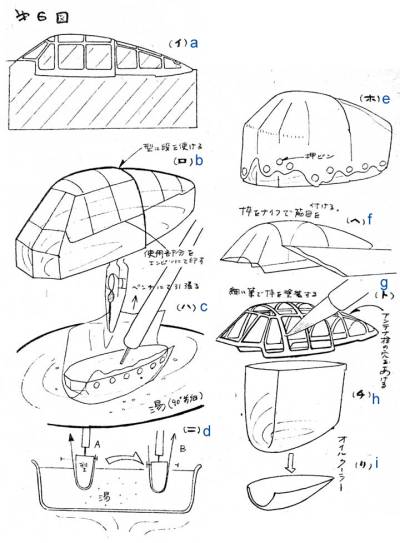
See Figure 6.First, carve a male mold from wood, as you did for the fuselage, beginning from the side profile (a). Pay close attention to the angle and width of the forward screen. As in (b), file a step in the mold where the sliding hood would sit; these steps reproduce faithfully in the pressed piece, so even multi-step canopies like those of the Tenzan or Saiun can be replicated by shaping the male mold accordingly.
In ©, The critical caution is not to let the water boil. If vinyl is dipped in boiling water, it turns cloudy like frosted glass. Instead, once the water boils, remove it from the heat and use it as the temperature drops. As you stretch the vinyl sheet with pliers, the area under tension will elongate. Pin that point with a thumbtack, then continue drawing the sheet over the mold, tacking down any wrinkles. Repeat on the opposite side. When the usable area is entirely wrinkle-free, stop and remove the part.
Even without a female mold, this method can yield a clean canopy. Whoever devised it deserves a solid-modeler’s Nobel Prize—if such a thing existed!
Next, in (f), lightly scribe the canopy frame lines with a craft-knife tip. Compared with freehand painting, scribing improves precision; the shallow grooves act as paint dams (see g), reducing bleed and making intricate frames easier to paint. Do not forget to cut a small hole for the antenna mast.
In (h), the mold for the oil cooler is shown. Finally, (i) illustrates the finished oil cooler itself. Rather than carving it from wood, press-forming it in vinyl by the same method is easier; the hollow result, though small, looks more convincing.
As shown at A and B, the difference in dipping angle determines the molding result—use moderate-temperature water and a steady motion for best effect.
Landing Gear Construction
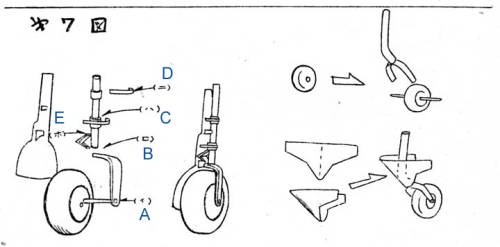
Now comes the notoriously troublesome part—the landing gear. Unless one is a master carver like Hidari Jingorō, it is virtually impossible to carve such complex parts from a single piece of wood. As a result, metal components—and the challenges of soldering—become essential.
Hidari Jingorō — a legendary Edo-period sculptor-carpenter famed for works such as the “Sleeping Cat” at Nikkō Tōshō-gū; the comparison underscores how exceptional such carving would have to be.
Model railroaders may have some soldering experience, but this work is far more delicate: parts so small you can barely hold them. Still, soldering is indispensable in solid-model construction and worth developing through practice. A soldering iron of around 80 W is suitable. There is no substitute for hands-on learning. If solder beads up and refuses to wet the joint, your iron may be too hot—watch your temperature. Prepare several sizes of plated knitting needles for struts. Use brass sheet for gear doors and tinplate for smaller fittings. For wheels, use 12 mm diameter at 1:50 and 16 mm at 1:30. Assemble in the sequence (A) → (B) → (C), and so on. Thoroughly file the mating surfaces, apply only a very small amount of flux/paste, and solder quickly (it rarely goes perfectly the first time). For the tailwheel, small sizes are not readily available commercially, so you will need to scratch-build them—take your time.
Propeller Construction
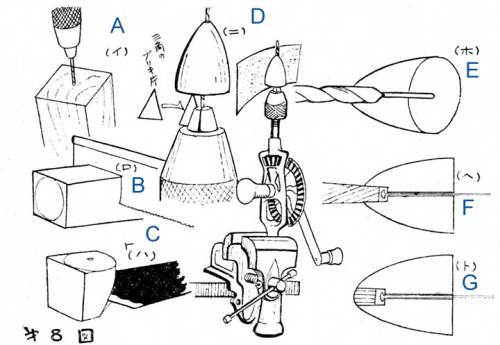
As shown in Figure 8, begin with the spinner. Drill into a clean-grained wood block with a bit just large enough for a sewing pin (about 0.8–0.9 mm).
Then, as in (B), cut the block 3–4 mm longer than final size. In (C), carve the spinner toward the center hole. If you lack a hand drill, insert a pin and rotate the piece by hand while sanding; it will produce a sufficiently accurate spinner for practical use.
If you do have a hand drill, follow (D): mount the same bit in the chuck, cut a small triangular piece of tinplate, and wedge it into the chuck gap. Press the tip of the triangle against the back of the spinner; this lets the spinner rotate freely without the drill slipping.
This method yields a well-centered spinner comparable to a lathe-turned part. In (E), drill a hole just large enough for the pinhead. In (F), glue a small wooden plug into the rear, let it dry, and file it flush.
Once finished, the spinner should rotate smoothly. Some say that rubbing a little pencil graphite into the pinhead seat improves rotation—feel free to try it.