
This is an old revision of the document!
He-115B Reform Record
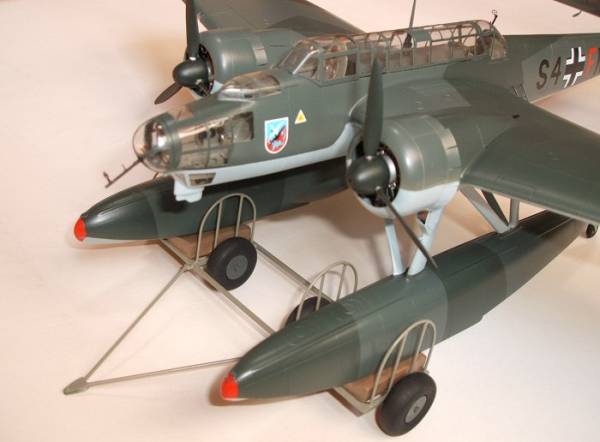
Introduction
This page is the entrance to the He-115B Reform Record by Kazu Fukuda.
The record presented here is not simply a sequence of work-in-progress photographs. It is a record of a completed model being seen again, questioned again, corrected again, and brought toward a renewed final form.
The original forum entries have been preserved separately as archival source pages. This page, by contrast, provides a reading framework.
Its purpose is to help readers understand the reform not only as a technical repair, but also as a process of renewed judgment.
In this record, a finished model does not remain fixed as a final result. It becomes the starting point for another act of making.
What Is Preserved Here
The He-115B model had already been completed once.
After many years, however, the painted surface had deteriorated. Cracks and mold appeared, and the model could no longer remain in its former condition.
Mr. Fukuda then undertook a major reform.
He removed paint, cut away the nose section, rebuilt parts of the aircraft, remade canopies, corrected surfaces, engraved panel lines, prepared markings, painted the model again, installed engines and floats, and finally brought the model to completion once more.
This archive therefore preserves three kinds of value:
- the technical record of how the reform was carried out
- the visual record of how the form changed through the process
- the judgment record of how an earlier completed model was reconsidered
The last point is especially important.
A reform record shows something that a finished model alone cannot show. It shows the movement from dissatisfaction to correction, and from correction to renewed completion.
A Note on Reading This Reform in Retrospect
Mr. Fukuda completed this reform less than two years before his passing.
It would be inappropriate to state his inner motive with certainty.
The record itself tells us that the model had deteriorated after twenty years, and that it seemed regrettable to let it decay further in that state.
At the same time, when read in retrospect, this reform may be understood as more than a repair of an old model.
It may also be read as a late act of re-seeing.
A model that had once been completed was opened again. Its problems were recognized. Its form was corrected. Its surface was judged again. And a new final image gradually emerged.
This page therefore reads the He-115B Reform Record through the following four perspectives:
- problem recognition
- continuous correction
- updating judgment
- the emergence of a renewed final image
These perspectives are not imposed from outside the record.
They are drawn from the movement visible in the surviving process itself.
Two Layers of This Archive
This archive is organized in two complementary layers.
1. Original Record Layer
The original record was posted as a sequence of forum entries.
Those entries were arranged in reverse chronological order, as was typical for the forum format.
In order to preserve the documentary structure of the source, the original posting logic is retained in the Original Record Pages.
These pages should be read as preserved source pages.
They retain the original sequence of entries as closely as possible.
2. Stage Reading Layer
The reverse chronological order of the original forum is valuable as a record, but it is not always the easiest way to understand the development of the reform.
For that reason, this archive also provides a reconstructed reading layer.
The reform is divided into five chronological stages.
Each stage page explains the process in greater detail, using selected photographs, key source phrases, and interpretive commentary.
The five Stage pages are not meant to replace the Original Record Pages.
They are guides for reading them.
Four Perspectives
The five Stage pages should be read with four larger questions in mind.
1. Problem Recognition
Where did the reform begin?
The answer is not simply “with repair.”
It began with the recognition that the existing model had become unsatisfactory in its present state.
Deterioration, cracks, mold, and the decision to cut away the nose section all show that the model was no longer accepted as a stable finished object.
The first stage of reform is therefore an act of recognition.
The maker sees the problem and decides that the model must be opened again.
2. Continuous Correction
The reform did not proceed by replacing one old part with one new part.
It proceeded through repeated correction.
The new nose section was shaped and trial-fitted. Canopy formers were made. Heat-pressed parts were tested. Gaps were corrected. Interior parts were installed. Surfaces were prepared again.
Each step depended on the previous one.
The work was not a straight line from plan to result. It was a sequence of adjustments.
3. Updating Judgment
Correction is not only technical.
It is also visual and intellectual.
When panel lines are sketched, engraved, and refined, the maker is deciding how the aircraft surface should be read. When putty is allowed to dry sufficiently before painting, the maker is judging not only the present surface but also its future appearance. When markings and colors are prepared, the aircraft’s identity is being reconstructed.
In this sense, the reform is a process of updated judgment.
The maker does not merely restore the old model. He decides again what the model should become.
4. Emergence of a Renewed Final Image
At the end of the record, the parts begin to gather into a convincing whole.
Canopies, engines, tailplane, floats, propellers, machine guns, markings, colors, and small fittings no longer appear as separate tasks.
They allow the aircraft image to return.
The completed model is therefore not simply the old model repaired.
It is a renewed final image.
Stage Reading Pages
The following five Stage pages provide the main reading path through the reform.
Each page focuses on one phase of the process and one major interpretive question.
| Stage | Page | Main Focus | Main Perspective |
|---|---|---|---|
| Stage 1 | Initial Condition, Dismantling, and Problem Recognition | deterioration, cutting away the nose, paint removal, preparation for reform | problem recognition |
| Stage 2 | Nose Reconstruction, Formers, and Canopy Work | new nose section, wooden formers, heat-pressed canopies, interior parts | continuous correction |
| Stage 3 | Joining, Surface Preparation, Panel Lines, and Trolley Work | joining the nose, surfacer, panel lines, float trolley | updating judgment |
| Stage 4 | Markings, Painting, and Final Preparation | national markings, unit codes, colors, cockpit components, trolley adjustment | judgment through finishing |
| Stage 5 | Engines, Canopies, Floats, and Completion | engines, canopies, tailplane, floats, final assembly, completion | renewed final image |
These Stage pages are intended as interpretive guides.
They do not replace the original record pages. Rather, they help readers follow the reform in chronological order and understand how the work moves from problem recognition to renewed completion.
Readers who want to study the process in detail should proceed from Stage 1 to Stage 5.
Readers who want to check the preserved source material should consult the Original Record Pages listed below.