
This is an old revision of the document!
He-115B Reform Record
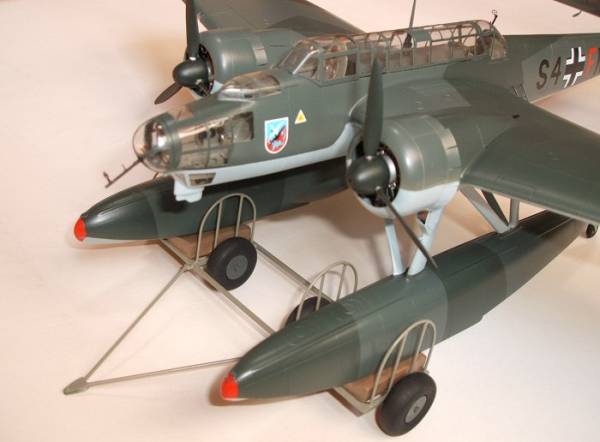
Introduction
This page presents the He-115B Reform Record as both an archival record and a guide to reading the process of reform.
It should not be understood simply as a sequence of work-in-progress photographs leading toward a finished model. What matters here is not only what was made, but what was reconsidered, what was corrected, and how form was judged again through the course of the work.
Because this record survives across multiple forum-based entries, it preserves more than technical procedure. It preserves a sequence of re-seeing.
In that sense, the He-115B reform record is valuable not only as a making record, but also as a record of changing judgment.
Why This Record Matters
A reform record differs in an important way from a new build record.
In a new build, form emerges from raw material. In a reform, the maker is already confronting an existing object.
That difference matters.
A reform makes especially visible:
- where the earlier form became unsatisfactory
- which parts were judged to require correction
- how a revised image of the aircraft gradually emerged
- how making became a form of re-reading
For that reason, this record should be read not only as a process of construction, but as a process of updated decisions about form.
How to Read This Record
This archive is presented in two different but complementary layers.
1. Original Record Layer
The original He-115B reform record was posted as a sequence of forum entries. Those entries were arranged in reverse chronological order, as was typical for the forum format.
In order to preserve the documentary structure of the original source, that posting logic is retained in the pages listed below as Original Record Pages.
These pages should be understood as archival preservation pages.
2. Reading Layer
Because reverse chronological forum order is not always the clearest way to understand the development of form, this parent page also provides a chronological reading framework.
This reading layer is not intended to replace the original source. Rather, it serves as a guide for following the reform in a clearer interpretive sequence.
In this way, the archive preserves both:
- the documentary integrity of the original forum record
- the readability needed for study and interpretation
Note on the Structure
The original forum-based record has been preserved in separate pages:
- as an archival layer
- in original reverse chronological posting order
- with minimal interpretive interference
This page, by contrast, is a reconstructed guide for reading the record as a sequence of stages.
It should therefore be read as an entry point and interpretive map, while the original pages remain the preserved documentary source.
Chronological Reading Index
Stage 1 — Initial condition, dismantling, and problem recognition
The reform begins with deterioration, disassembly, paint removal, and the recognition that the earlier form can no longer remain as it is.
This stage is important because it shows that reform begins not with making alone, but with identifying a problem in form.
Related source pages:
Stage 2 — Nose reconstruction, formers, and canopy work
The record then moves into the reconstruction of the nose section and the making of canopy formers, heat-pressed parts, and associated interior structures.
Here the reform becomes clearly constructive, but it is still driven by re-judgment rather than simple replacement.
Related source pages:
Stage 3 — Joining, surfacer, panel lines, and trolley work
The newly made nose section is joined to the body, surfaces are prepared, panel lines are engraved, and float trolley work begins.
This stage is especially useful for understanding how reform moves from local reconstruction toward renewed coherence of the whole model.
Related source pages:
Stage 4 — Markings, painting, and final preparation
National markings, unit codes, underside colors, upper colors, and interior fittings are prepared and applied.
This stage shows how finishing is not separate from judgment: paint, masking, markings, and equipment all contribute to how the aircraft finally reads as form.
Related source pages:
Stage 5 — Engines, canopies, floats, and completion
The final stage includes upper camouflage completion, engines, canopies, tailplane, float finishing, float installation, and final completion.
This stage is not simply the end of labor. It is the point at which the revised form finally settles into a new conclusion.
Related source pages:
Original Record Pages
These pages preserve the original forum-based record in its original reverse chronological posting order.
Suggested Reading Path
Readers encountering this record for the first time may wish to proceed in the following order:
- Read the introduction on this page
- Move through the Chronological Reading Index
- Consult the Original Record Pages for source preservation and detailed reference
- Compare stages in order to see where judgment, correction, and renewed form become visible
Related Pages
Closing Note
The He-115B Reform Record matters not only because it preserves a finished model.
It matters because it preserves:
- the recognition of problems
- the sequence of correction
- the updating of judgment
- the emergence of a renewed final form
A finished model shows a result. A reform record shows the movement of thought that led to that result.
That is why this record deserves to be preserved in its original form, and also to be read as a structured sequence of re-seeing.