
Stage 4 — Markings, Painting, and Final Preparation
Introduction
This page is Stage 4 of the reconstructed reading of the He-115B Reform Record by Kazu Fukuda.
This stage follows the joining, surface preparation, panel line engraving, and trolley work of Stage 3.
In Stage 3, the model regained surface coherence. The newly made nose section was joined to the main body. Surfacer was applied. Panel lines were engraved. The float trolley was prepared.
Stage 4 begins from that prepared surface.
The main theme of this stage is judgment through finishing.
Markings, paint, masking, unit codes, interior components, and the final adjustment of the float trolley are not merely finishing tasks.
They determine how the aircraft will be recognized.
They give the model its visual identity.
In this stage, the He-115B begins to move from a prepared body toward a historically and visually specific aircraft.
Source Page
This Stage page is based on the following preserved source page:
Source entries covered in this stage:
| Entry | Date and time | Main subject |
|---|---|---|
| No.654 | 2008-01-28 12:44:50 | National markings and unit codes |
| No.655 | 2008-01-28 14:35:16 | National markings and unit codes |
| No.656 | 2008-01-30 14:19:31 | National markings and unit codes |
| No.657 | 2008-01-30 14:21:52 | National markings and unit codes |
| No.658 | 2008-02-01 17:07:11 | National markings and unit codes |
| No.659 | 2008-02-05 10:18:38 | Painting the unit marking |
| No.660 | 2008-02-08 12:19:27 | Underside |
| No.661 | 2008-02-08 12:22:35 | Painting the underside color of the floats |
| No.662 | 2008-02-10 18:47:25 | Seat interior components |
| No.663 | 2008-02-11 12:27:38 | Finishing the float trolley |
Although the original forum page preserves the entries in reverse chronological posting order, this Stage page reads them chronologically as a process of giving the model its final visual identity.
From Surface Preparation to Identification
Stage 4 begins after the surface has been prepared.
The model is no longer in the stage of cutting, rebuilding, or basic surface recovery.
It has become ready to receive markings and paint.
This change is important.
A smooth surface alone does not yet make the model specific.
Panel lines prepare the aircraft surface. Markings and colors identify the aircraft.
They locate the model within a particular historical and visual setting.
In this case, the model is being finished as an aircraft of Küstenfliegergruppe 506, with the fuselage code S4+FK.
Key source phrase
“The model is being finished as an aircraft of Küstenfliegergruppe 506, so the fuselage code is S4+FK.”
This phrase marks the shift from general form to specific identity.
The model is no longer only a He-115B in form.
It is being completed as a particular aircraft with particular markings.
Preparing the Unit Code
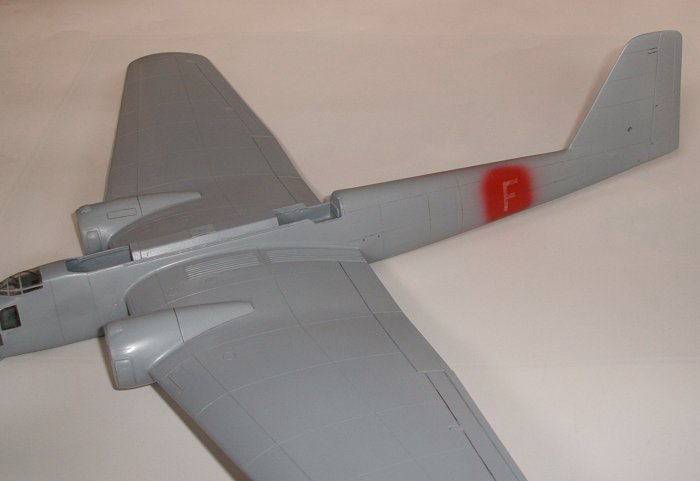
The first step in this stage is the preparation of the national markings and unit codes.
Because the letter F in the fuselage code is red, red paint was sprayed first at the designated position.
After the red paint had dried, cellophane tape with reduced adhesive strength was applied to a suitable plastic sheet.
Using a template, the letter F was scribed and carefully cut out with a design knife.
The cut-out F was then applied to the designated position on the fuselage.
Key source phrase
“Because the letter F is red, red paint was first sprayed at the designated position.”
This process shows that the marking is not added as a simple surface label.
It is built up through layers, masking, cutting, and sequence.
The final letter depends on decisions made before the main body is painted.
In this sense, the marking is part of the construction of the final image.
Painting the Black Areas
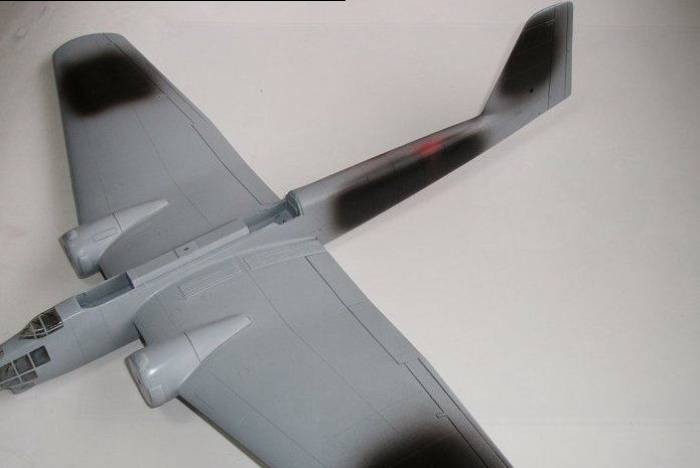
Next, black paint was sprayed broadly over the positions where the national markings and unit codes would be placed.
This was done on the wings, fuselage, and vertical tail.
At this stage, the markings do not yet appear in their final form.
They are being prepared as layered paint operations.
This is important because the finished marking will appear clean only if the earlier layers and masks are correctly planned.
Interpretive point
A marking is seen at the end as a clear sign.
But in the making process, it is produced through hidden layers, temporary masks, and carefully ordered steps.
The visual clarity of the finished aircraft depends on work that is partly concealed by later paint.
Preparing the White Borders
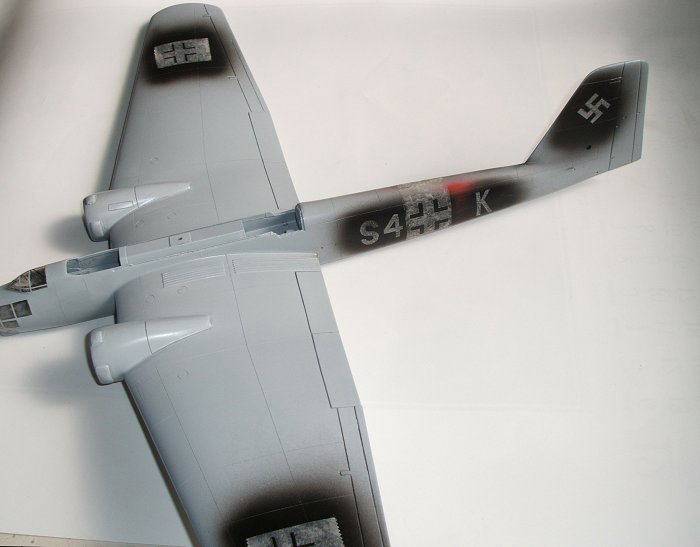
After the black paint had dried, preparation began for painting the white borders of the national markings.
Strips of cellophane tape with reduced adhesive strength were applied to the designated positions on the main wings, vertical tail, and fuselage.
Using templates, the cutout shapes for the white paint were scribed onto the tape.
These shapes were then carefully cut out with a design knife.
The fuselage unit code letters and numbers S, 4, and K were prepared and applied in the same way as the previously made F.
Key source phrase
“Then, using templates, the cutout shapes for the white paint were scribed onto the tape. These were then carefully cut out with a design knife.”
This operation resembles the panel line work in Stage 3.
There, lines were sketched, engraved, and refined. Here, markings are drawn, cut, masked, and painted.
In both cases, the surface becomes a place of controlled judgment.
The maker is deciding where visual information should appear, how sharply it should read, and how it should relate to the aircraft form.
Masking as a Form of Judgment
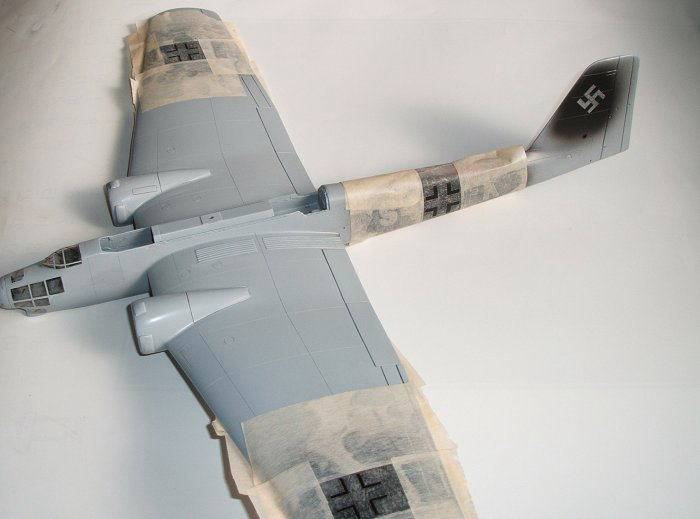
The next entry shows masking tape applied in order to paint the white borders of the national markings.
Masking is temporary.
It does not remain in the finished model.
Yet it determines the final appearance.
This is one of the important lessons of Stage 4.
The finished form depends on temporary operations.
The viewer sees the clean marking. The process shows the hidden decisions that made it possible.
Interpretive point
Masking is not merely protection.
It is a way of defining where the aircraft image will appear.
In a reform record, such temporary operations are especially valuable.
They reveal the decisions normally hidden beneath the finished surface.
Markings Revealed
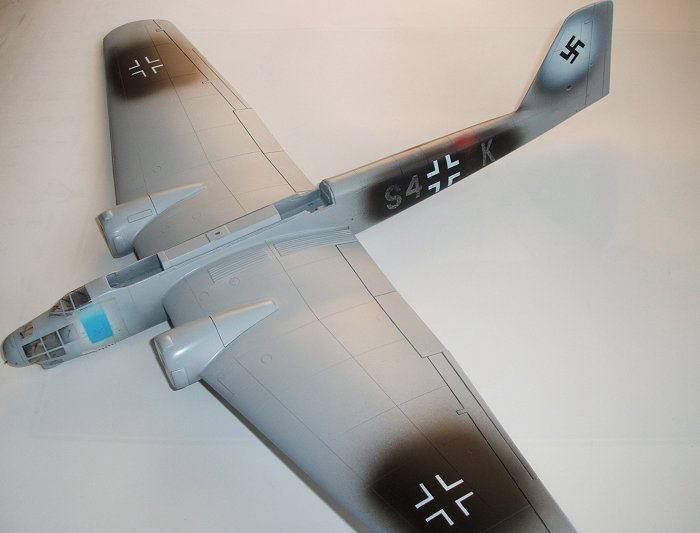
After the sprayed white paint had dried, the masking was removed.
The national markings appeared clearly.
On the nose, the blue base color for the unit emblem had already been sprayed.
This is the moment when the hidden sequence of masking, cutting, and painting becomes visible as a sign.
The aircraft begins to regain not only surface coherence, but also identity.
The marking is a visual claim:
this is not only a rebuilt model, but a specific aircraft within a historical scheme.
Historical Markings and Archival Description
This record includes historical military markings because they are part of the documented appearance of the aircraft being modeled.
Their inclusion here is descriptive and archival.
They are treated as part of the historical and visual record of the model-making process.
The purpose of this page is not to endorse the symbols, but to preserve and interpret how Mr. Fukuda constructed the aircraft’s documented visual identity.
Painting the Unit Marking
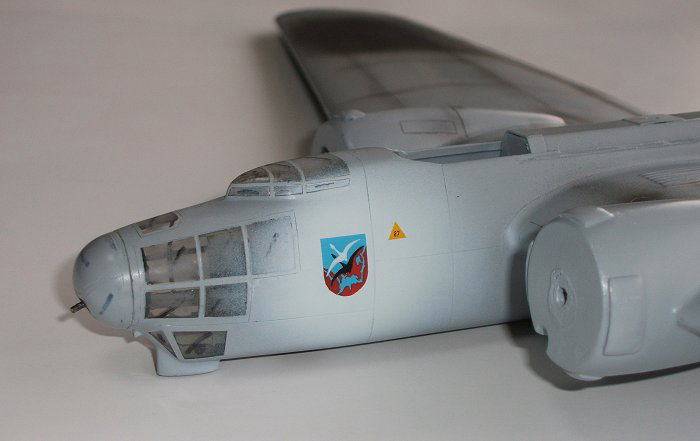
The unit emblem of the 2nd Staffel, Küstenfliegergruppe 506 was painted on the nose.
The record describes it as a stylized swan flying over the fjords of northern Europe.
The triangular marking indicating the use of 87-octane fuel was also painted.
These designs were painted with a fine brush.
The record notes that this required considerable concentration.
Key source phrase
“These designs were painted with a fine brush, which required considerable concentration.”
This is one of the most important moments in Stage 4.
The national markings and unit codes were made through templates, masking, and cutting.
The unit emblem required another kind of judgment.
It required hand control.
Here, the maker’s attention becomes visible in a different way.
The emblem is small, but it carries a strong visual function.
It gives the nose area a particular identity and draws the viewer’s eye to the forward fuselage, the very area that had been rebuilt earlier in the reform.
Interpretive point
The unit emblem is not only a detail.
It is a sign placed on the reconstructed nose, giving that rebuilt area its final identity.
After the unit emblem and fuel marking were painted, they were masked with cellophane tape like the national markings and unit codes.
Only after these markings were protected could painting finally begin.
Painting the Underside
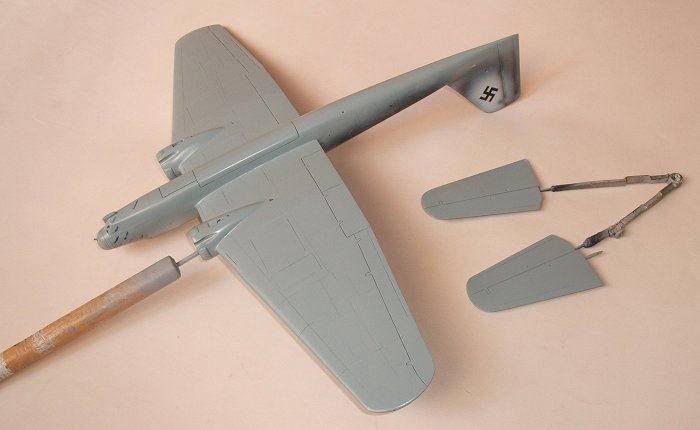
The underside color RLM 65 was sprayed on.
The record also describes how the model was held during painting.
The main body was held by inserting an awl into the engine nacelle section with the left hand. For the horizontal tailplane, a divider was inserted for support.
This practical detail is important.
Painting is not only a question of color.
It is also a question of how the object can be held, supported, rotated, and protected while the paint is applied.
A large floatplane model has projecting surfaces and delicate parts.
The maker must control not only the brush or airbrush, but also the physical handling of the model.
Key source phrase
“The underside color RLM 65 was sprayed on.”
The underside color changes the model from a prepared surface into a painted aircraft.
It also begins the transition from markings preparation to full-color identity.
Painting the Floats
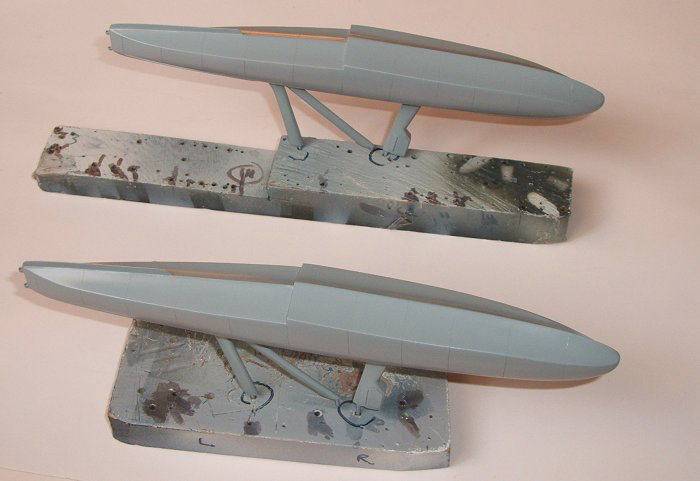
The floats were also painted with the underside color RLM 65.
They were supported by inserting their struts into holes made in scrap wooden blocks.
This method allowed the floats to be held during spraying.
Again, the record shows that painting depends on support and preparation.
The floats are not small secondary pieces.
They are essential to the visual balance of the He-115B.
Their color, alignment, and later attachment will strongly affect the final impression of the completed model.
Interpretive point
For a floatplane, the floats are part of the aircraft’s identity.
Painting them is not a separate minor task, but part of restoring the whole image of the aircraft.
Interior Components During Drying Time
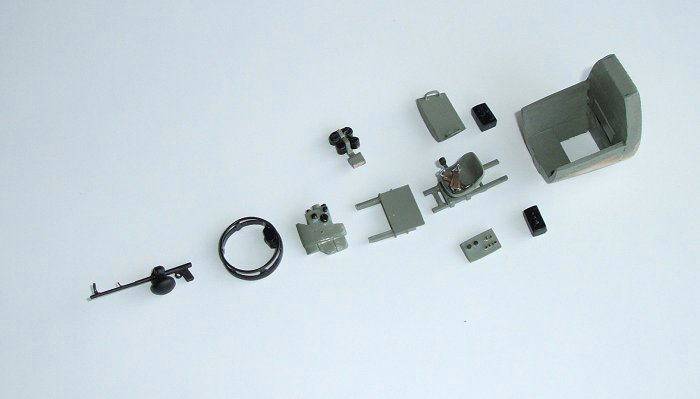
While the underside color was drying, the main equipment around the cockpit and the rear radio operator / gunner’s position was assembled together.
This entry is brief, but it shows efficient and sequenced work.
Drying time is not empty time.
It becomes time for preparing the next elements.
The cockpit and rear radio operator / gunner’s position are internal areas, but they contribute to the completeness of the aircraft image.
They also connect back to Stage 2, where the nose interior and canopy work were carefully reconstructed.
In Stage 4, interior preparation is no longer isolated from exterior painting.
Both are part of the final preparation for bringing the model together.
Finishing the Float Trolley
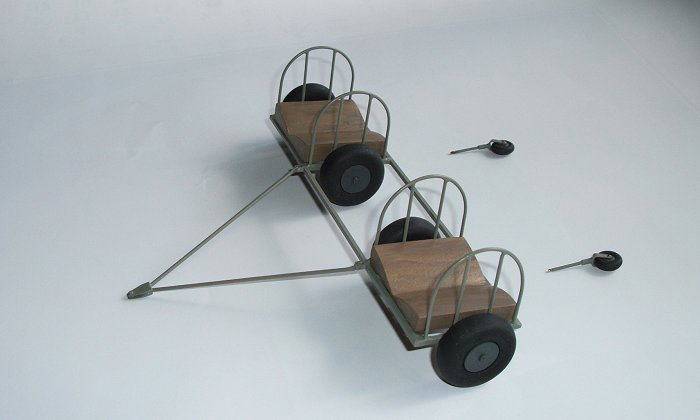
The frame and tires of the float trolley were painted and assembled.
At the right is the temporary tailwheel to be fitted at the rear of the float.
The wooden pads that directly support the floats were only placed provisionally on the frame at this stage.
After the floats were fixed to the main body, the model would be placed on the temporarily positioned pads.
Only then would the pads be glued to the frame.
This was done in order to match the spacing between the left and right pads precisely to the spacing between the two floats.
Key source phrase
“This is done in order to match the spacing between the left and right pads precisely to the spacing between the two floats.”
This is a very important example of late-stage judgment.
Even near the end of finishing, Mr. Fukuda did not fix everything in advance.
He left the pads provisional until the actual spacing of the floats could be confirmed.
This is not indecision.
It is disciplined sequencing.
The final support must be adjusted to the actual completed model, not to an assumed measurement.
Interpretive point
Final preparation still contains uncertainty.
Good finishing does not eliminate adjustment. It reserves adjustment until the moment when the real relationship can be checked.
The trolley therefore continues the logic seen throughout the reform.
Temporary placement allows accurate final judgment.
Meaning of Stage 4
Stage 4 is the stage in which the prepared model receives visual identity.
The national markings, unit codes, unit emblem, underside color, interior components, and float trolley are all part of this process.
They may look like finishing details.
However, they are more than decoration.
They determine how the model is recognized.
They also show that finishing is still a form of making.
The model is not simply painted after the form has been completed.
Rather, paint and markings complete the form’s readability.
They allow the surface, structure, and identity of the aircraft to come together.
This stage also shows the continuing importance of process judgment.
The markings require templates, masking, cutting, drying, and removal. The unit emblem requires fine brushwork and concentration. The underside color requires careful holding and support. The floats require separate handling. The trolley pads remain provisional until the actual float spacing can be confirmed.
Stage 4 therefore demonstrates that finishing is not the end of judgment.
It is one of the places where judgment becomes most visible.
Reading the Images
The images in this stage should be read as evidence of marking, masking, painting, and final preparation.
| Image | What it shows | How to read it |
|---|---|---|
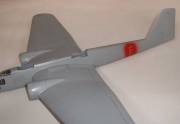 | red paint for the letter F and preparation of the fuselage code | visual identity begins through layered preparation |
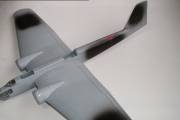 | black paint sprayed at marking positions | markings are built from concealed paint layers |
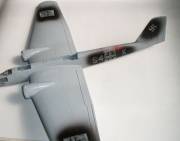 | tape, templates, and cutout preparation | surface signs are defined through cutting and masking |
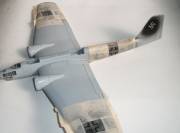 | masking for white borders | temporary masking determines final sharpness |
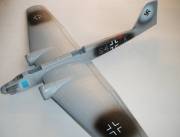 | markings revealed after masking removal | the aircraft identity becomes visible |
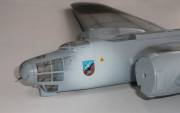 | unit emblem and fuel marking painted on the nose | the reconstructed nose receives a specific identity |
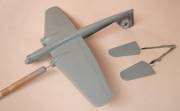 | underside color RLM 65 sprayed on the main body | painting requires support, handling, and sequence |
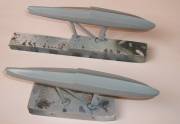 | floats supported and sprayed | the floatplane’s major visual elements receive color |
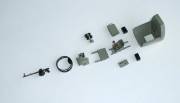 | cockpit and rear position equipment assembled | interior components are prepared during drying time |
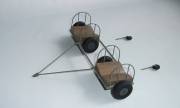 | painted trolley and provisional wooden pads | final support remains adjustable until the actual fit is known |
Connection to the Next Stage
Stage 4 ends with the aircraft marked, the underside painted, interior components prepared, and the float trolley brought close to its final state.
The model has now received much of its visual identity.
However, it is not yet complete.
The upper camouflage still remains. The canopies, engines, horizontal tailplane, floats, propellers, machine guns, and small fittings must still be installed.
This leads directly to Stage 5.
In Stage 5, the final elements will gather. The aircraft will move from prepared and painted form to completed model.
Navigation
- Entrance page: He-115B Reform Record
- Source page: Original 04
Closing Note
Stage 4 is the stage of judgment through finishing.
It shows that finishing is not separate from form.
Markings, unit codes, paint, masking, interior components, and support structures all determine how the model will finally be read.
The He-115B is not only being painted.
It is being identified.
It is being prepared to appear as a specific aircraft.
Through these operations, the reform moves closer to its final image.
The model is no longer only a repaired body.
It has begun to regain its historical and visual presence.