
Stage 3 — Joining, Surface Preparation, Panel Lines, and Trolley Work
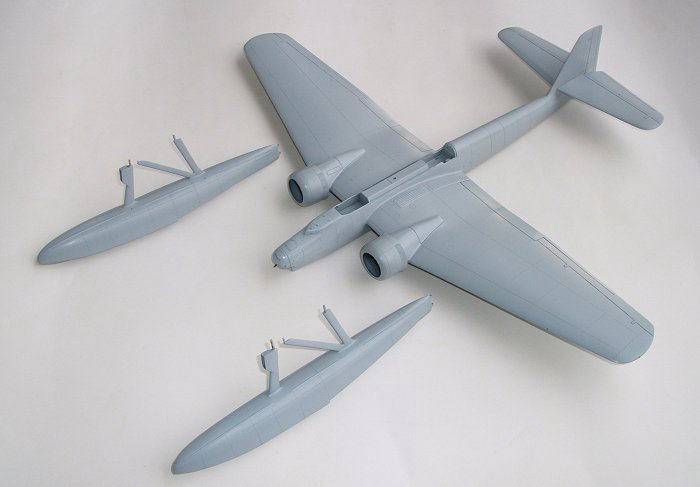
Introduction
This page is Stage 3 of the reconstructed reading of the He-115B Reform Record by Kazu Fukuda.
This stage follows the reconstruction of the nose section and canopy work.
In Stage 2, the new nose section was shaped, trial-fitted, and developed together with the canopy system and interior parts.
Stage 3 begins when that reconstructed nose area becomes ready to return to the main body.
The main theme of this stage is updating judgment.
The reform now moves from local reconstruction toward the renewed coherence of the whole model.
The newly made nose section is completed and joined to the body. Gaps are filled with polyester putty. Surfacer is applied to the floats and the main body. Panel lines are sketched, engraved, and refined. The float trolley is also built as a supporting element for the later completed model.
This stage is important because the reform no longer concerns only the replacement of one damaged area.
It begins to restore the aircraft as a whole.
Source Page
This Stage page is based on the following preserved source page:
Source entries covered in this stage:
| Entry | Date and time | Main subject |
|---|---|---|
| No.644 | 2007-12-02 11:29:46 | Installation of the rotating gun position canopy |
| No.645 | 2007-12-06 17:49:59 | Joining the nose section |
| No.646 | 2007-12-26 12:35:40 | Undercoat on the floats |
| No.647 | 2007-12-31 19:03:27 | Undercoat on the main body |
| No.648 | 2008-01-19 09:42:26 | Panel line engraving |
| No.649 | 2008-01-20 16:47:42 | Float trolley frame |
| No.650 | 2008-01-20 17:03:43 | Material blocks for the float trolley tires |
| No.651 | 2008-01-22 10:38:43 | Wheels |
| No.652 | 2008-01-22 10:49:55 | Wheels temporarily assembled on the float trolley |
| Undated top entry | preserved in source order | Templates for national markings and unit codes |
Although the original forum page preserves the entries in its source order, this Stage page reads them chronologically as a movement from reconstructed parts to renewed whole-model coherence.
The undated entry on templates for national markings and unit codes is treated here as a bridge toward Stage 4, where markings and painting become the central focus.
From Reconstructed Nose to Whole Body
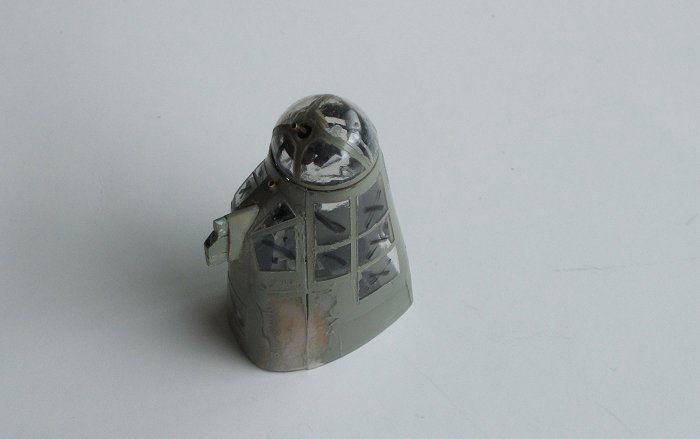
Stage 3 begins with the installation of the rotating gun position canopy at the tip of the nose.
This is the final element of the reconstructed nose area before it is joined to the main body.
The record notes that the barrel of the MG 15 had been made detachable and had been removed in the photograph.
This small detail is important.
It shows that even before final assembly, the model is being designed with later handling, painting, and installation in mind.
The nose area is not simply closed. It is prepared as part of a larger sequence.
Key source phrase
“With this, the newly made nose section is complete, and it will now be joined to the main body.”
This phrase marks a turning point.
Until this point, the reform has concentrated on the nose area.
From this moment, the reconstructed part must rejoin the whole aircraft.
Joining the Nose Section
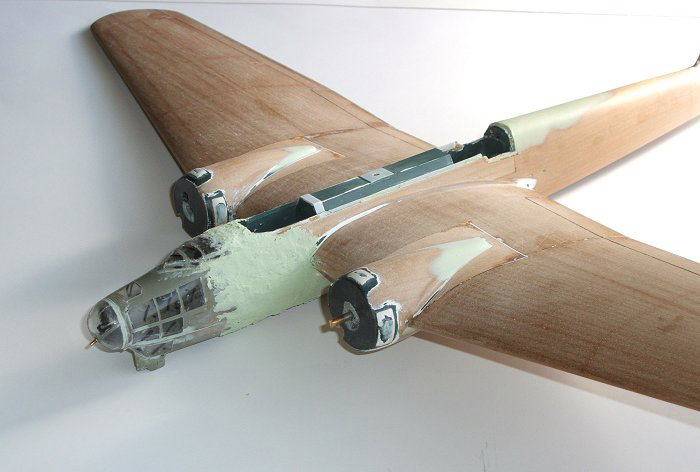
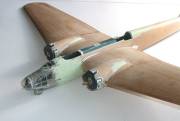
The newly made nose section was completed and joined to the main body.
This is one of the most important moments in the entire reform.
A new part, made after cutting away the old nose, is now returned to the original body.
The model begins to move from an opened state toward a unified form again.
However, joining does not mean that the problem is solved at once.
Gaps remain. They are filled with polyester putty. The putty must dry sufficiently before later painting.
Key source phrase
“Polyester putty was applied into the gaps and is currently drying.”
Key source phrase
“Even with polyester putty, sufficient drying time is necessary, otherwise sink marks may appear after painting.”
This is a highly significant technical note.
It shows that Mr. Fukuda was not judging the model only in its present condition.
He was also anticipating what might happen later.
If the putty did not dry sufficiently, the surface could sink after painting. A defect that was not visible immediately could appear later.
In other words, the maker’s judgment extends across time.
He is judging the present operation by imagining its future effect.
The Meaning of Drying Time
Drying time may seem like a minor technical matter.
In this reform record, however, it reveals a larger attitude.
The reform is not driven by speed. It is driven by the stability of the final surface.
A solid model surface is not merely a covering. It is the place where the form is read.
If the surface later sinks, the viewer’s perception of the aircraft form is disturbed. The connection between the new nose and the main body may become visible as a flaw.
For that reason, waiting is part of making.
Interpretive point
In a reform, judgment is not limited to the shape that can be seen now.
The maker must also judge the changes that may appear later.
This is why Stage 3 can be read as a stage of updated judgment.
The maker is not only correcting visible gaps. He is preventing future disturbances in the final image.
Surfacer and Surface Unification
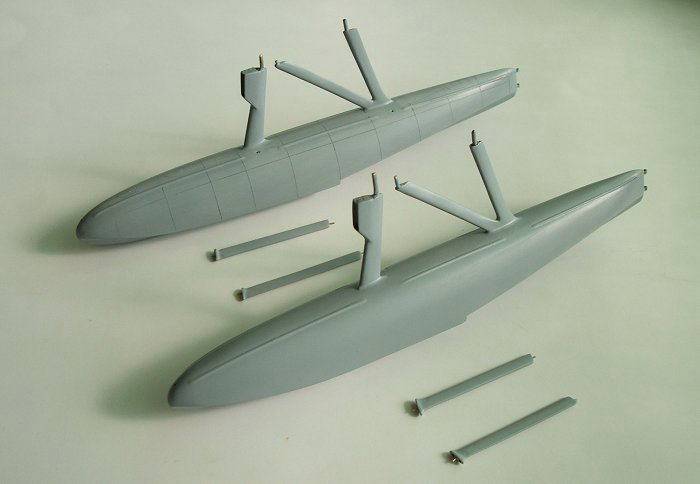
Surfacer was then applied to the floats and their supporting struts.
In the background, the record notes the state after wet sanding and panel line engraving.
This means that the surface is no longer being treated only as a repaired area.
It is being prepared as part of the whole aircraft.
Surfacer has several meanings in this stage.
It prepares the surface for painting. It reveals irregularities. It creates a common ground across different materials and repaired areas. It helps the model move from separate operations toward a unified visual body.
The floats are especially important because they are not minor accessories.
For a floatplane such as the He-115B, the floats are major elements of the aircraft’s identity.
They influence the balance, stance, and visual weight of the model.
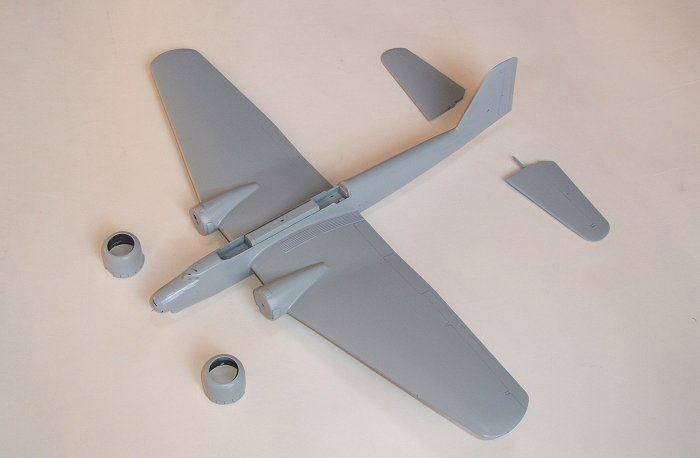
The main body was also given a surfacer undercoat.
At this point, the model is entering a new visual stage.
The cut, joined, filled, and corrected areas begin to be brought under a common surface condition.
This is not yet final painting.
But it is a preparation for the aircraft to be read again as a continuous form.
Panel Line Engraving
After the surfacer coat had dried, panel line engraving was carried out.
This is the central interpretive moment of Stage 3.
Panel lines are not merely small details added to the surface.
They determine how the surface of the aircraft is read.
The process was not done in one step.
First, the positions of the panel joints were sketched in pencil. Then the panel joints were engraved with a scriber. Finally, the lines were carefully traced again with a design knife.
Key source phrase
“First, the positions of the panel joints were sketched in pencil.”
Key source phrase
“Then the panel joints were engraved with a scriber, and finally the lines were carefully traced again with a design knife.”
This sequence is important.
Pencil first. Scriber second. Design knife third.
The panel line is not simply cut into the surface. It is decided, tested, engraved, and refined.
The surface becomes a field of judgment.
The maker must decide where the panel joints belong, how deeply they should be indicated, and how cleanly they should read after painting.
Interpretive point
A panel line is a technical detail, but it is also a decision about how the aircraft form will be understood.
This is why Stage 3 is not only a stage of surface preparation.
It is a stage where the model’s visual information is reconstructed.
From Surface to Reading
The panel lines help transform the model from a smooth repaired object into an aircraft surface.
They give structure to the form.
They tell the viewer how to read the body, wings, floats, and panels.
This is especially important in a reform.
The old surface has been removed. The new nose section has been joined. The model now needs a renewed surface language.
Panel lines provide that language.
They connect shape with aircraft identity.
They also connect the repaired part with the rest of the model.
If the panel lines are careless, the model may appear repaired but not coherent.
If they are carefully judged, the model can regain unity.
Building the Float Trolley
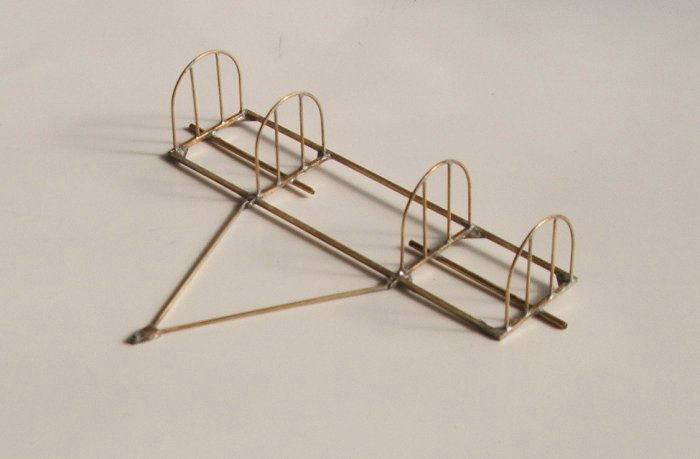
After the surface work, the record turns to the float trolley.
At first glance, the trolley may seem separate from the model itself.
However, it is important to the way the completed floatplane will be displayed and understood.
The trolley used to support the float section was assembled by soldering brass rods.
Wooden pads were attached where the bottom of the floats rests. Four wheels were fitted on both sides. The record also notes that, when the aircraft is brought ashore, the floats appear to be placed on such a trolley, and a removable tailwheel is attached to the rear of the float in order to handle the aircraft on land.
This shows that the trolley is not merely a stand.
It belongs to the imagined operational setting of the aircraft.
Interpretive point
The float trolley extends the model beyond the aircraft body.
It helps place the floatplane within a believable situation.
In this sense, the trolley contributes to the renewed final image.
It supports the model physically, but it also supports the way the model is read.
Making the Wheels
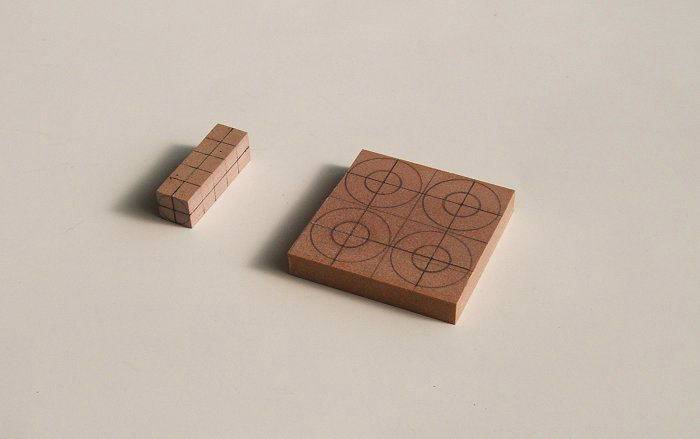
The next entries describe the making of the float trolley wheels.
The material for the wheel hubs and tires was synthetic wood.
The wheel hubs were made by shaping a square block into a round rod and then cutting it to the required thickness.
The tires were made by cutting the block into four pieces, shaping them into discs, and opening a central hole with a gouge to receive the wheel hub. They were then finished with files and sandpaper so that the hub would fit properly.
This sequence may appear modest compared with the reconstruction of the aircraft itself.
But it shows the same logic of making.
A block is shaped. A part is fitted. The fit is adjusted with files and sandpaper. The final form is reached through progressive correction.
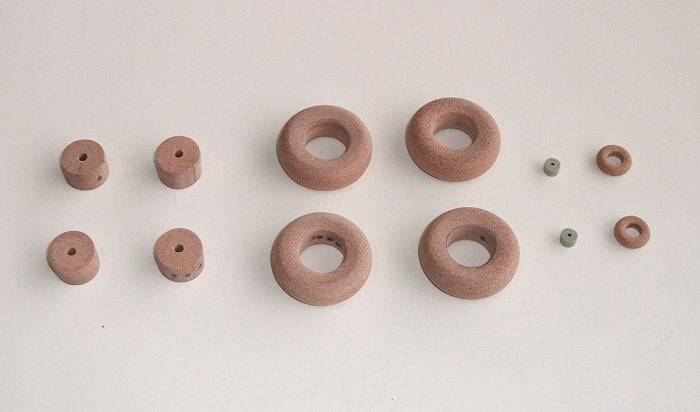
The wheels are small, but they participate in the whole visual system of the completed model.
Their presence helps make the trolley believable.
The trolley, in turn, helps make the floatplane believable as an aircraft that exists not only in the air or water, but also in a ground-handling context.
Temporary Assembly and Later Disassembly
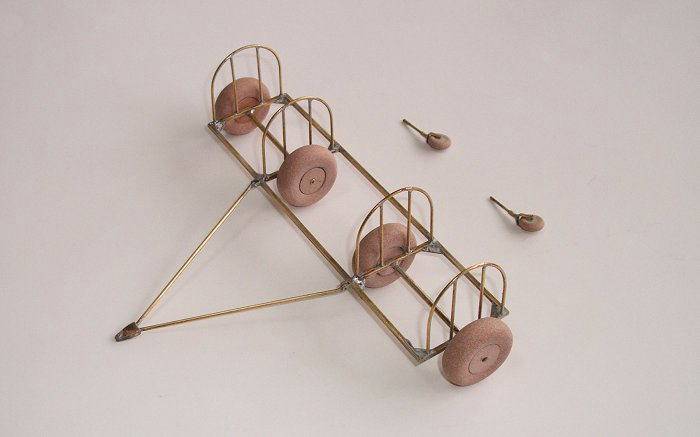
The wheel hubs were temporarily fitted into the main wheel tires and provisionally set onto the trolley frame.
The tailwheel tires and hubs were also temporarily fitted to the supporting strut.
The record then notes that each part would be disassembled again, painted separately, and formally assembled later.
Key source phrase
“After this, each part will be disassembled again, painted separately, and then formally assembled.”
This is another important example of process judgment.
Temporary assembly is not final assembly.
It is a way of checking relationships before the final finish.
The part is assembled in order to be judged. Then it is taken apart again so that painting and final assembly can be done properly.
This rhythm is characteristic of the whole reform:
- assemble temporarily
- check the relationship
- correct the form
- disassemble if necessary
- finish separately
- assemble formally later
The trolley therefore mirrors the larger logic of the model.
It shows, on a smaller scale, how the entire reform proceeds.
A Bridge Toward Markings
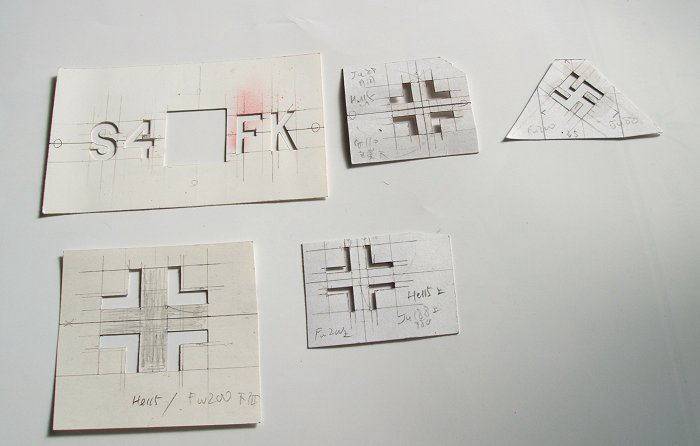
The preserved Original 03 page also contains an undated top entry showing templates for national markings and unit codes.
Because this entry is preserved within Original 03, it is noted here.
However, its thematic meaning points forward to Stage 4.
The templates belong to the next major phase: markings, painting, and final preparation.
Business card paper was used for the templates.
This small detail already indicates the next kind of judgment.
The model is about to move from surface preparation to identification.
Panel lines make the aircraft surface readable. Markings will make the aircraft historically and visually identifiable.
For that reason, this entry is best understood as a bridge between Stage 3 and Stage 4.
Meaning of Stage 3
Stage 3 is the stage in which the reform begins to recover whole-model coherence.
The reconstructed nose is joined to the body. Gaps are filled. Drying time is respected. Surfacer is applied. Panel lines are decided and engraved. The float trolley is constructed and provisionally assembled. Templates for markings begin to appear.
These operations may seem different from one another.
But they share a common purpose.
They prepare the model to be read again as a unified aircraft.
The new nose must not remain an added part. It must become continuous with the body.
The surfacer must not merely cover the surface. It must prepare the model for a new visual unity.
The panel lines must not merely decorate the surface. They must organize the viewer’s reading of the aircraft.
The trolley must not merely support the model. It must contribute to the final presentation of the floatplane.
Stage 3 therefore marks the transition from reconstruction to renewed coherence.
Reading the Images
The images in this stage should be read as evidence of integration, surface judgment, and preparation for final presentation.
| Image | What it shows | How to read it |
|---|---|---|
 | rotating gun position canopy installed at the nose tip | the reconstructed nose section reaches completion before joining |
 | new nose section joined to the main body | local reconstruction returns to the whole aircraft |
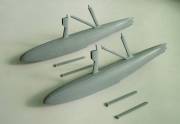 | surfacer applied to floats and struts | the float section is prepared as part of the renewed surface |
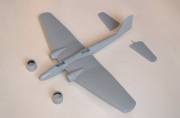 | surfacer applied to the main body | the repaired body moves toward a unified surface condition |
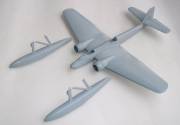 | panel lines sketched, engraved, and refined | the aircraft surface is judged and made readable |
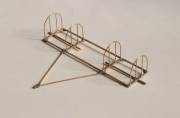 | brass rod trolley frame | the completed model’s support and setting begin to be constructed |
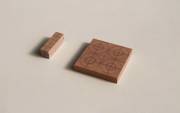 | synthetic wood blocks for hubs and tires | small support elements are shaped through the same logic of correction |
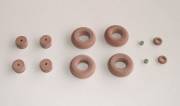 | shaped tires and hubs | supporting details gain form and fit |
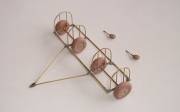 | provisional assembly of trolley wheels | temporary assembly allows later judgment, painting, and formal assembly |
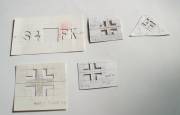 | templates for markings and unit codes | the record begins to move toward identification and painting |
Connection to the Next Stage
Stage 3 ends with the model’s surface prepared and the logic of final identification beginning to appear.
The reconstructed nose has been joined. Surfacer and panel lines have given the model a renewed surface structure. The float trolley has begun to establish the model’s final presentation. Templates for markings and unit codes point toward the next phase.
This leads directly to Stage 4.
In Stage 4, markings, painting, and final preparation become the main focus. The aircraft will begin to receive its visual identity through national markings, unit codes, colors, and carefully controlled masking.
Navigation
- Previous stage: Stage 2 — Nose Reconstruction, Formers, and Canopy Work
- Entrance page: He-115B Reform Record
- Source page: Original 03
Closing Note
Stage 3 is the stage of renewed coherence.
It shows how a reconstructed part is returned to the whole body, how the surface is prepared, and how the aircraft begins to regain readable structure.
The most important point is that this stage is not only about making the surface smooth.
It is about making the model intelligible again.
The joined nose, the dried putty, the surfacer, the panel lines, the trolley, and the marking templates all contribute to that purpose.
Through these operations, the reform moves beyond repair.
It becomes a process of deciding again how the He-115B should appear as a complete and convincing form.