
Stage 1 — Initial Condition, Dismantling, and Problem Recognition
Introduction
This page is Stage 1 of the reconstructed reading of the He-115B Reform Record by Kazu Fukuda.
This stage corresponds to the beginning of the reform.
It covers the moment when the earlier completed model was no longer accepted simply as a finished object, but was instead seen again as something that required intervention.
The main theme of this stage is problem recognition.
The reform begins not with new construction, but with a decision.
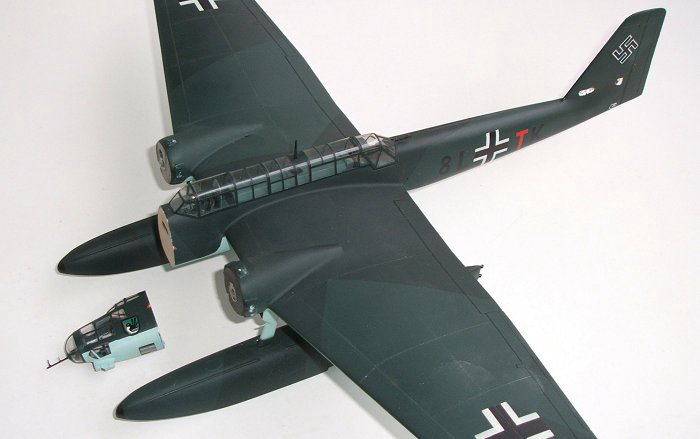
The model had deteriorated. The painted surface had cracked. Mold had appeared. The model could no longer remain in its existing condition.
From this point, the former completion was opened again.
Source Page
This Stage page is based on the following preserved source page:
Source entries covered in this stage:
| Entry | Date and time | Main subject |
|---|---|---|
| No.626 | 2007-10-29 18:23:10 | Nose cut away, horizontal tail disassembled |
| No.627 | 2007-10-29 18:31:07 | Paint removal from the tail section |
| No.628 | 2007-10-29 18:33:11 | Paint removal completed |
| No.629 | 2007-10-29 18:40:14 | Nose section material block |
Although the original forum page preserves the entries in the posting order of the source, this Stage page reads them as the opening sequence of the reform.
The Beginning of the Reform
The first important point is that the reform did not begin from a blank block of wood.
It began from an existing model.
The He-115B had already been completed once. It had already existed as a finished work.
However, after twenty years, the painted surface had developed many cracks, and mold had appeared. The model was described as being in a severely deteriorated condition.
This condition changed the meaning of the model.
It was no longer only a completed work to be displayed. It had become an object that demanded a decision.
Should it be left as it was? Should it be preserved in its deteriorated state? Or should it be opened again and remade?
Mr. Fukuda chose the last option.
That decision is the true beginning of the reform.
Key source phrase
“After twenty years, the painted surface had developed countless cracks, and mold had appeared, leaving the model in a severely deteriorated condition.”
Problem Recognition
The phrase above is important because it shows that the reform begins with recognition.
The model’s problem was not only physical deterioration.
It was also a problem of form.
A deteriorated painted surface changes how the aircraft is seen. Cracks, mold, and damaged surfaces interrupt the continuity of the aircraft image. They make it difficult for the model to remain convincing as a representation of the He-115B.
In this sense, problem recognition is not simply a practical matter.
It is also a visual judgment.
Mr. Fukuda recognized that the model could no longer carry its form properly in its existing condition.
This recognition led to a major reform.
Interpretive point
The first act of the reform is not cutting, sanding, or rebuilding.
The first act is seeing that the earlier completion has become insufficient.
Cutting Away the Former Completion
The first visible action was decisive.
The nose section was cut away. The horizontal tail was disassembled.
This was not a small repair.
The nose is one of the most important visual centers of an aircraft model. It determines much of the character of the aircraft. To cut it away means that the earlier completion was no longer being protected as untouchable.
The model was being opened.
This is one of the most important meanings of Stage 1.
The completed model was not simply repaired on the surface. It was structurally interrupted so that a new form could be made possible.
Key source phrase
“As a first step, the nose was cut away and the horizontal tail was disassembled.”
The image of the cut-away nose is therefore not merely a work-in-progress photograph.
It is the image of a decision.
It shows the point at which a completed work becomes a site of renewed making.
Removing the Old Paint
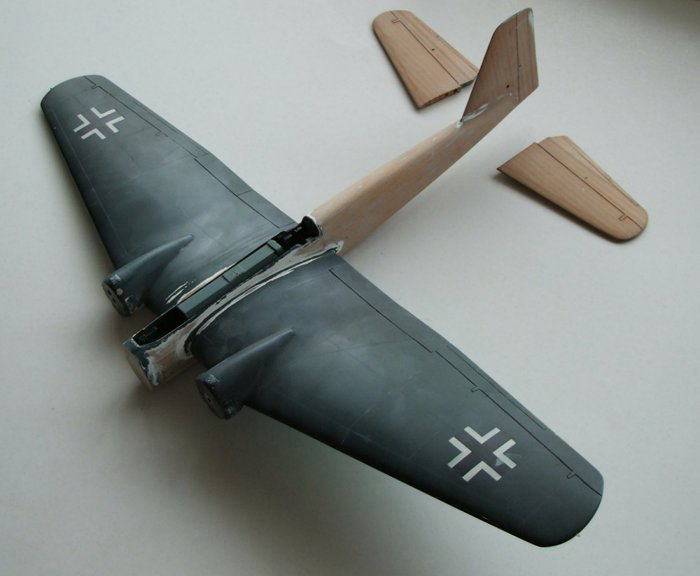
After the first dismantling, paint removal began.
The old lacquer was not easy to remove.
The source notes that lacquer has a sticky quality and easily clogs sandpaper. For that reason, the lacquer was first removed carefully with coarse No. 60 paper. When the white surfacer began to appear, the work continued with No. 100 paper until the wood surface was exposed.
This description is technical, but it also has interpretive importance.
The reform required the model to be brought back beneath its finished surface.
The paint layer had once been part of the final appearance. Now it had to be removed.
The model was being returned, step by step, from a finished surface to a workable body.
Key source phrase
“When the white surfacer begins to appear, the work is continued with No. 100 paper until the wood surface is exposed.”
This movement from painted surface to exposed wood is central to the meaning of a reform.
The maker is not merely adding new work. He is uncovering the older work and preparing it to receive new judgment.
Care Around Fragile Form
The source also notes that particular care was required around the trailing edge of the wing.
This detail should not be overlooked.
The trailing edge is thin and vulnerable. It is easy to damage during sanding. At the same time, it is important to the visual sharpness of the aircraft.
This small note shows that dismantling and paint removal are not rough operations.
They require controlled judgment.
The maker must remove what has failed while preserving what can still support the form.
Interpretive point
Reform is not destruction.
It is selective removal.
The maker must decide what to cut away, what to strip back, what to preserve, and what to prepare for rebuilding.
Paint Removal Completed
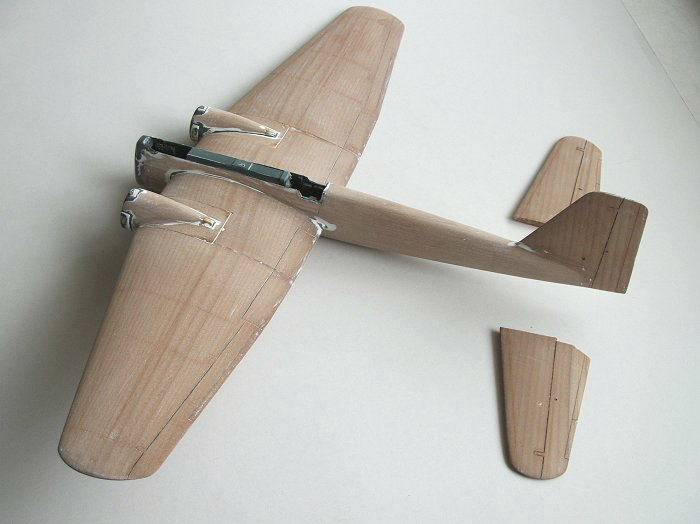
The next entry shows that paint removal from the fuselage, main wing, and tail surfaces had been completed.
The floats would be stripped in the same way.
At this point, the model had entered an intermediate state.
It was no longer the old finished model. But it was not yet the renewed model either.
This in-between state is important.
The model had been stripped of its former appearance. Its surface had been brought back to a condition where further work could begin. The reform had created a new starting point.
In a new build, the starting point is usually raw material.
In this reform, the starting point is different.
It is the old model, stripped back and made available for reworking.
Preparing for the New Nose Section
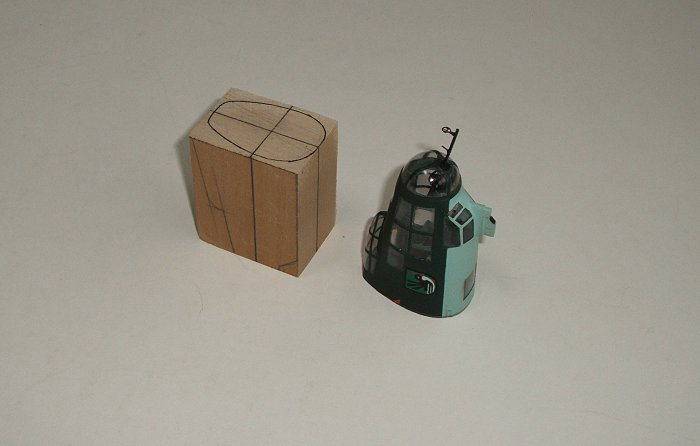
The final entry in Stage 1 introduces the material block for the new nose section.
This block is important for two reasons.
First, it will become the new nose section. Second, it will also serve as the wooden former for the bombardier’s canopy in the nose area.
The newly prepared block is shown beside the old nose section that was cut away. The old nose is used as a reference while the new nose section is shaped.
This is a significant moment.
The old part has not simply been discarded. It remains present as a reference.
The reform therefore contains both separation and continuity.
The old nose is cut away because it can no longer remain as it was. Yet it is still used to guide the making of the new part.
Key source phrase
“The old nose is used as a reference while the new nose section is shaped.”
This phrase shows the logic of the reform very clearly.
The new form does not appear by rejecting the old form completely. It appears by comparing with it, learning from it, and revising it.
Meaning of Stage 1
Stage 1 establishes the basic character of the entire He-115B Reform Record.
It shows that the reform begins from four connected actions:
- recognizing deterioration
- cutting away the parts that must be rebuilt
- removing the failed surface
- preparing material for a renewed form
These actions are technical, but they are also interpretive.
They show that Mr. Fukuda was not simply repairing damage.
He was reopening a completed work and making it available for renewed judgment.
The most important point is that the model’s earlier completion did not disappear.
It remained present as memory, reference, and problem.
The old model became the ground on which the new reform could begin.
Reading the Images
The images in this stage should be read not only as process photographs, but as evidence of changing status.
| Image | What it shows | How to read it |
|---|---|---|
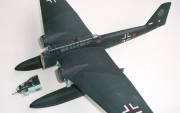 | the nose cut away and the horizontal tail disassembled | the former completion is opened again |
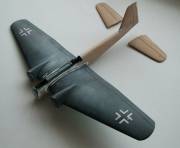 | paint removal beginning from the tail section | the old surface is being stripped back |
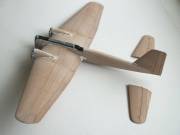 | paint removal from fuselage, wing, and tail completed | the model enters an intermediate state |
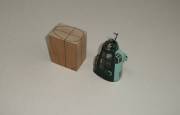 | new material block beside the old nose section | the old form becomes a reference for the new form |
Connection to the Next Stage
Stage 1 ends with the preparation of the material block for the new nose section.
This leads directly to Stage 2.
In Stage 2, the reform moves from problem recognition and dismantling to active reconstruction.
The new nose section will be shaped. It will be trial-fitted to the main body. Wooden formers will be made. Canopy parts will be heat-pressed. The reform will begin to create new form from the opened model.
Navigation
- Previous page: He-115B Reform Record
- Source page: Original 01
Closing Note
Stage 1 is the stage of recognition.
It shows that reform begins when a completed object is no longer accepted as complete.
The model had deteriorated, but deterioration alone did not create the reform. The reform began when the maker judged that the model should not be left in that state.
That judgment led to cutting, dismantling, stripping, and preparation.
In this way, Stage 1 reveals the first movement of the entire record:
from a damaged finished model to an opened object to the possibility of renewed form.