
This is an old revision of the document!
Fw 200 C-3 Construction Record
Introduction
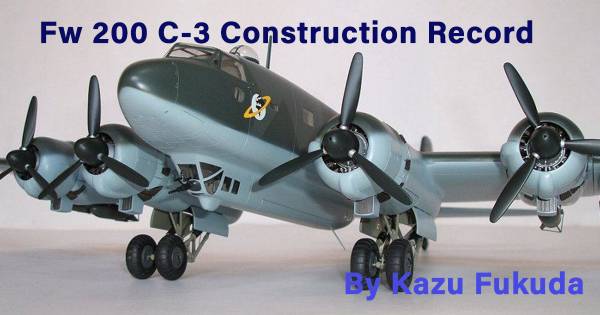
This page serves as the entrance to the construction record of the Focke-Wulf Fw 200 C-3 by Kazu Fukuda.
This record is not intended merely to present a completed model. It preserves the process of making itself: from material preparation to the shaping of major components, interior work, canopies, machine guns, nacelles, engines, propellers, bombs, surface preparation, painting, and final assembly.
What matters here is not only the beauty of the finished model.
At what stage were particular parts made? Which components were prepared first? Where did the maker wait for drying? How were separate parts finally integrated into the completed form of the aircraft?
By following this sequence of work, we can read not only Fukuda’s craftsmanship, but also the decisions that shaped the making process.
Reconstruction of This Record
On the existing site from which these materials were preserved, the Fw 200 C-3 construction record was not arranged strictly in chronological order.
Instead, it had been organized by parts and fields of work, such as mock-up, nacelles and engines, machine guns, propellers, painting, and completed model photographs.
That organization made it easy to follow the work on specific parts, but it also made it difficult to see how the entire construction process progressed over time.
In this archive, the existing classification order is not adopted as-is.
Instead, the record has been reconstructed as closely as possible according to confirmed dates, relationships within the original text, the state of work visible in the photographs, and the natural sequence of model-making procedures.
For that reason, the order shown under this page is not the same as the order in which the material appeared on the existing site.
This does not deny the value of the existing site. The photographs and text preserved there are important source materials.
However, in this archive, priority is given to the progress of the making process itself, rather than to a part-based classification.
Treatment of Chronology
Items with confirmed dates are arranged according to those dates.
Items without confirmed dates are placed carefully, based on the wording of the text, the state of work shown in the photographs, and their relationship to surrounding processes.
The chronological placement of each item is treated with the following levels of certainty.
- A: The date is confirmed.
- B: The date is not confirmed, but the position in the process is almost certain.
- C: The position is inferred from the photographs and text.
- D: The position is still uncertain.
This classification is not intended to force the record into an artificial order.
Rather, it is intended to clarify what is confirmed and what remains an editorial inference.
Construction Record Navigation
Chronology | Original 01 | Original 02 | Original 03 | Original 04 | Original 05 | Original 06 | Original 07
Reading Pages: Reading 01 | Reading 02 | Reading 03
What This Construction Record Preserves
This Fw 200 C-3 construction record has at least three kinds of value.
1. A Technical Record
First, it is a technical record of model making.
Many processes are preserved through photographs and text: material preparation, shaping of wooden parts, installation of interior components, treatment of canopies, construction of nacelles and engines, propellers and bombs, painting, markings, and final assembly.
These processes cannot be fully understood from the completed model alone.
This record shows the accumulated work behind the final form.
2. A Visual Record
Second, it is a visual record of how a form gradually emerges.
The Fw 200 C-3 is a large and complex aircraft. Its overall form comes into being only through the combination of many elements: fuselage, wings, tail surfaces, nacelles, engines, landing gear, armament, canopies, and propellers.
In this construction record, each of these parts is made separately, and then gradually integrated into a single whole.
The record preserves a process of form generation that cannot be seen from completed photographs alone.
3. A Record of Judgment
Third, it is a record of judgment.
Which parts should be made first? At what stage should interior components be installed? When should surface preparation begin? When is it appropriate to proceed to painting? At what point should the maker wait for drying?
These are not merely procedural steps.
They are decisions within the progress of making.
In particular, after completing the accessory parts, Fukuda did not immediately proceed to painting. He waited for the putty to dry sufficiently.
This decision is important. Not rushing toward completion, but allowing time in order to avoid later shrinkage or cracking, is an essential judgment in model making.
Difference from the He 115 B Reform Record
This Fw 200 C-3 construction record can be read in contrast with Fukuda’s He 115 B Reform Record.
The He 115 B record followed a model that had already been completed once. It showed how a finished model was opened again, how deterioration and dissatisfaction were found, how corrections were made, and how the model was brought to a new completed state.
By contrast, the Fw 200 C-3 record begins with materials and parts, and gradually builds up the overall form of the aircraft.
He 115 B Reform Record A record of reconsidering, reopening, and correcting a model that had already been completed once.
Fw 200 C-3 Construction Record A record of building up the completed form of an aircraft from unfinished materials and separate parts.
When these two records are read side by side, it becomes clear that Fukuda’s records are not simply records of procedures.
They include seeing, thinking, waiting, correcting, and assembling.
Overall Flow of the Construction Process
The construction process of the Fw 200 C-3 can be organized broadly as follows.
- Material preparation and preparation of major blocks
- Emergence of the main forms: fuselage, wings, and tail surfaces
- Interior work, cockpit, canopies, and gondola construction
- Construction of machine guns, interior equipment, bombs, and other detail parts
- Construction of nacelles, cowlings, and engines
- Construction of propellers, spinners, and accessory parts
- Waiting period, including drying of putty
- Surfacer, marking preparation, and painting
- Final assembly of engines, propellers, machine guns, antennas, and other parts
- Completion
This sequence is not the classification order of the existing site.
It is the order reconstructed by reading the material as a making process.
Reconstructed Original Record Pages
The following pages reconstruct the Fw 200 C-3 construction process as closely as possible in chronological order.
| Original Record | Page | Main Contents | Main Viewpoint |
|---|---|---|---|
| Original 01 | Material preparation and the emergence of the overall form | Material preparation, shaping of major blocks, trial assembly, confirmation of the overall form | Starting point of the whole form |
| Original 02 | Interior, cockpit, canopies, machine guns, and gondola | Interior, instrument panel, seats, canopies, side windows, machine guns, gondola | Supporting the form from within |
| Original 03 | Nacelles, cowlings, and attachment to the wing | Cowlings, nacelle parts, attachment to the wing, tail surfaces, mock-up completion | Integration of the outer form |
| Original 04 | Spinners and propellers | Spinner material, shaft-hole work, rotating shafts, propeller blades, painting and assembly | Precision of rotating parts |
| Original 05 | Engines, bombs, and accessory parts | BMW Bramo engines, SC500 bombs, accessory parts, decision to wait for drying | Completion of part groups |
| Original 06 | Painting and markings | Surfacer, national markings, unit codes, underside color, upper colors | Preparation and judgment before finishing |
| Original 07 | Final assembly and completion | Cowlings, engines, machine guns, antennas, propellers, completed model photographs | Integration into the completed form |
Chronology
For an overview of the construction process, see the chronology page.
The chronology arranges the items according to confirmed dates. For items without confirmed dates, it indicates their position in the process and the level of certainty.
Reading Pages
Interpretive readings based on the construction record are organized as separate pages.
The original record pages are intended to preserve the flow of the source material as much as possible. The reading pages, on the other hand, examine what can be understood from the construction process: Fukuda’s approach to making, his decisions, and the characteristics of his records.
Reading pages will be developed from perspectives such as:
- How did the overall form emerge?
- How did interior structures and detail work relate to the completed form?
- At what stage were separate groups of parts integrated into the aircraft as a whole?
- What meaning does the decision to wait for drying have within the overall process?
- What position does the Fw 200 C-3 record occupy within Fukuda’s body of construction records?
Recommended Reading Order
If this is your first time reading this record, the following order is recommended.
- First, read this entrance page.
- Next, check the overall flow in the Chronology.
- Then read Original 01 through Original 07 in order.
- If necessary, return to the photographs and text in each original record page.
- Finally, read the interpretive reading pages to consider the meaning of the process.
Readers interested in technical procedures may begin with Original 01 and proceed in order.
Readers interested in the maker’s thought and judgment may first consult the chronology, and then pay particular attention to the flow from Original 05 to Original 07: accessory parts, drying period, painting, and final assembly.
Editorial Policy
In the original record pages under this section, the original article text by Fukuda is respected as much as possible.
Explanations and notes added by the archive are shown separately so that they are not confused with the original text.
When original article text is presented, it is shown in the following type of box.
Supplementary explanations and chronological notes by the archive are shown separately when necessary.
Editorial Note
This section contains supplementary explanation by the archive.
Related Pages
Closing Note
The importance of the Fw 200 C-3 construction record does not lie only in the fact that it shows a completed model of a large aircraft.
This record preserves how the completed form came into being.
Materials were prepared. Parts were shaped. The interior was built. Details were added. Accessory parts were made. Drying was allowed. Painting was carried out. Finally, all parts were integrated into a whole.
In each of these steps, there were decisions made by the maker.
A completed model shows the result. A construction record shows the thinking and procedures that led to that result.
In this sense, the Fw 200 C-3 construction record is not only a document of Fukuda’s craftsmanship. It is also an important record that shows the value of the making process in solid model aircraft building.