
Fw 200 C-3 Construction Record — Original 06
Painting and Markings
Note
This page preserves Kazu Fukuda’s original forum-based construction record as closely as possible to its original source structure.
It covers the painting process resumed after a four-month interval, including the surfacer work, national markings, unit code, underside color RLM 65, and upper surface camouflage colors RLM 72/73.
The text of each entry is shown in a highlighted box in order to make clear that it is based on Fukuda’s original post text.
For a chronological reconstruction of the whole record, see:
Source Information
- Original format: forum post archive
- Period covered on this page: date unconfirmed, after the four-month pause and resumption of work
- Main contents: surfacer, national markings, unit code, underside color RLM 65, upper surface colors RLM 72/73
- Original post text: Kazu Fukuda
- Page organization: Japanese Solid Model Archive
Original Record Navigation
Fw 200 C-3 Construction Record | Chronology | Original 01 | Original 02 | Original 03 | Original 04 | Original 05 | Original 06 | Original 07
Previous: Original 05 — Engines, bombs, and accessory parts | Next: Original 07 — Final assembly and completion
Position of This Page
This page deals with the painting and marking process of the Fw 200 C-3 after the accessory parts had been completed and the model had been left to dry sufficiently.
In the July 22 record, Fukuda wrote that he would not proceed immediately to painting, in order to avoid later shrinkage or cracking in the putty-shaped areas.
This page records the stage after that waiting period, when construction resumed and proceeded through surfacer, national markings, unit code, underside color, and upper surface camouflage.
The important point here is that painting was not simply the act of adding color.
Fukuda first prepared the national markings and unit code, masked them with cellophane tape, and then revealed them after painting by removing the masks. In this way, the markings were incorporated into the painted surface itself.
The record also preserves many small but important judgments that affected the final result: reducing the adhesive strength of the cellophane tape before use, cutting the masks accurately, adding the yellow outline to the unit code, and taking care to prevent the paint film from peeling away when the masking was removed.
[Date Unconfirmed — After Four Months]
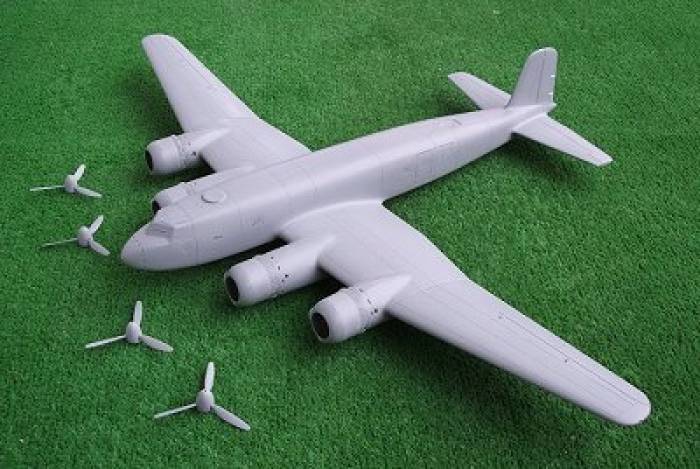
Resuming the Painting Work
Editorial Note
This entry is important as the record of resuming construction after the decision to “wait for drying” mentioned in the July 22 entry.
The four-month interval should not be read simply as an interruption. It can be understood as a period for allowing the putty-shaped areas to stabilize.
Fukuda also notes the difference in drying behavior between the white and gray types of surfacer. This gives us a glimpse of his practical sense of materials during the painting process.
[Date Unconfirmed]
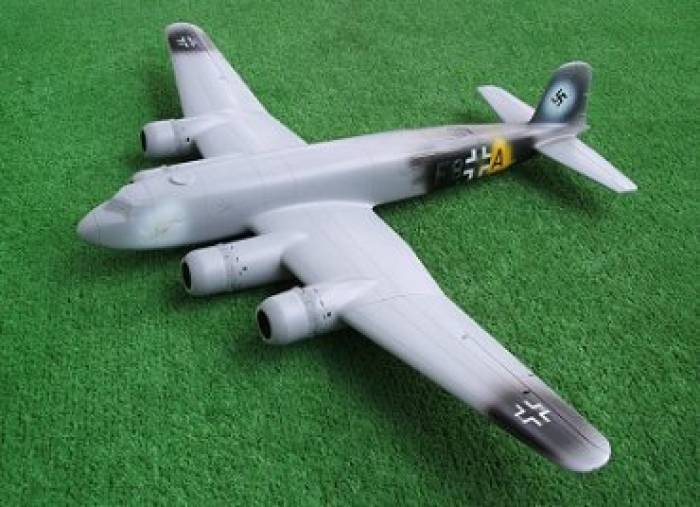
Preparing the Markings for a KG 40 Aircraft
Editorial Note
This entry states the decision to finish the model as an aircraft belonging to KG 40.
The unit code, yellow outline, and unit emblem strongly affect the character of the completed aircraft. Fukuda intended to represent these not with decals, but through painting and masking.
This shows that the painting process was not merely a matter of applying colors. It was also the process by which the aircraft’s affiliation and individuality were formed.
[Date Unconfirmed]
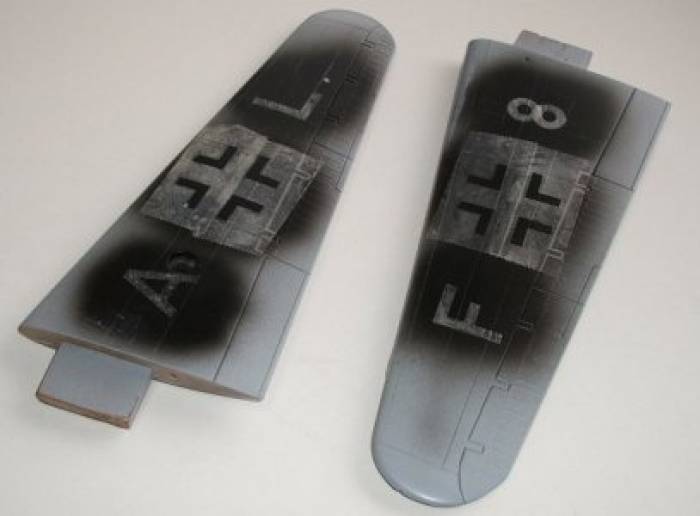
Making the National Markings and Unit Code
Editorial Note
This entry gives a concrete record of how the national markings and unit code were made.
Fukuda first sprayed black, then applied cut-out cellophane-tape masks for the letters, so that later painting would leave the letters and markings visible.
This method requires not only accurate cutting of the letters and markings, but also careful planning of the order of colors: which areas are painted first, which parts are left visible, and which parts are protected by masking.
[Date Unconfirmed]
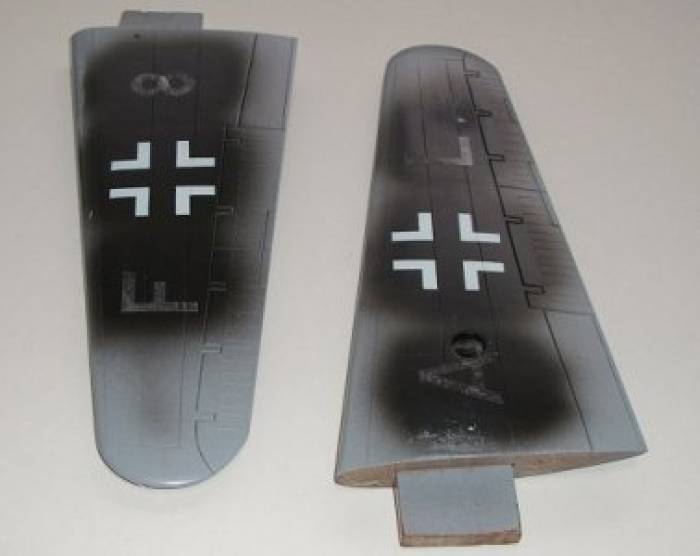
Painting the White Edges of the Balkenkreuz
Editorial Note
This entry shows the process of creating the white edges of the Balkenkreuz by painting.
In this kind of painted marking, the accuracy of the masking directly appears in the finished result. Because the marking emerges only after the tape is removed, the final shape must be anticipated in reverse throughout the process.
[Date Unconfirmed]
Finalizing the Masking
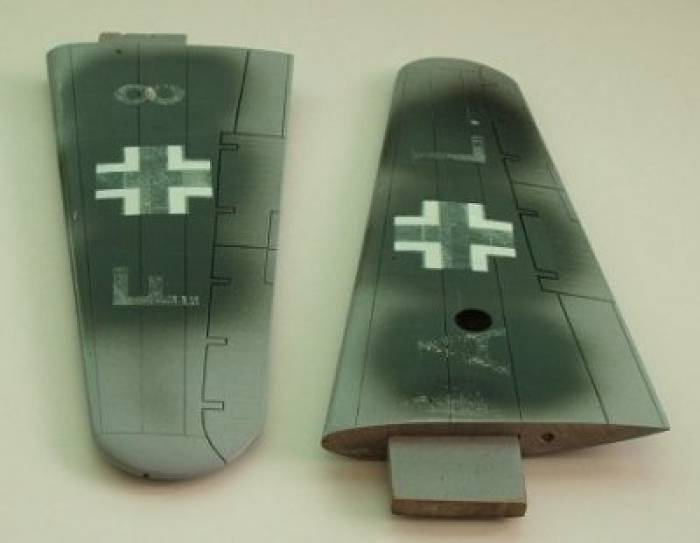
Editorial Note
This entry is especially important within the painting process.
Fukuda notes that cellophane tape should not be used directly. Instead, it should first be applied to the back of the hand to reduce its adhesive strength.
This was done to avoid the risk of lifting the underlying paint or markings when the masking was removed. In other words, this was not only a technique for achieving a clean finish, but also a judgment made to protect the work already completed.
[Date Unconfirmed]
National Markings on the Upper Wing Surfaces
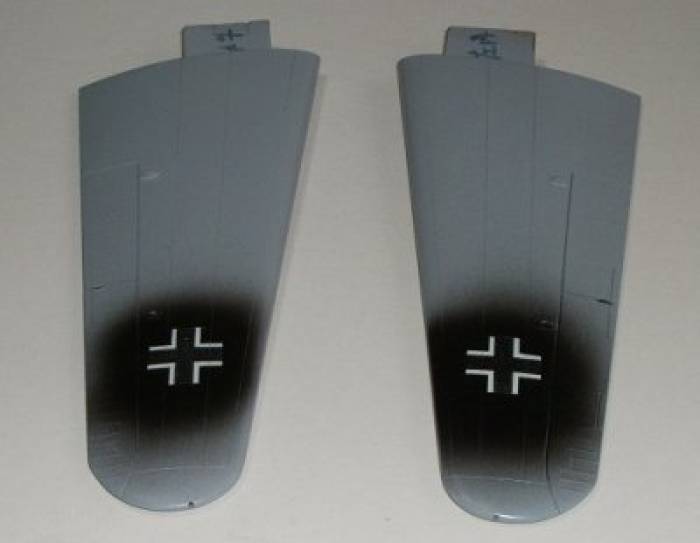
Editorial Note
The method used on the underside of the wing is applied here to the upper wing surfaces.
Even when the same method is repeated, the positions and visual appearance differ between the upper and lower surfaces, so careful placement of the markings is still necessary.
Although this is a short entry, it shows that the markings across the entire aircraft were being finished by a consistent method.
[Date Unconfirmed]
Markings on the Fuselage and Vertical Tail
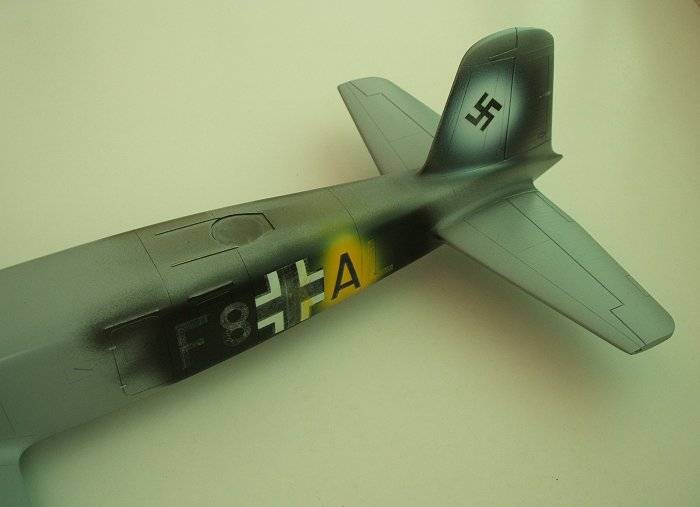
Editorial Note
This entry explains the markings on the fuselage and vertical tail, as well as the yellow outline around the unit code letter A.
The process of spraying yellow, removing the masking, and then masking again to leave a 0.8 mm outline around the A is especially delicate.
It includes several judgments at once: the shape of the letter, the width of the outline, the order of painting, and the resetting of the mask.
[Date Unconfirmed]
Painting the Underside Color RLM 65
Editorial Note
At this stage, the underside color RLM 65 is painted.
By this point, the national markings and unit code have already been masked. Therefore, this is not simply the act of spraying the underside color. It is also part of the process by which the markings prepared underneath will later appear.
[Date Unconfirmed]
Revealing the Underside Markings
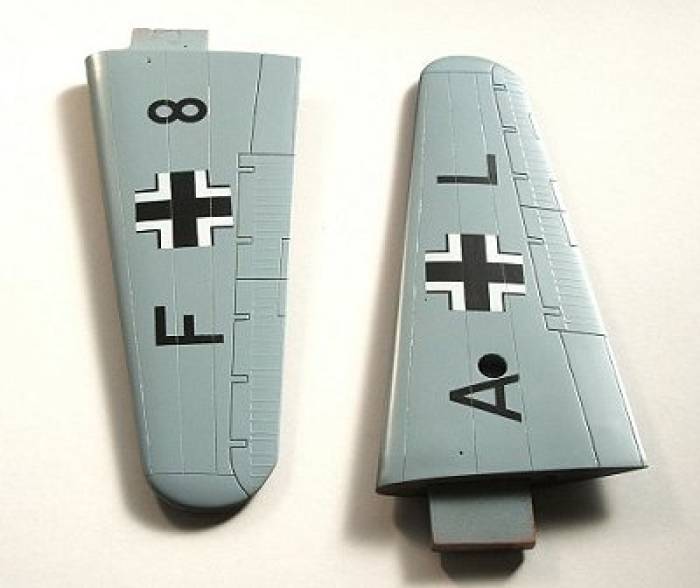
Editorial Note
In this entry, the Balkenkreuz and the F8+AL unit code on the underside appear after the masking is removed.
This is the first moment when the results of the painting process become clearly visible. The cutting, masking, painting sequence, and adjustment of adhesive strength are all confirmed here as the actual finish.
The explanation that the round hole beside the code letter A is for the landing light also helps us understand the positional relationship between markings and aircraft details.
[Date Unconfirmed]
Bomb Racks, Landing Light, and Pitot Tube Socket
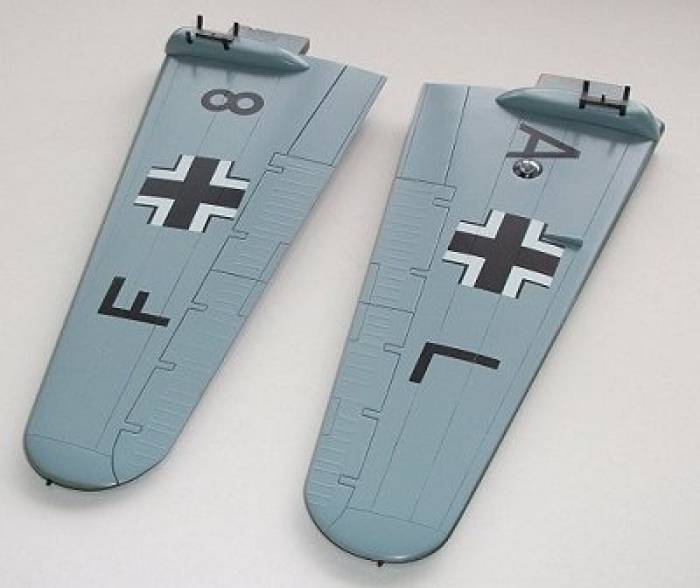
Editorial Note
After the underside painting and markings, the bomb racks, landing light, and pitot tube socket are added.
The important point here is that the pitot tube was made removable. This can be read as a judgment for handling a thin and easily damaged part during later work and storage.
At this stage, the underside of the wing changes from a painted surface into a convincing aircraft surface with armament-related parts and small details.
[Date Unconfirmed]
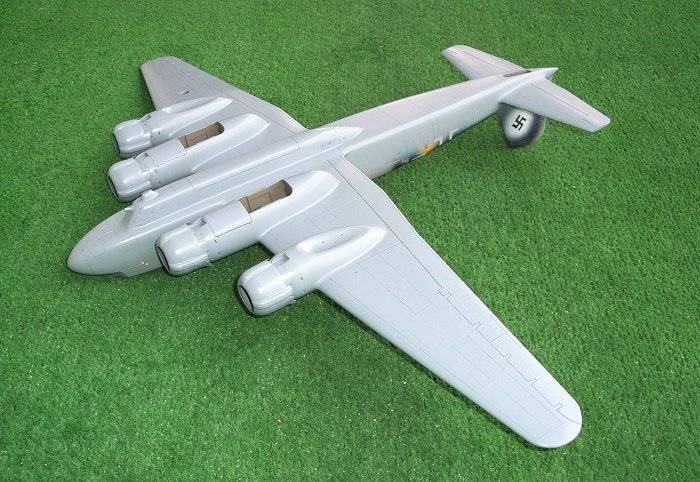
After Painting the Upper Surface Colors RLM 72/73
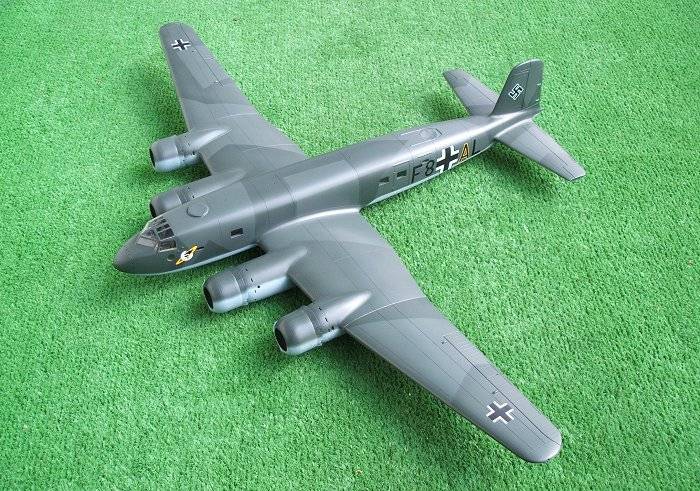
Editorial Note
This entry shows the condition after the upper surface colors RLM 72/73 had been painted and the masking removed.
Because the national markings, unit code, unit emblem, and window glass appear at the same time, the aircraft’s external appearance moves much closer to completion at this stage.
The note that RLM 72/73 were camouflage colors for maritime operation aircraft, slightly greener than those used on land operation aircraft, is also important. Here, the choice of color is not merely visual; it is connected to the operational environment of the aircraft.
Summary of This Page
This page has covered the painting and marking process of the Fw 200 C-3.
Main Focus of This Stage
- Resuming work after four months
- Using the gray type of Mr. Surfacer
- Preparing the unit code and unit emblem for a KG 40 aircraft
- Creating the national markings and unit code through painting and masking
- Reducing the adhesive strength of cellophane tape to prevent paint peeling
- Painting the underside color RLM 65
- Removing the masking to reveal the underside Balkenkreuz and F8+AL
- Installing bomb racks, landing light, and pitot tube socket
- Painting the upper surface colors RLM 72/73 and revealing the upper markings and windows
The important point in this page is that painting is not merely “adding color at the end.”
The national markings, unit code, yellow outline, unit emblem, and window glass all appear through the preparation of masks and the planned order of painting.
The small technique of reducing the adhesive strength of cellophane tape is also an important judgment for protecting the paint film.
Fukuda’s record preserves not only the completed appearance, but also the concrete steps and precautions by which that appearance was achieved.
Toward the Next Stage
The next record moves toward completion through the attachment of the cowlings, oil coolers, engines, machine guns, antennas, air intakes and vents, rear rotating machine gun, sliding canopy, and propellers.
Archival Note
This page preserves the painting and marking process.
In Fukuda’s record, not only the order of painting but also the judgments that affected the finish are concretely recorded: reducing the adhesive strength of cellophane tape, accuracy in cutting the masks, the yellow outline, and care taken to avoid peeling when the masking was removed.
For analytical organization, see:
Navigation
← Fw 200 C-3 Construction Record | Chronology | ← Original 05 | Original 06 | Original 07 →