
Fw 200 C-3 Construction Record — Original 03
Nacelles, Cowlings, and Attachment to the Wing
Note
This page preserves Kazu Fukuda’s original forum-based construction record as closely as possible to its original source structure.
It covers the work on engine nacelles, cowlings, attachment to the wing, installation of the rear fuselage and tail surfaces, and completion of the mock-up.
The text of each entry is shown in a highlighted box in order to make clear that it is based on Fukuda’s original post text.
For a chronological reconstruction of the whole record, see:
Source Information
- Original format: forum post archive
- Dates included on this page: April 30, June 10, June 17, June 21
- Main contents: cowlings, engine nacelles, attachment to the wing, rear fuselage, tail surfaces, mock-up completion
- Original post text: Kazu Fukuda
- Page organization: Japanese Solid Model Archive
Original Record Navigation
Fw 200 C-3 Construction Record | Chronology | Original 01 | Original 02 | Original 03 | Original 04 | Original 05 | Original 06 | Original 07
Previous: Original 02 — Fuselage interior, cockpit, canopies, machine guns, and gondola | Next: Original 04 — Spinners and propellers
Position of This Page
This page deals with the processes around the engine nacelles, which played a major role in determining the outer form of the aircraft after the work on the fuselage interior and gondola.
After checking parts such as the cowlings, oil coolers, exhaust pipes, and landing gear covers, the engine nacelles were attached to the wing. The rear fuselage, tailplane, and vertical tail were then fixed in place.
What is important here is that the making of individual parts was no longer simply a matter of separate component construction.
The work had moved into a stage in which each part contributed directly to establishing the overall form of the Fw 200 C-3.
With the completion of the mock-up on June 21, the collection of materials and shaped blocks could be seen, at least provisionally, as a single aircraft form.
[April 30]
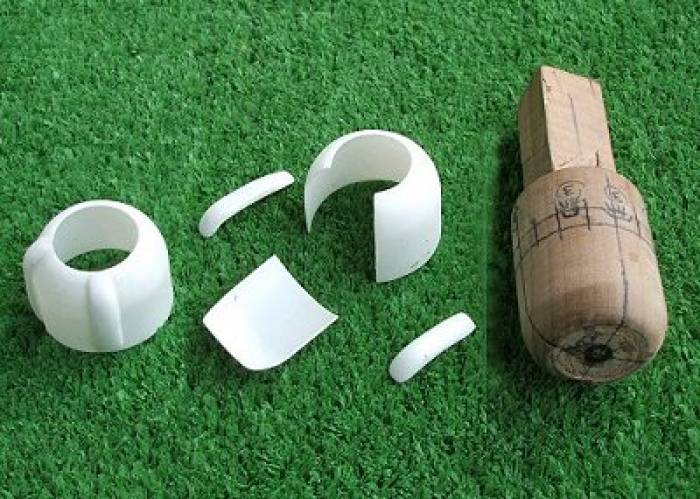
Heat-Pressing the Cowlings
Editorial Note
The cowling is an important part that determines the impression of the engine area.
Here, instead of forming it as a single piece, Fukuda divided it into two heat-pressed sections, taking into account the bulges of the intake duct covers on the actual aircraft.
This is important because the method of forming the part was adjusted in response to the aircraft’s actual shape.
The process is not only about making a shape; it is also about choosing a method that makes that shape possible.
[June 10]
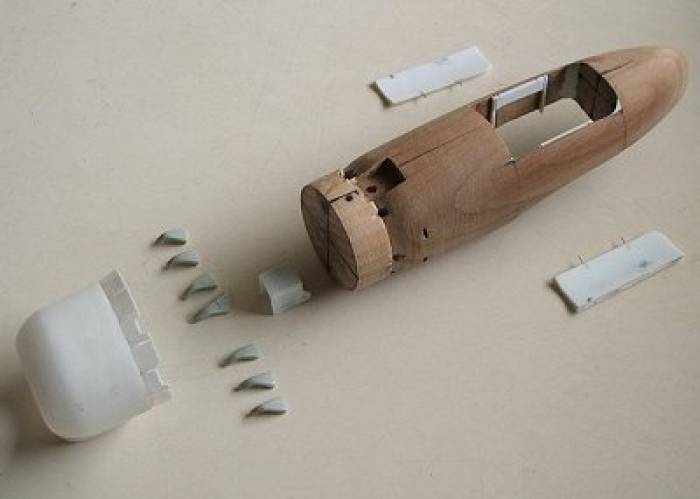
Parts Around the Engine Nacelles
Editorial Note
At this stage, not only the nacelle bodies, but also the cowlings, cowl flaps, exhaust pipes, oil coolers, and main landing gear bay covers have been prepared.
The particularly important point is Fukuda’s note that the holes for attaching the exhaust pipes must be made before the nacelles are attached to the wing.
This is not simply a matter of the order in which parts are made. It is a judgment that anticipates whether tools and hands will be able to reach the work area later.
[June 10]
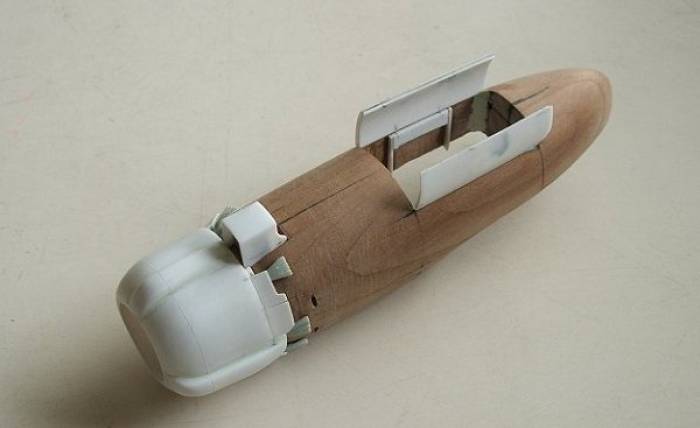
Trial Assembly of the Engine Nacelle
Editorial Note
Here, the attachment condition of the surrounding parts is checked before the nacelle is glued to the wing.
Trial assembly is not carried out merely to see the completed appearance early. It is a process for checking parts that will become difficult to correct after gluing.
After this check, the nacelles are fixed to the wing in the next stage.
[June 17]
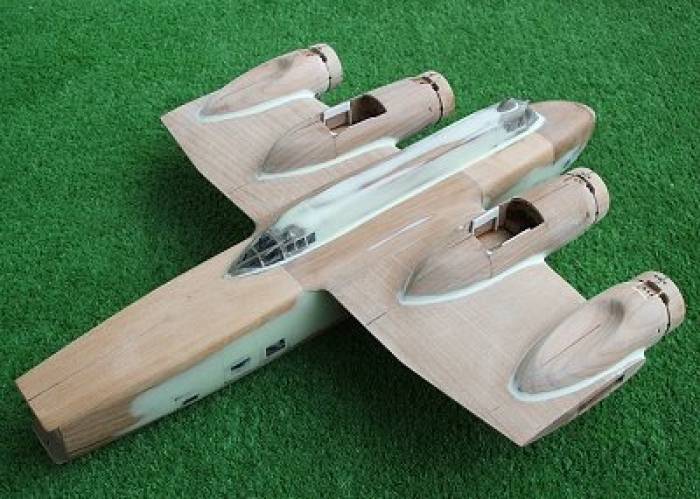
Attachment of the Engine Nacelles to the Wing
Editorial Note
In this entry, the engine nacelles are fixed to the wing.
The scooped-out undersides of the No. 1 and No. 4 nacelles, prepared for semi-recessed bombs, are an important feature related to the character of the Fw 200 C-3 as an aircraft.
The attachment of the nacelles transforms the wing from a simple wing shape into a structure that includes engines, landing gear, and bomb installation.
This is a key stage in establishing the aircraft’s overall form.
[June 21]
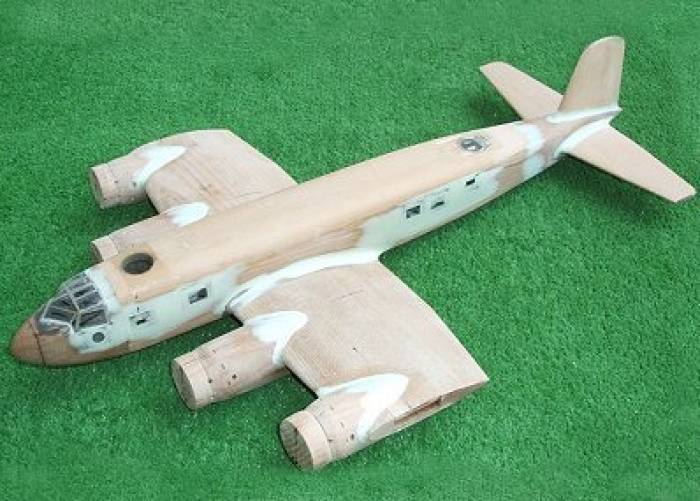
Attachment of the Rear Fuselage, Tailplane, and Vertical Tail
Editorial Note
Here, the rear fuselage, tailplane, and vertical tail are attached, and the form of the rear half of the aircraft is established.
The fact that the gaps were corrected with polyester putty shows that this was not merely a matter of joining parts together. It was also work to adjust the continuity of the outer form.
At this stage, the main outer form of the aircraft can almost be confirmed as a whole.
[June 21]
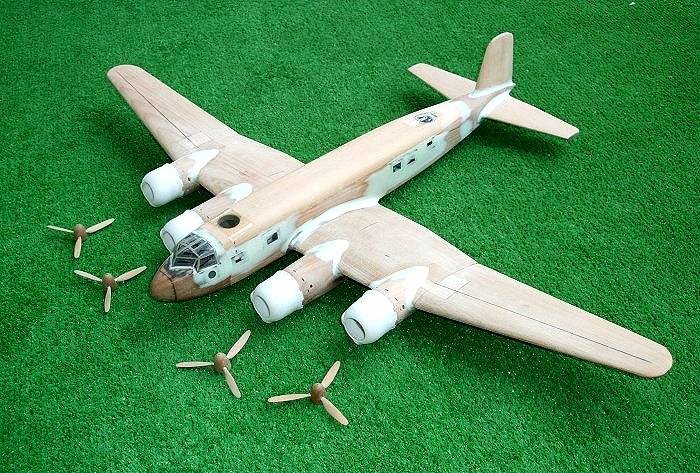
Mock-Up Completed
Editorial Note
This record marks an important turning point in the Fw 200 C-3 construction record.
What has been completed here is not the final finished model. However, the main outer form has come together, and by temporarily assembling the outer wings and cowlings, the overall volume and impression of the aircraft can be checked.
Fukuda’s phrase “gentle form” is especially important.
It is not merely a description of shape. It is a reading of the character of the Fw 200 C-3 as a patrol bomber based on an airliner.
Summary of This Page
This page has covered the processes that largely determine the outer form of the Fw 200 C-3.
Main Focus of This Stage
- Making the cowlings by heat-pressing
- Preparing the parts around the nacelles
- Temporarily assembling the parts before gluing the nacelles to the wing
- Attaching the engine nacelles to the wing
- Attaching the rear fuselage, tailplane, and vertical tail
- Temporarily assembling the outer wings and cowlings to check the overall volume
At this stage, the Fw 200 C-3 moves significantly from a collection of materials and blocks toward the appearance of a single large aircraft.
In particular, the attachment of the nacelles to the wing and the fixing of the tail section and tail surfaces establish the basic outer form of the aircraft.
Fukuda’s comment on the “gentle form” at the completion of the mock-up is also significant for reading this record.
He was not simply making the shape according to drawings. He was reading the character of the aircraft through its form.
Toward the Next Stage
The next record moves to the construction of the spinners and propellers.
Through the drilling of shaft holes in the spinners, shaping of pitch in the propeller blades, trial assembly, painting, and final assembly, the rotating parts that support the completed impression of the engine area are made.
Archival Note
This page preserves the process from the engine nacelles to the completion of the mock-up as source material.
The attachment of the nacelles, cowlings, rear fuselage, and tail surfaces belongs to the stage in which the overall form of the aircraft is established.
For analytical organization, see:
Navigation
← Fw 200 C-3 Construction Record | Chronology | ← Original 02 | Original 03 | Original 04 →