
This is an old revision of the document!

In last month’s issue, we explained the construction of the main wing—including the retractable landing gear—and the engine section.
This month, we will build the fuselage and tail unit, assemble the airframe, and complete the finish.
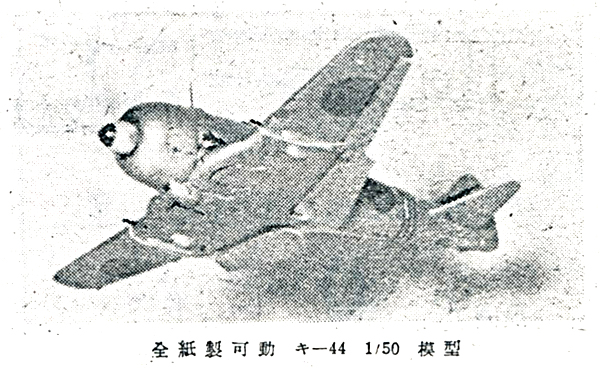
Fully paper-built, fully movable Ki-44 — 1/50 scale model
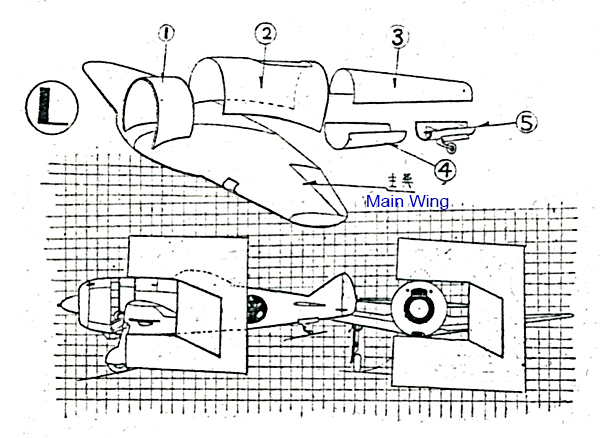
(A) For aircraft such as the Ki-44, whose fuselage—aside from the engine section—is mostly bounded by straight lines, I divided the fuselage into three parts.
However, for airframes with strong curvature like the *Raiden*, division into seven to ten sections is required.
The numbers in (A) indicate the order of fuselage attachment:
• In section (2), cut out the cockpit opening in advance with a knife.
• In section (5), construct the tail-wheel retraction mechanism.
As shown, create simple gauges from the three-view drawing on graph paper and use them during assembly. Even gauges of this simplicity are sufficient; however, if greater accuracy is desired, prepare sectional, side-view, and plan-view gauges in the same manner.
When attaching fuselage sections (1) and (2) to the wing, pay close attention to the installation angle (incidence).
If the result is unsatisfactory, do not hesitate to redo the attachment as many times as necessary.
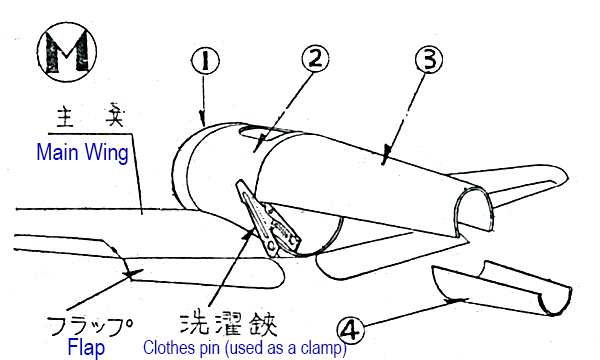
(B) This step illustrates how to join the fuselage sections.
If the paper thickness is adequate, apply cement directly to each cut surface and use several clothespins—narrowed at the tips—to hold the joints as shown.
This method is extremely convenient.
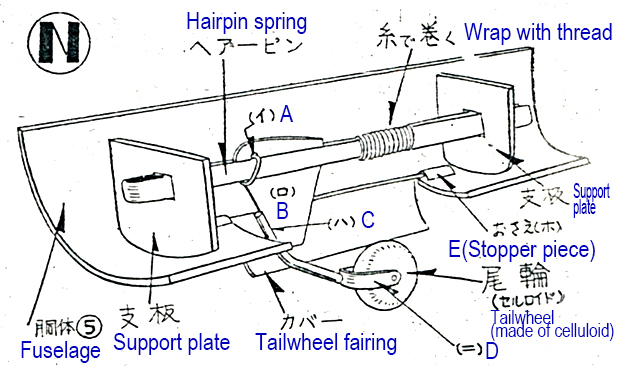
(C) This diagram shows fuselage section (5), which contains the tail-wheel retraction mechanism.
At 1/50 scale, even grasping the tail-wheel with fingertips can be difficult.
However, by drilling a hole into an old triangular ruler and pinning the U-shaped metal fitting (D), then shaping it with a file, the work becomes much easier.
Solder the portion at (E) to the metal fitting at (F), and drill a hole at (A) to wrap wire into a hair-pin shape as shown.
The cover is made of brass or tinplate; solder wire to the edge and secure it with paper at (G).
After completing this work, attach the assembly as fuselage section (5).
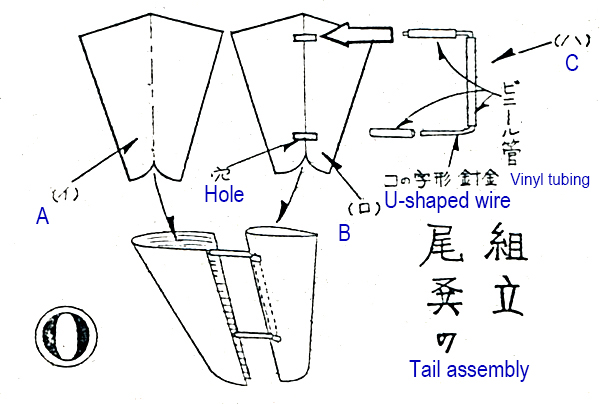
(D) Next, construct the tail surfaces.
Because the structure is identical to last month’s aileron method, the explanation is omitted here.
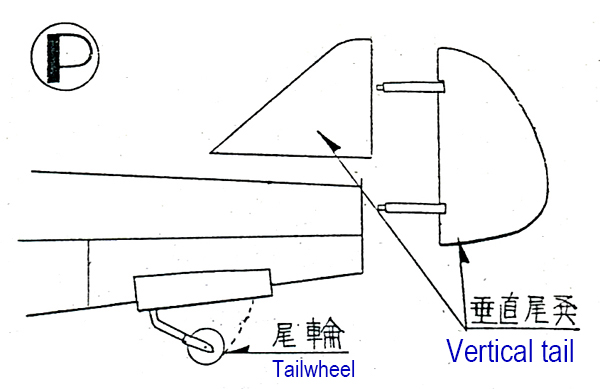
(E) Assembly and installation of the vertical tail are shown.
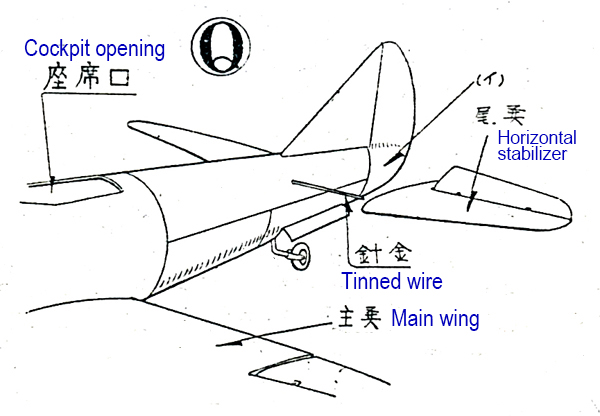
(F) To install the horizontal tailplane, pass wire through the appropriate location and cement the tailplane in place.
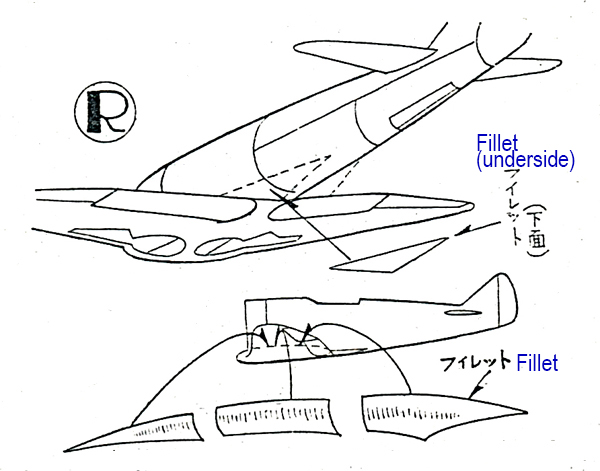
(G) Fillets are notoriously troublesome in wooden solid models, but in paper construction, they are surprisingly simple. First, attach the lower triangular fillet according to the drawing, then divide paper of cigarette-packet thickness into three or four strips and install them as shown. With practice, the method becomes extremely easy and can be applied to any size.
At this stage, the airframe—without the engine—has been completed.
Do not install the engine yet.
Apply lacquer putty with your fingertip to the fillet joints, tail-plane attachment areas, fuselage seams, and the underside of the vertical tail at point (A) in step (F).
Moisten a brush with a small amount of thinner to smooth the surface.
Allow to dry for several hours; sand with paper and repeat if unevenness remains.
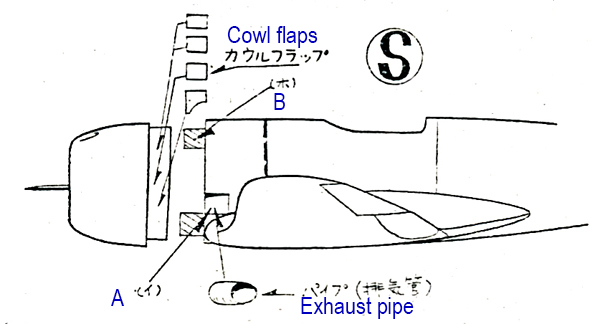
(H) After the putty dries, form the exhaust pipes by rolling tinplate into tubes. Cut a slot at position (A) and secure with cement. Then apply backing paper at (G) and attach the engine section.
Although the airframe is now structurally complete, it is better to attach the cowl flaps after painting, using tweezers.
This prevents paint from clogging gaps and increases realism.
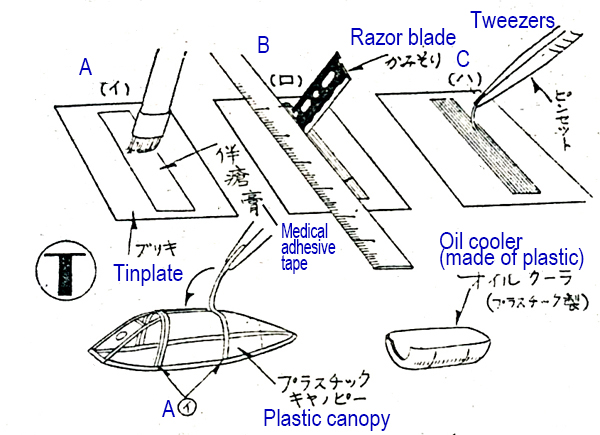
(I) The canopy is made from plastic. Because the method was published by Mr. Kazuo Takasaki in the November 1954 issue (No.40), p.81, the explanation is omitted here. Be sure to press-form the external canopy using plastic sheet. With this technique, even complex stepped canopies—such as those of the *Tenzan* or *Saiun*—can be reproduced simply by shaping the male mold accordingly.
If plastic is difficult to obtain, celluloid may be used. To reduce cloudiness, apply a small amount of clear lacquer to both sides.
For canopy framing, purchase paper surgical tape (about 20 yen) from a pharmacy. As shown, first stick the tape onto tinplate, paint it, allow it to dry, then cut to size with a razor and apply with tweezers. Although it adheres well, apply a tiny amount of cement at the intersections as insurance.
Oil coolers, upper and lower air intakes, and similar accessories can also be made from plastic, yielding better realism.
In twin-engine aircraft, identical components can be reproduced with ease.
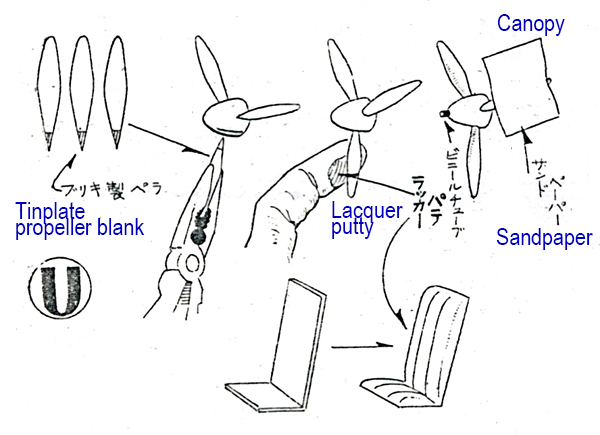
(J) Propellers carved from bamboo with pitch are difficult for beginners. Here, we describe a method using tinplate. Cut the blades from tin; taper the roots so they insert into the spinner. Carve the spinner from round stock, shape, and cut three slots with a razor. Insert the blades using pliers and set the pitch.
Apply lacquer putty with your fingertip (do not apply all at once—divide into several applications 4–5 hours apart). After fully dry, sand carefully. If unsatisfactory, repeat the entire process.
For the seat, spread putty over an L-shaped piece of paper and cut notches with a knife—the result resembles a leather-covered seat.
For the instrument panel, paint paper green and draw dials in white ink.
(K) Painting methods have been published previously and are similar to wooden solid models. In brief: • After applying putty, sand thoroughly. • Apply lacquer surfacer with a wide brush 3–4 times. • After full drying, wet-sand with #320 paper (avoid letting water enter gaps such as the aileron slots). Repeat this 2–3 cycles. Finish with #420–600 paper and apply lacquer in several thin coats. If available, polish with compound at the end.
For reference, the lacquer-painting process chart published in the *Saiunkai Bulletin* is included below.
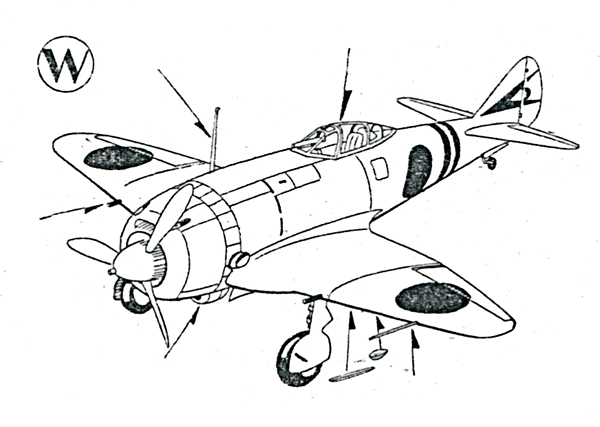
(L) After painting, perform the equivalent of panel-line scribing used in wooden solids. This step is troublesome, but must be done before the final coat fully dries—use a knife to incise the lines. Once complete, install the antenna, guns, and other external fittings as shown in (L). For the canopy, lightly apply cement to the inside and secure with surgical tape.
With that, your beloved aircraft is complete, and your desktop will surely become livelier. I hope that even a portion of this article proves helpful. I am currently experimenting with techniques for expressing jet-aircraft curves in paper. If there is interest, I will publish the results.
Even small hints can be valuable; I sincerely hope that solid-model enthusiasts submit ideas to this magazine, and hereby conclude this installment.