
This is an old revision of the document!
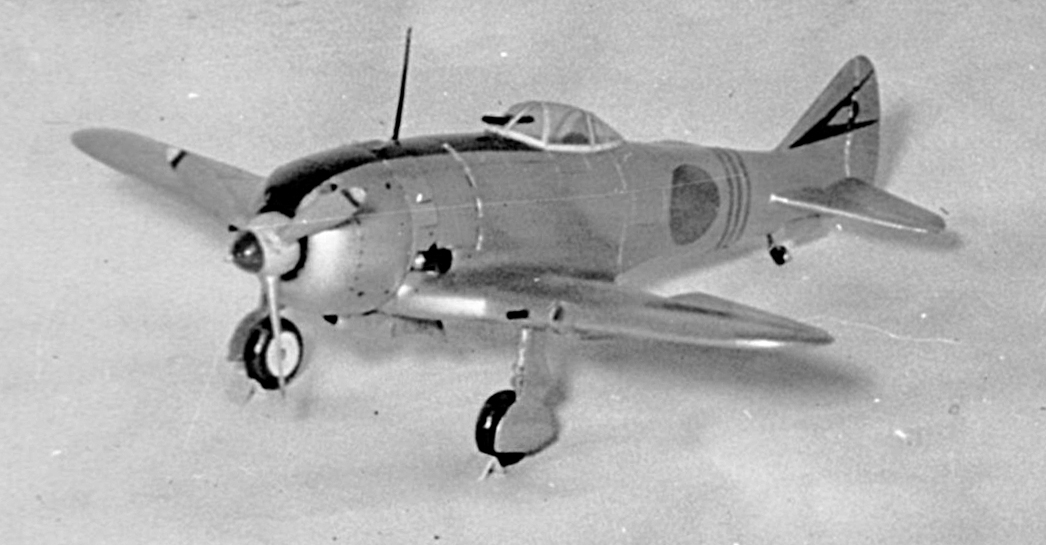
Completed paper “Shōki” with fully retractable gear and movable surfaces (from Ōmachi’s personal album)
In every issue of this magazine, beautifully finished photographs of solid models are published from our exhibition, and they are a great pleasure for us fans to look at. Naturally, any enthusiast would think, “If only I had something like that on my own desk as well…”. However, it has seemed to me that such enjoyment is granted only to the small number of people who are confident in woodworking. As for myself, an ordinary reader, until quite recently all I could do was gaze at those photographs of solid models.
Even if I gathered the materials and tried to start work, I found it difficult to handle the woodworking tools themselves, before even getting to issues of carving or assembly, and each time I gave up on building.
The method I will now describe—a “paper solid model”—came about when I took a hint from children’s cut-paper crafts.
My experience is still limited, with just a little over ten aircraft completed since I began, but, though it may be presumptuous, I have taken up the pen in the hope that it may be of some help to solid-model fans who are not comfortable with woodworking.
Now then, when building in paper, the first difficulty is expressing the curved portions of the aircraft, and the second is deformation of the wing surfaces caused by humidity. These issues can be solved by taking plenty of time and by working in a relatively small scale, and careful selection of paper quality is also essential. On the other hand, landing gear—especially retractable gear—which is quite labor-intensive on wooden solid models, can be mounted very simply in paper models by making good use of the interior space; flaps and all control surfaces can also be made movable with relative ease. As key points, I recommend first choosing an aircraft whose outline is bounded largely by straight lines, and then making skillful use of lacquer putty.
The “Ki-44” discussed this time took about 70 hours to complete. I will explain the process with reference to the figures. For the main airframe, spinner and wheels are made of wood, the landing-gear area uses metal, and all other parts are paper.
Below I will describe in detail the tools and materials required for construction.
Tools
◎ Metal shears (necessary both for heavy paper work and for the landing-gear parts)
◎ Pliers
◎ Long-nose pliers (with fine tips)
◎ Half-round file (about a five-piece set)
◎ Kiridashi / craft knife
◎ Awl
◎ Tweezers
◎ Clothespins (several)
◎ Soldering tools
◎ Punch
===== Materials =====
◎ Thin brass sheet or tinplate (a small amount)
◎ Vinyl tubing for hand-knitting (available at variety or notions shops)
◎ Straight pins that will fit inside the tubing mentioned above
◎ Insect pins
◎ Hairpins (there are various sizes; prepare the small ones with strong spring force)
◎ Paper surgical tape (the paper type)
◎ Cemedine (general-purpose adhesive)
◎ Lacquer putty (without this, working in paper solid is quite difficult. If you go to a large paint shop, they will usually sell you a small amount.)
◎ Lacquer surfacer (available at paint shops)
◎ Celluloid (both thick and thin)
◎ Transparent plastic sheet (for canopies)
Finally, the principal material: paper. It is no exaggeration to say that the choice of paper quality determines the excellence of the finished model. The thickness should be about 0.5 mm (roughly the thickness of three cigarette cartons stacked), with a certain toughness and a smooth surface. Hold the paper in your hand, pay attention to the direction of the fibers, and bend it as if forming a leading edge of the main wing; paper that bends smoothly along the grain is suitable. Drawing paper is unsuitable. You can also make use of cigarette and caramel boxes, etc.
I have outlined the main points above; please refer to each figure as you interpret the text.
For this “Ki-44,” I enlarged the drawing on page 62 of our magazine, No.35 (July issue), by 2.08 times to obtain approximately 1/50 scale, and drafted especially detailed gear drawings on graph paper.
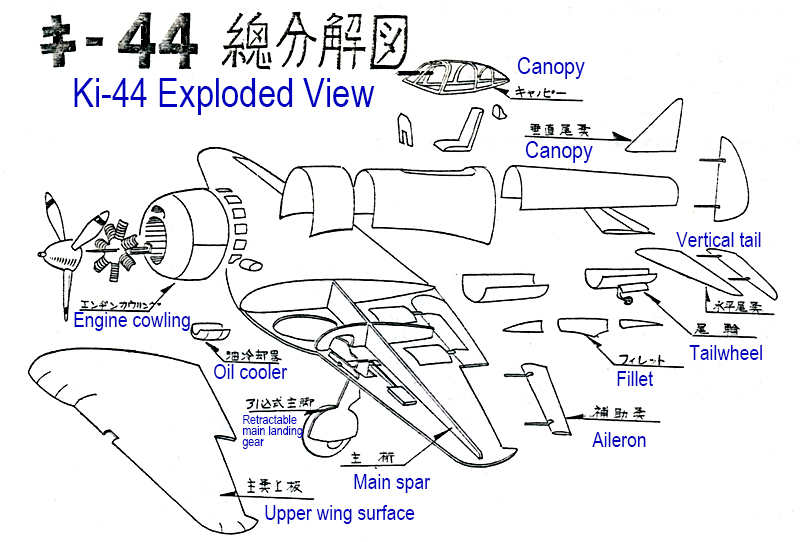
First, please refer to the “complete exploded view.”
With about this degree of subdivision, even the fuselage curves can be represented, and if you put some work into it, equipping the cockpit interior is quite rewarding.
One could begin from any part of the build, but here I will start with the landing gear.
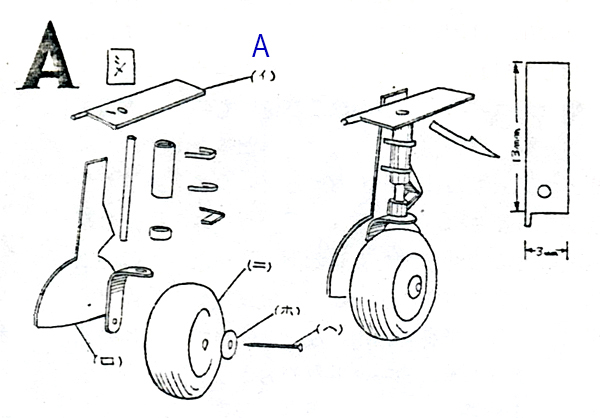
Referring to Figure (A), cut out the gear covers and other parts from brass sheet or tinplate, and solder them together.
The correct temperature is important, but it is just as essential to polish both joining faces thoroughly; for small parts, if you do not work quickly, the heat will spread and they will not bond well.
The key point in this step is the metal fitting (i).
This is gripped later by the spring (hairpin) and prevents the gear from retracting on its own when extended.
A width of about 3 mm is suitable; the length can be set at your discretion.
For this fitting (i), use slightly thicker brass sheet; make the hole with a single blow of the punch.
If you then file down the “raised” portion formed by the punch, you can obtain a clean hole even without a drill.
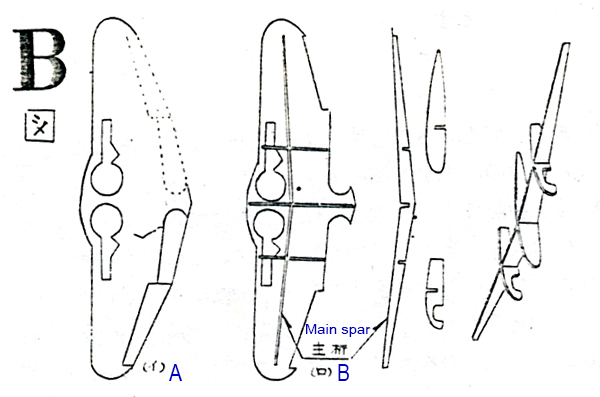
As step (B) (see Figure (B)), we move on to the main-wing construction.
As you can see, place the drawing on graph paper and cut out the wing parts from paper chosen as described above, matching it to the planform.
Cut out the gear bays, ailerons, and flaps all in one piece.
Cut the gear bay openings slightly smaller than the drawing, then finish the inside with a half-round file.
Because the paper fibers will stand up (“fuzz”), put a little Cemedine on your fingertip and press the fuzz down.
Treat the butterfly-type flaps the same way—file to shape, then use Cemedine to tame the fibers.
The piece cut out for the flap opening will be reused as the flap itself.
Next, install the spars.
Taking into account the thickness of the upper and lower wing skins, cut the spars from something like cardboard.
A layout roughly as indicated by (ku) in the diagram is structurally sufficient.
At this stage, you must ensure that when the upper wing skin is placed on top, the landing gear can be fully retracted into the wing.
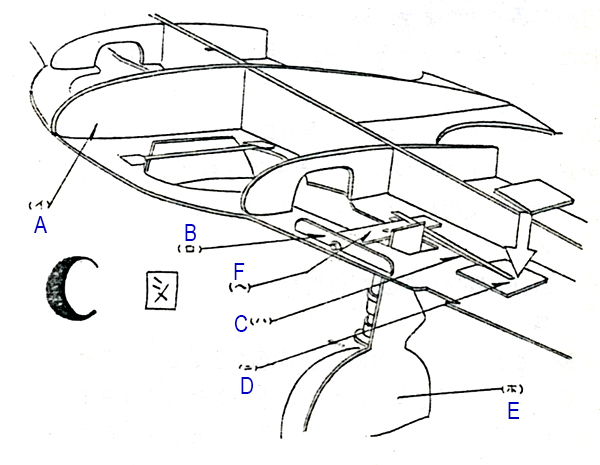
In step (C) (see Figure (C)), attach the gear made in step (A) to the lower wing skin from step (B).
The figure shows the gear in the extended position.
The key is the hairpin spring (ha), which clamps the fitting (i) from step (A) at point (he) in this figure.
When the gear is folded, this hairpin opens, and with a slight pull by fingertip the gear snaps smartly down.
If, during taxiing or landing roll, the gear tends to retract, increase the number of “pins” to two or three as reinforcement for the spring. Part (ro) is made from old celluloid rulers, thoroughly glued with Cemedine. Ideally there would be one such piece (ro) at both front and rear, but on the Ki-44—unlike the Ki-43—the gear retracts with a twist of about 2–3 degrees, so the retainer (ni) is used to hold the hairpin firmly in place. (The same twisted-retraction arrangement applies to types such as the Me 109, Spitfire, and Saiun, where the gear is first twisted and then retracted.)
Note: once the upper wing skin has been attached, if any of these glued joints come loose, they cannot be repaired. Apply plenty of Cemedine before closing.
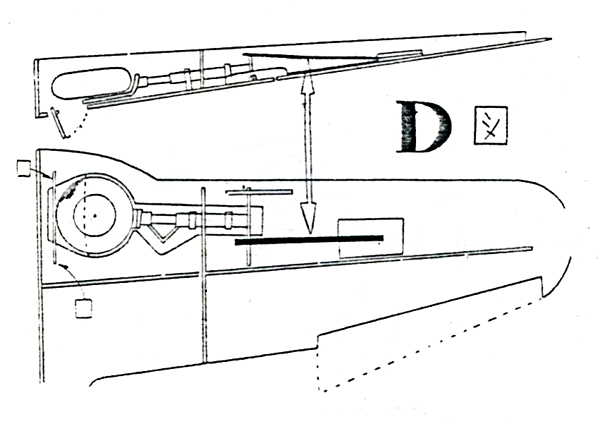
Figure (D) shows the gear in the retracted position.
(Please pay attention to the state of the springs.)
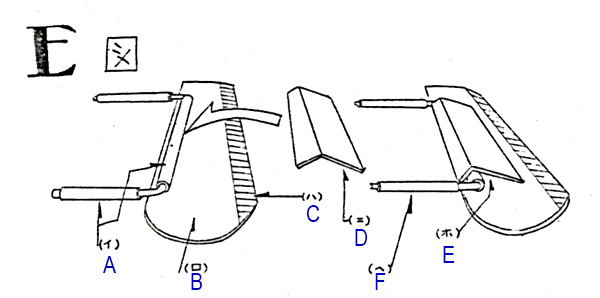
(E) shows the flap construction.
Cut vinyl tubing to suitable lengths and bend a piece of wire that fits snugly inside into a U-shape as in (i).
For (ro), reuse the flap piece you previously cut out; file the portion (ha), and then, as shown in (ni), glue down the vinyl tube firmly with a strip of paper using Cemedine.
For the tube at (he), use a piece that is slightly loose on the wire so that the flap can slide smoothly later.
This combination of wire and vinyl tubing is used for movable control surfaces throughout, so please keep it in mind.
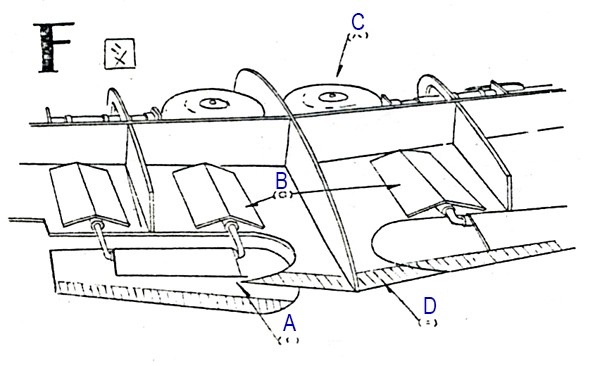
(F) shows the flap from the previous step installed on the wing.
(i) is the flap, and (ro) is the retainer for the vinyl tube; (ha) is the main gear.
File the area at (ni) in advance.
After the Cemedine has dried, be sure to check that the flap slides smoothly.
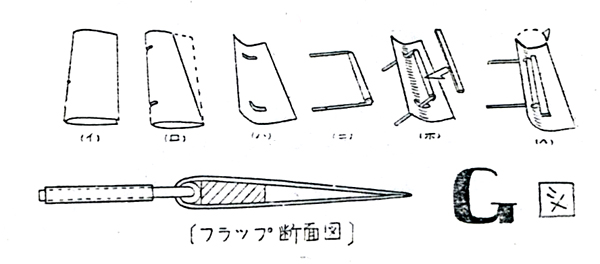
(G) shows the aileron construction, which is almost the same method as for the flaps.
In this case, paper from cigarette boxes is suitable.
First, fold the paper in two and cut it to shape as in the drawing, then cut out the opening at (ro).
Next, as in (ni), bend a length of wire threaded through vinyl tubing into a U-shape and pass it through the opening as in diagram (ho).
Glue the cardboard piece (paper core) shown in (ho) as in (he) with Cemedine, then fold the two halves together and glue.
(Refer to the flap cross-section.)
This structure is used generally for all movable control surfaces.
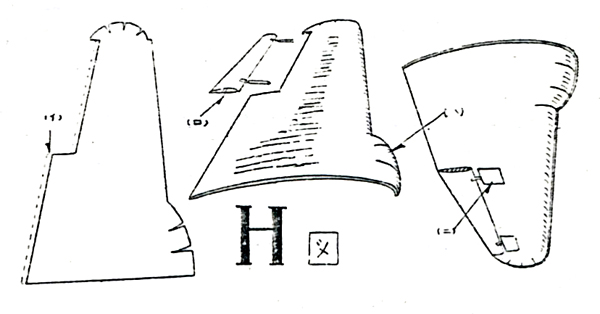
(H) The upper wing skin in this step is a troublesome part until you get used to it, so please work patiently.
Cut the area indicated by the dotted line at (i) slightly larger than the drawing.
At the bulge over the gear bay and at the wingtip, make three or four relief cuts.
Even if you cut a little too much, there is no need to worry, as the shape will ultimately be refined with lacquer putty.
(RO) is the flap from the previous step, and it is installed under the upper wing skin as in (ni), using paper strips as retainers. The reason it is not attached to the lower wing is that, given the wing thickness, a small gap would appear if placed below, whereas mounting it to the upper skin makes such gaps less noticeable.
For the leading edge, gradually bend the paper along the grain using pliers.
Take plenty of time and finish it cleanly.
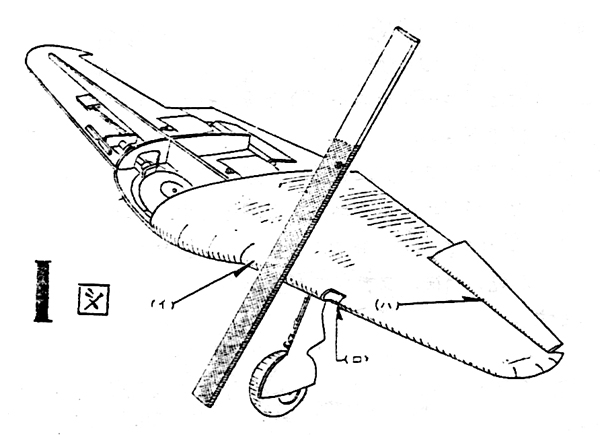
(I) Figure 1 shows the upper wing skin from the previous step glued onto the lower wing assembly.
Here, trim the overhanging trailing edge to match the lower wing.
Next, take out the lacquer putty, apply it with your fingertip into the gaps around the relief cuts, and, if the leading edge did not bend smoothly, coat that area with putty as well. After leaving it for several hours to dry completely, file it as shown in the figure. Sandpaper may actually give an even smoother finish than a file. Finish the wingtip in the same manner.
With this, the main-wing section is complete.
The bulged details on the wing underside will be added at the very end.
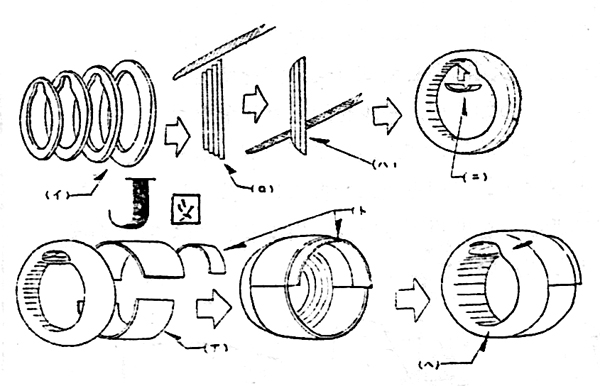
(J) Next comes the engine cowling at the very front of the fuselage, but you will find that it is simpler than it looks.
First, cut a doughnut-shaped ring from thick cardboard (even of inferior quality) as in (i).
Gradually increase the outer diameter to match the drawing, paying attention also to the inner diameter.
As in (ro), apply plenty of Cemedine, let it dry thoroughly, and then file to final shape.
For the inner diameter, form it with due regard to the carburetor intake, and press down any fiber fuzz with Cemedine.
Then attach the bulkhead (ni).
(Ho) is divided into two parts, upper and lower, and glued to the front. In this step, clothespins are handy for holding the upper and lower pieces from shifting while they dry. The small paper strips (to) are for attaching the cowl flaps later.
Finally, lightly file the Cemedine ridges to level them, coat the entire cowling with lacquer putty, and finish with sandpaper.
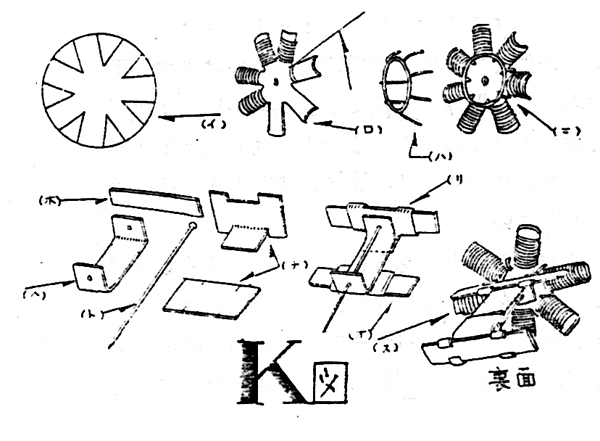
(K) The propeller-rotation unit must be inserted into the cowling made in the previous step, and here we take the opportunity to construct a simple imitation engine and install it.
Cut out the paper strips as in (i) and wrap fine steel wire around them. Next, make the fitting (ha) using tinned hookup wire or similar, and attach it as in (ni). For the rotating portion, work brass sheet into shape as in the figure; I used insect pins for part (to). (Ho) and (o) are paper pieces that will be fixed inside the cowling.
(Saiunkai) — *to be continued*
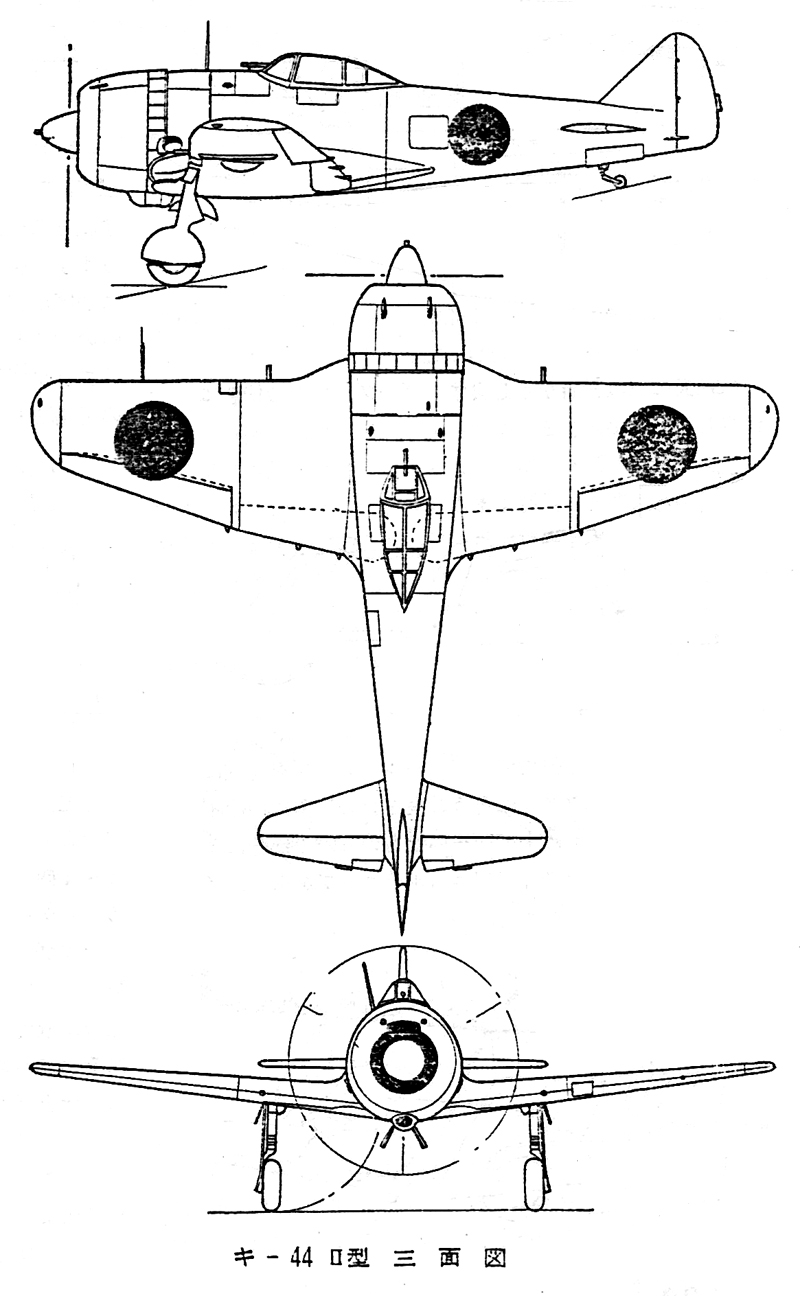
Three-view drawing of Ki-44 II type
From *Sekai no Kōkūki* (“Aircraft of the World”), Hōbun Shorin, February 1955 issue, pp.100–103.