
This is an old revision of the document!
Paper-Solid Model (Ki-44 “Shōki”) — Full-Movable, 1/30 Scale

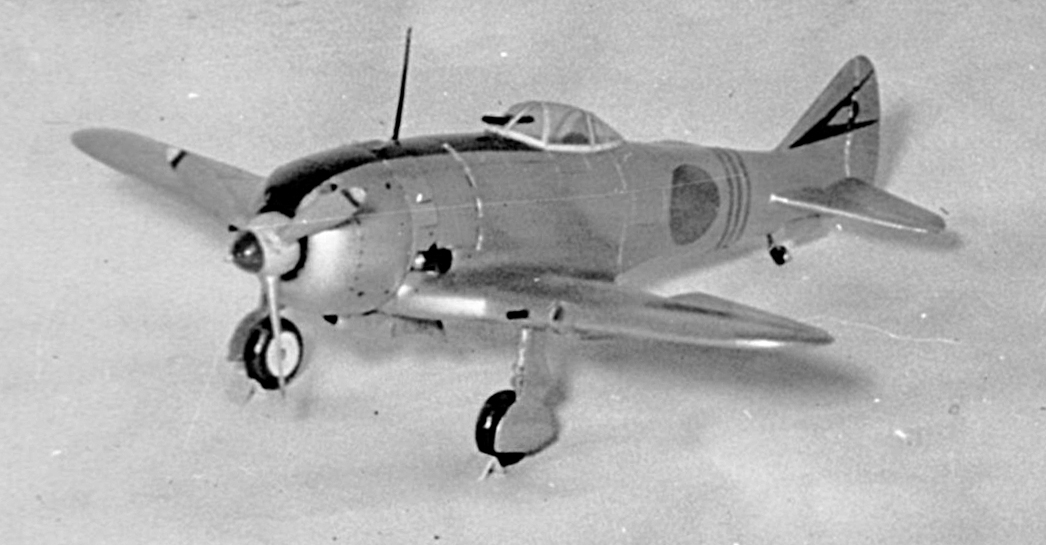
*Completed paper model of the Ki-44 “Shōki,” fully movable (from Ōmachi’s personal album).*
For many readers, the beautifully crafted solid-model photographs that appear in each issue of this magazine are a great source of admiration. Most of us have surely thought: *“If only I had one of these on my own desk…”* Yet in reality, such wooden solid models remain a privilege reserved for those confident in woodworking skills.
Until recently, I myself was no different—merely a spectator. Even after preparing materials, I repeatedly gave up before starting, discouraged not by shaping or assembly, but by my lack of experience with wood tools.
It was from children’s paper-cutting play that I found the idea for what follows: the paper-solid model. Although I have completed only a dozen or so examples, I write—boldly, perhaps—for the benefit of solid-model fans who are not at ease with woodworking.
The first difficulty of paper construction is reproducing curved aircraft surfaces. The second is deformation caused by humidity, especially on the wings. However, both challenges can be overcome through patience, reduced scale, and careful selection of paper.
Paper-solid models also offer advantages: landing-gear retraction, which requires great effort in wood, becomes remarkably simple thanks to the internal space. Flaps and control surfaces can also be made fully movable.
As a general rule, begin with an aircraft whose outline is defined mostly by straight lines, and make good use of lacquer putty.
The Ki-44 described here required approximately 70 hours to complete. Except for the spinner and wheels—which are wood—and small metal parts around the landing gear, the model is made entirely of paper.
Required Tools
* Metal shears (for thick paper and landing-gear parts) * Pliers * Needle-nose pliers * Half-round files (about five) * Kiridashi or craft knife * Awl * Tweezers * Several clothespins * Soldering tools * Punch
Materials
* Thin brass sheet or tinplate (small amount) * Vinyl tubing (available at general-goods shops) * Needles that fit inside the tubing * Insect pins * Hairpins (select small, strong-spring type) * Paper fasteners * Cemedine adhesive * Lacquer putty — essential for paper-solid work * Lacquer surfacer (from paint suppliers) * Celluloid sheets (thick and thin) * Transparent plastic sheet (for canopy) * Main material: paper
- About 0.5 mm thick (equivalent to three cigarette boxes)
- Smooth surface and natural adhesion
- Check grain direction and select paper that bends smoothly along the leading-edge curve
- Drawing paper is unsuitable
- Cigarette and caramel boxes may also be used
The Ki-44 for this article was enlarged 2.08× from the plan in *Issue No. 35 (July)* to obtain 1/50 scale. The landing-gear section was redrawn in detail on graph paper.
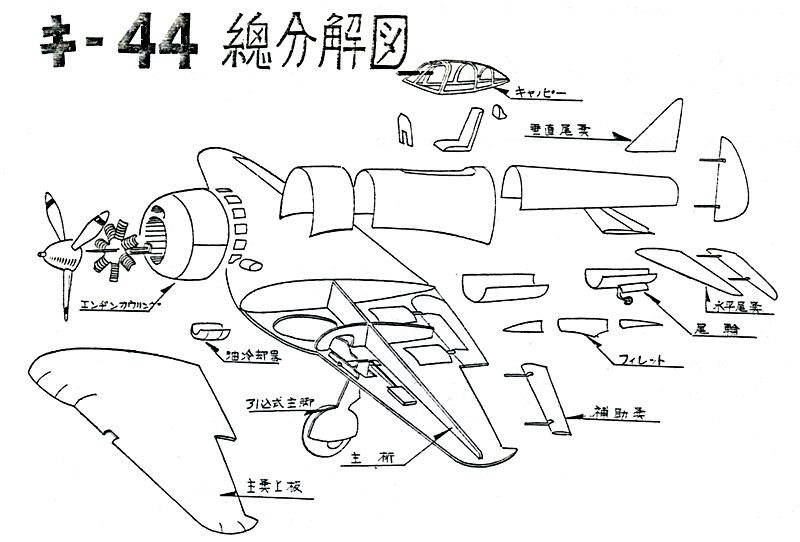
*Refer first to the “complete exploded view.” Even with this level of subdivision, curved surfaces can be expressed. Although work may begin elsewhere, here we start with the landing gear.*
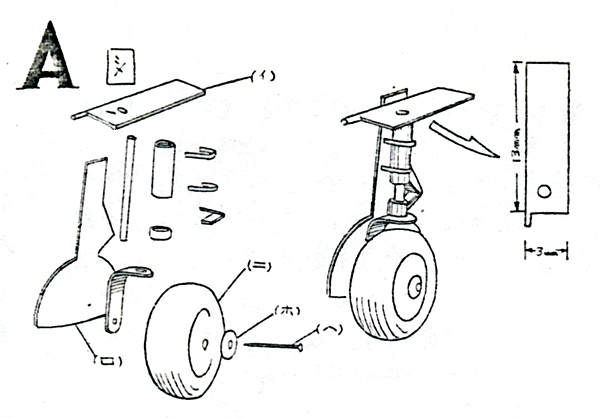
(A) Landing Gear Components
Cut the gear doors and related parts from brass or tinplate and solder them.
Both temperature control and surface preparation are important; work quickly to prevent heat loss.
The key component is the metal fitting (marked a), later held by the spring (hairpin) to prevent accidental retraction.
Use slightly thicker brass and punch the holes; file smooth afterward.
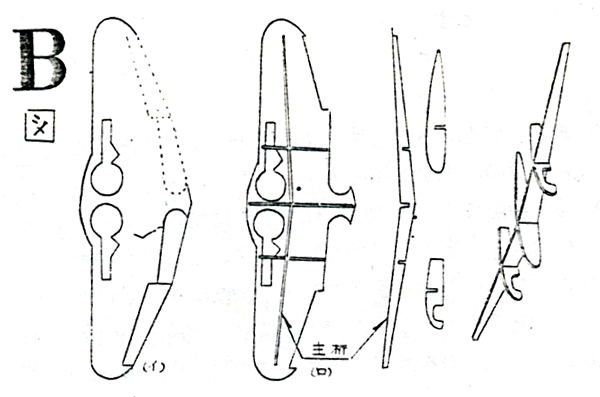
(B) Main Wing Construction
Cut the wing panels from the selected paper according to the traced outline.
Cut the wheel openings slightly undersized and finish with a half-round file.
Apply adhesive with a fingertip to suppress frayed fibers.
Insert spars cut from card; strength is sufficient as indicated in the diagram.
Before attaching the upper wing skin, ensure that the retracted gear fits completely.
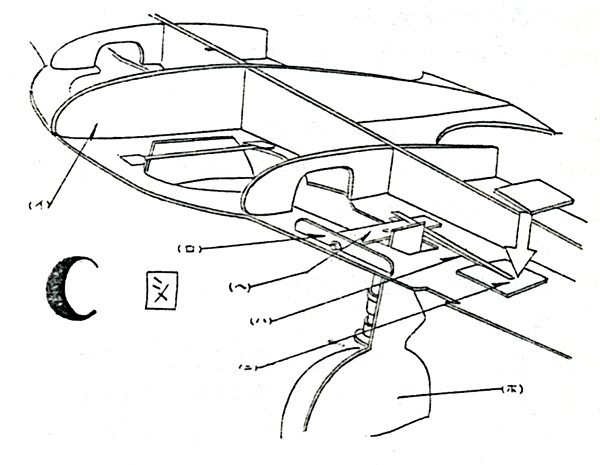
(C) Installing the Landing Gear
Attach the completed gear to the lower wing panel.
The hairpin spring (b) opens when folded and snaps the gear outward when pulled.
Strengthen with additional pins if needed.
Celluloid panels (c) are glued firmly.
Because the Ki-44 folds at a slight angle, secure the hairpin with the retainer (d).
Once the upper wing skin is attached, repairs are impossible—apply adhesive thoroughly.
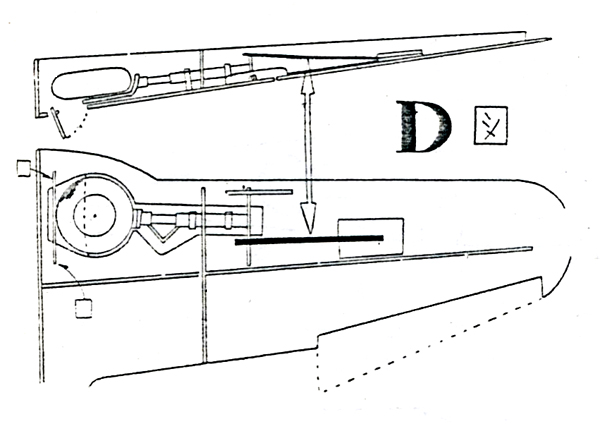
(D) Gear in Retracted Position
(Observe the spring condition.)
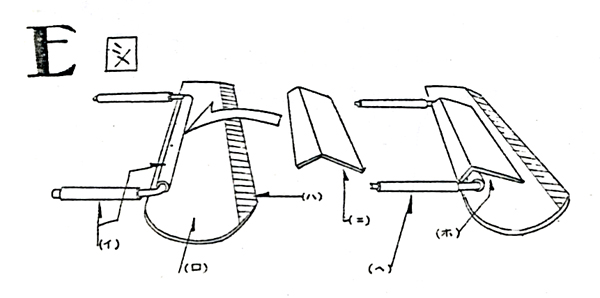
(E) Flap Mechanism
Cut vinyl tubing and fit a U-shaped wire.
Reinforce with paper strips and adhesive.
Use slightly looser tubing for smooth sliding.
This system will be reused for all control-surface articulation.
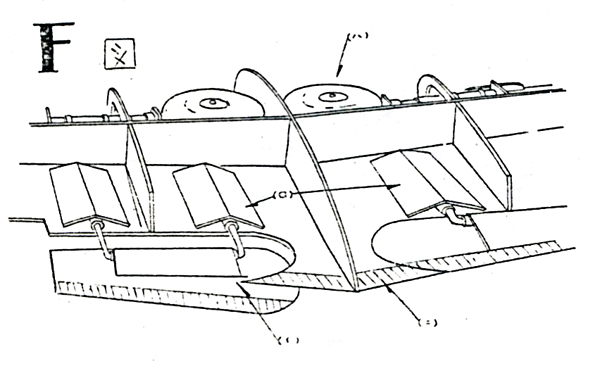
(F) Flap Installation
Ensure smooth movement after the adhesive dries.
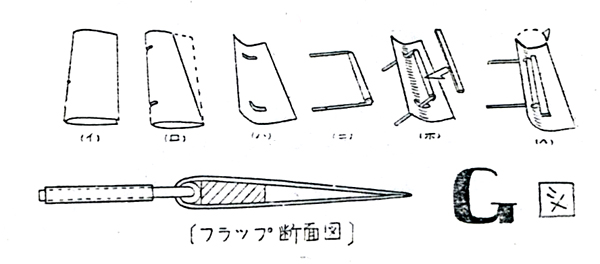
(G) Ailerons
Construct similarly to flaps, using cigarette-box paper.
Insert wire and fold after bonding.
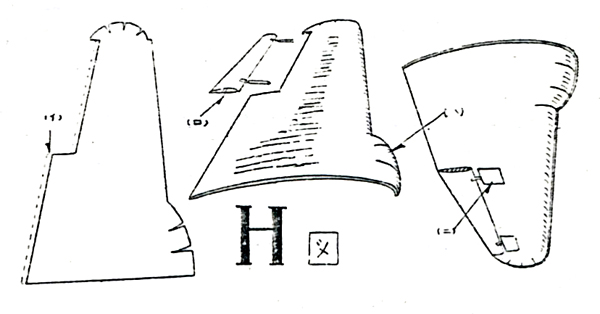
(H) Upper Wing Skin
Cut slightly oversize and fit gradually.
Make several relief cuts near the gear bulge and wingtips; excess will be shaped with lacquer putty.
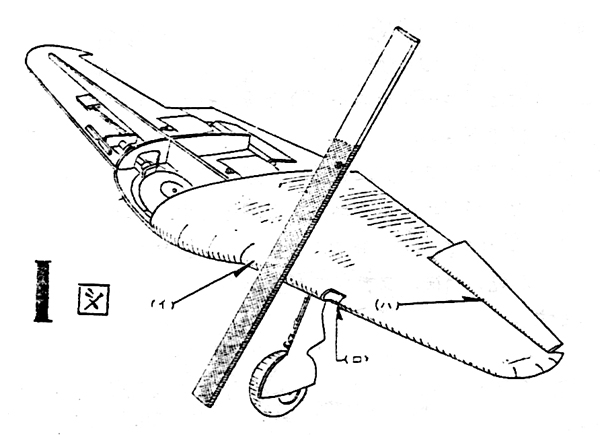
(I) Final Wing Shaping
After attaching the upper skin, trim the trailing edge and apply putty to fill gaps.
Sand smooth after drying.
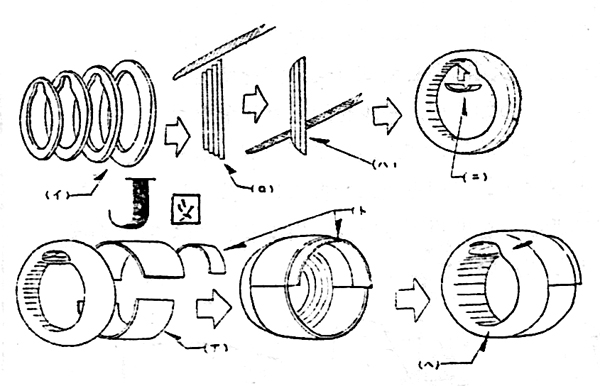
(J) Engine Cowling
Cut thick card into a donut shape and enlarge gradually while observing both diameters.
Apply putty and sand smooth.
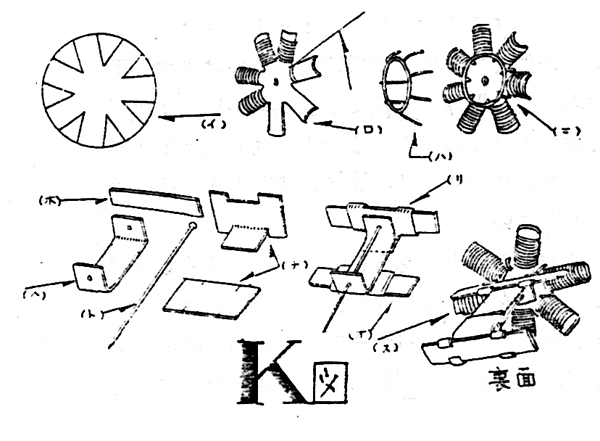
(K) Imitation Engine
Create cylinders from strips of paper wrapped around fine wire.
Fabricate metal fittings and assemble the propeller-mount structure accordingly.
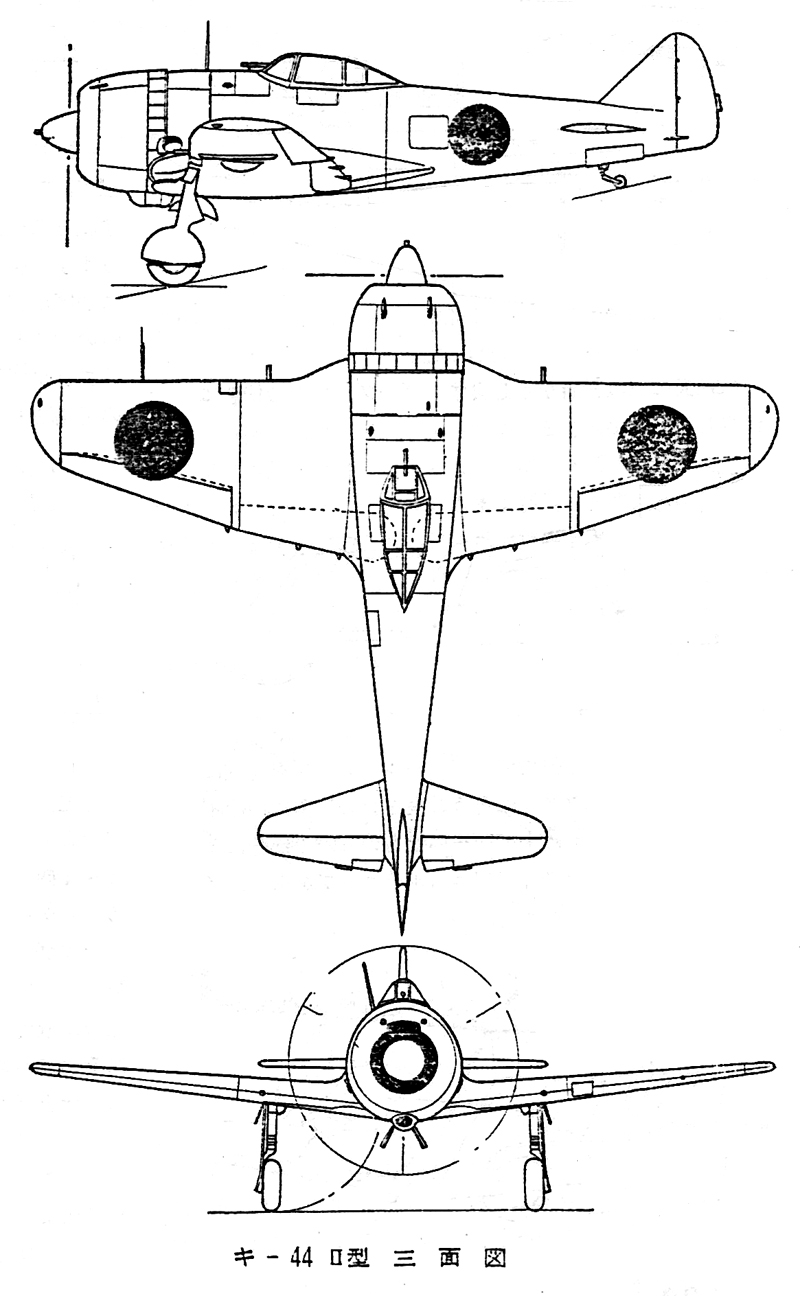
*Ki-44-II airframe plan — from “World Aircraft,” Hōbun Publishing, Feb. 1955 (pp.100–103).*