
03-1 Mock-up: Cowling and Radiator
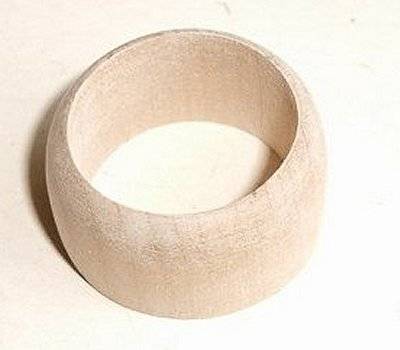
Open holes in the nose cowling, whose outer shape has already been formed together with the fuselage block, to install the annular radiator. After rough cutting with a round gouge, finish by wrapping sandpaper around a round stick (I used the handle of a carving knife).
 |
|---|
| Fig. 3-1 Cowling |
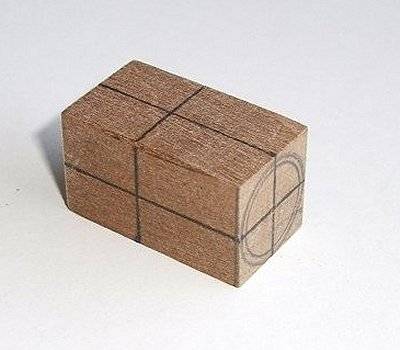
Once the inner diameter of the cowling is finished, begin making the annular radiator. Start with the central core piece, carved from the same stock as the spinner. Accurately shape the square block.
 |
|---|
| Fig. 3-2 Radiator Core Material |
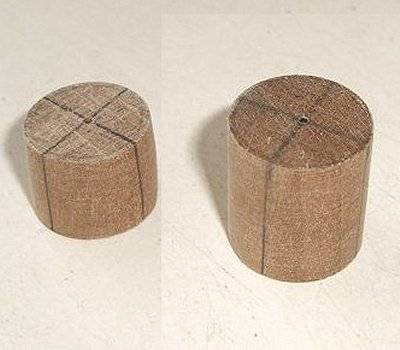
Rough-shape the square block with a knife, then round it with a file and sandpaper. Divide it into two rods, one for the spinner and one for the radiator.
 |
|---|
| Fig. 3-3 Spinner and Radiator Parts |
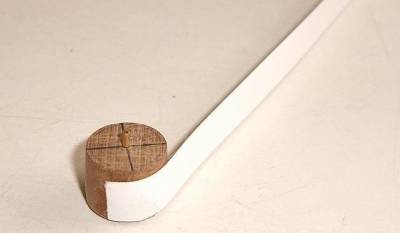
Cut waste calendar paper into 10 mm-wide strips and wrap them around the round bar to form the radiator fins.
 |
|---|
| Fig. 3-4 Radiator Fins |
Continue wrapping until the diameter fits snugly inside the cowling, then glue the end so it will not loosen.
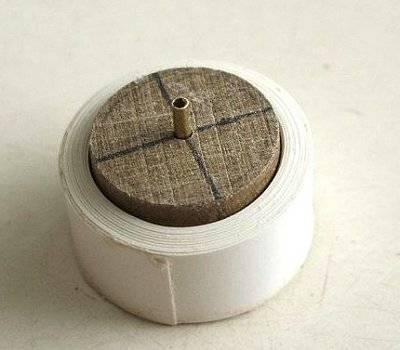 |
|---|
| Fig. 3-5 Wrapped Radiator Fins |
Attach eighteen 0.3 mm nickel-silver wires to the radiator’s front face. Drill precise 0.3 mm holes in the exposed side of the central core with a pin vise and insert the wires. Add small reinforcing strips of plastic sheet at the top and bottom to give the assembly the look of a true radiator.
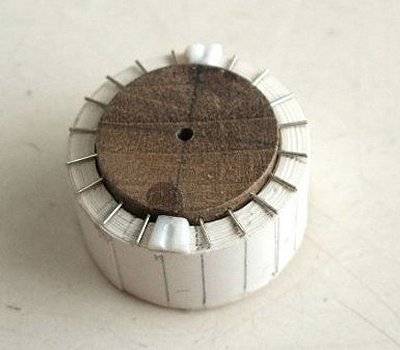 |
|---|
| Fig. 3-6 Engine Rods |
Here the radiator is temporarily fitted into the cowling, reproducing one of the Fw 190 D-9’s characteristic features.
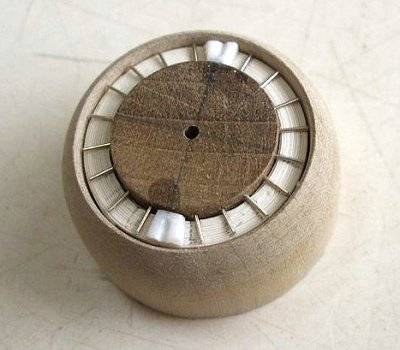 |
|---|
| Fig. 3-7 Trial Engine Assembly |
Eleven cowling flaps are mounted around the annular radiator cowling. Cut the grooves for them carefully with a design knife. Make each flap from 0.3 mm plastic sheet cut into 4 mm strips; test-fit the strip around the cowling, determine the total length, and divide it evenly into eleven.
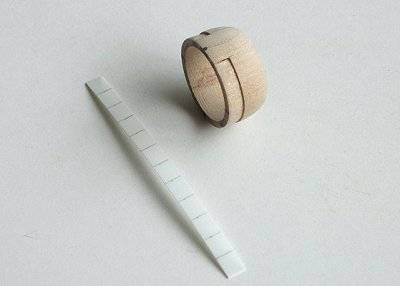 |
|---|
| Fig. 3-8 Cowling Flaps |
Cut out the eleven flaps, curve each by pressing it against a brush handle, and glue five from the upper right, then five from the upper left. Adjust the final bottom flap to correct any slight length error—trim if too long, remake if too short.
 |
|---|
| Fig. 3-9 Flap Adjustment |