Fw 200 C-3 Construction Record — Original 07
Final Assembly and Completion
Note
This page preserves Kazu Fukuda’s original forum-based construction record as closely as possible to its original source structure.
It covers the final assembly process, including the attachment of the cowlings, oil coolers, machine guns, antennas, rear rotating machine gun, propellers, and the completion of the model.
The text of each entry is shown in a highlighted box in order to make clear that it is based on Fukuda’s original post text.
For a chronological reconstruction of the whole record, see:
Source Information
- Original format: forum post archive
- Period covered on this page: date unconfirmed, from final assembly to completion
- Main contents: cowlings, oil coolers, engines, machine guns, antennas, propellers, and completed model photographs
- Original post text: Kazu Fukuda
- Page organization: Japanese Solid Model Archive
Original Record Navigation
Fw 200 C-3 Construction Record | Chronology | Original 01 | Original 02 | Original 03 | Original 04 | Original 05 | Original 06 | Original 07
Previous: Original 06 — Painting and markings | Back: Fw 200 C-3 Construction Record
Position of This Page
This page deals with the final stage of the Fw 200 C-3 construction record.
In the previous stage, the painting and marking process was carried out, including surfacer, national markings, unit code, underside color RLM 65, and upper surface colors RLM 72/73.
On this page, the painted airframe receives the cowlings, oil coolers, engines, machine guns, antennas, air intakes, vents, rear rotating machine gun, sliding canopy, propellers, and other final parts.
What is important here is that the many parts made separately in earlier stages are now integrated into a single completed form.
In particular, Fukuda’s note that the centerlines of the No. 1 and No. 4 engines open outward by about three degrees from the aircraft centerline is important. This is not merely a matter of attaching parts; it is a judgment based on reading the form of the actual aircraft.
[Date Unconfirmed]
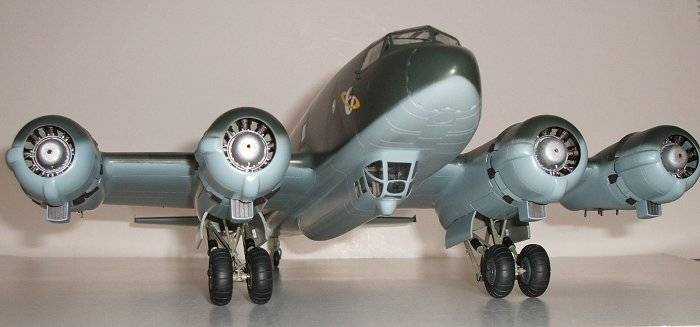
Attachment of the Cowlings and Oil Coolers
Editorial Note
In this entry, the cowlings and oil coolers are attached.
The particularly important point is Fukuda’s note that the centerlines of the No. 1 and No. 4 engines open outward by about three degrees from the aircraft centerline.
This shows that the parts were not simply attached facing straight forward. Instead, the attachment angle was judged by reading the features of the actual aircraft’s form and engine arrangement.
Even at the stage of final assembly, the reading and checking of form continued.
[Date Unconfirmed]
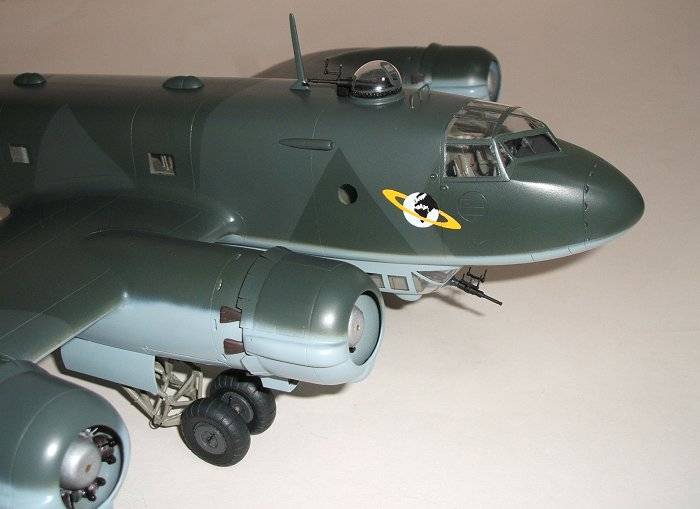
Nose Upper Rotating Turret and Forward Gondola Gun
Editorial Note
Here, machine guns are attached to the upper nose rotating turret and to the forward part of the gondola.
The point to note is that the gun barrels were made removable. This can be read as a practical judgment for protecting thin, easily damaged parts during later handling and storage.
The addition of the antenna mast, air intake, and ventilation outlet also increases the amount of visual information on the upper fuselage and gives the aircraft a stronger sense of presence.
[Date Unconfirmed]
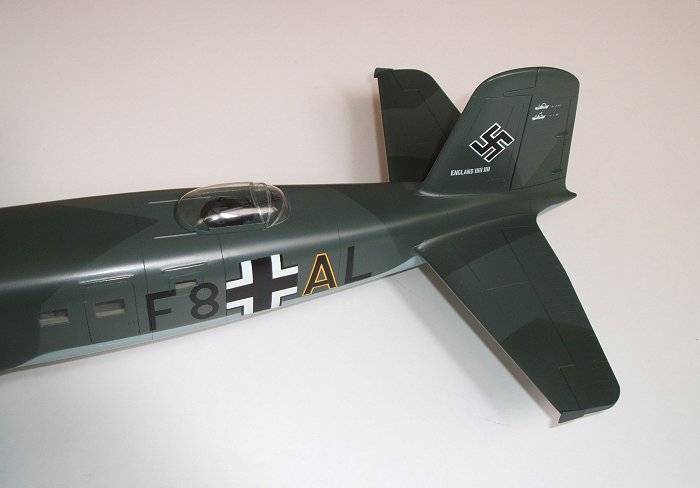
Rear Upper Fuselage Rotating Machine Gun and Sliding Canopy
Editorial Note
In this entry, the rotating machine gun and sliding canopy on the rear upper fuselage are attached.
Fukuda notes that this canopy resembles the one on the He 111. This is not merely a statement that a part was attached. It shows that he understood the character of the part through comparison with another aircraft.
The sortie marks and ship-sinking marks painted on the vertical tail also strengthen the individuality of the aircraft.
These markings are preserved here as part of the historical and documentary record of scale model making.
[Date Unconfirmed]
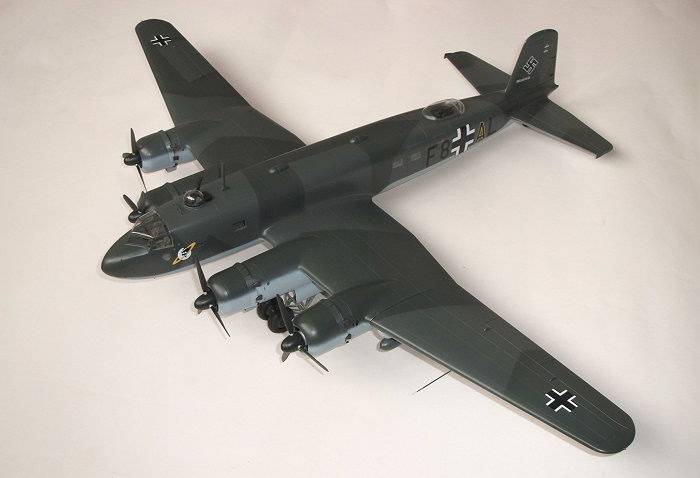
Attachment of the Propellers and Completion
Editorial Note
In this entry, the propellers are attached last, and the Fw 200 C-3 reaches completion.
The propellers were parts made together with the spinners in Original 04. By attaching them here, the engines, cowlings, spinners, and propellers become integrated, and the appearance of the aircraft as a four-engined machine is completed.
The statement that the work was “about half a year behind schedule” also shows that this was a long, sustained construction project.
Completed Model Photographs
These photographs record the completed Fw 200 C-3 from several angles.
They are not simply photographs of a finished model. They also serve as documents that show how the entire construction process was finally integrated into one completed form.
Left Front View
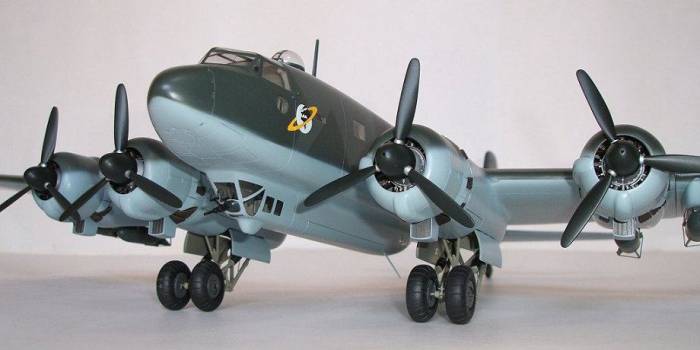
Editorial Note
The left front view allows the nose, fuselage, wing, four engines, propellers, and the volume of the underside to be seen together.
If an image is needed for the entrance page or for sharing, this kind of oblique front view is one of the clearest candidates.
Right Front View
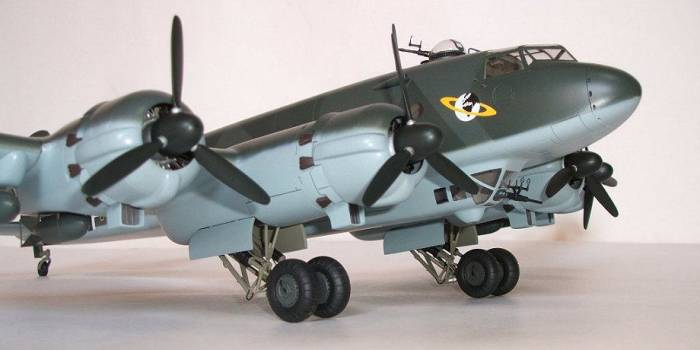
Editorial Note
The right front view shows the engine arrangement, wing span, and relationship between wing and fuselage from the opposite side.
For understanding the overall form of the large Fw 200 C-3, records from both sides are useful.
Right Side View
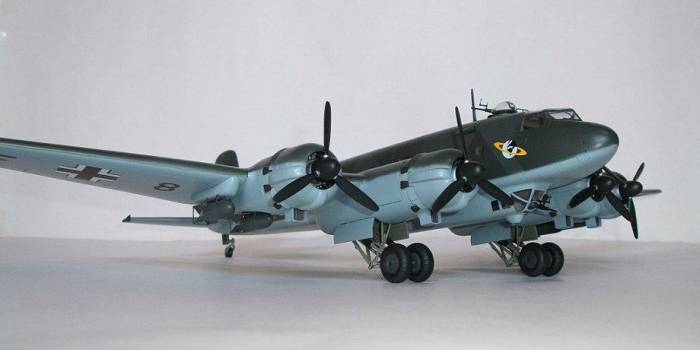
Editorial Note
The right side view makes it possible to confirm the length of the fuselage, the position of the wing, the tail section, the vertical tail, and the horizontal balance of the entire aircraft.
This angle clearly shows that the Fw 200 C-3 had a long fuselage derived from an airliner.
Top View
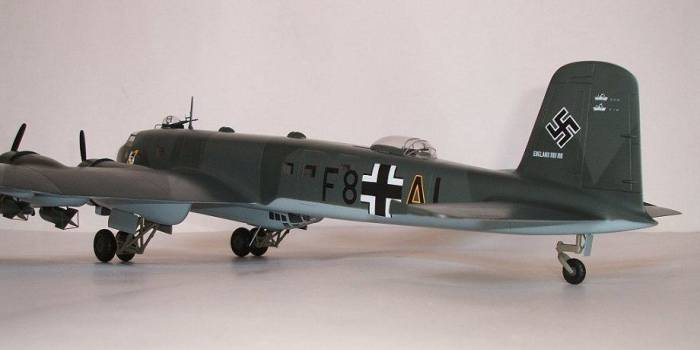
Editorial Note
The top view makes it possible to examine the wing planform, engine arrangement, tail surfaces, upper camouflage, and national markings.
While the oblique front view conveys three-dimensional volume, this angle is useful for reading the aircraft layout and planform.
Summary of This Page
This page has covered the final stage of the Fw 200 C-3 construction record.
Main Focus of This Stage
- Attaching the cowlings and oil coolers
- Checking the attachment angle of the No. 1 and No. 4 engines
- Attaching machine guns to the upper nose rotating turret and the forward gondola
- Making the gun barrels removable
- Attaching the antenna mast, air intake, and ventilation outlet
- Attaching the rear upper fuselage rotating machine gun and sliding canopy
- Painting sortie marks and ship-sinking marks on the vertical tail
- Attaching the propellers last and completing the model
- Recording the completed aircraft from several directions
What is important at this stage is that the parts made separately up to this point are integrated into a single completed form.
Engines, propellers, machine guns, antennas, vents, canopies, and markings were all individual subjects of construction. In the final stage, however, they determine the impression of the aircraft as a whole through their relationships with one another.
The completed model photographs are also not merely images showing completion. They are documents showing how the sequence of material preparation, interior work, nacelles, propellers, engines, bombs, painting, markings, and final assembly came together in the final form.
Reading Page
This final assembly and completion process is discussed in the reading page from the following perspective:
After reading through the original records, see the reading page for an interpretive reconsideration of the entire construction process.
Archival Note
This page preserves the record from final assembly to completion.
As the cowlings, oil coolers, machine guns, antennas, vents, propellers, and other accessory parts are attached, the separate pieces of work are brought together into one completed form.
In particular, Fukuda’s note that the centerlines of the No. 1 and No. 4 engines open outward by about three degrees from the aircraft centerline should be read as an important judgment based on the form of the actual aircraft, not merely as a note about part attachment.
For analytical organization, see:
Navigation
← Fw 200 C-3 Construction Record | Chronology | ← Original 06 | Original 07
Related Pages: Entrance | Chronology | Reading 01 | Reading 02 | Reading 03