Fw 200 C-3 Construction Record — Original 05
Engines, Bombs, and Accessory Parts
Note
This page preserves Kazu Fukuda’s original forum-based construction record as closely as possible to its original source structure.
It covers the records of the BMW BRAMO-FAFNIR 323 engines, SC 500 bombs, and related accessory parts.
The text of each entry is shown in a highlighted box in order to make clear that it is based on Fukuda’s original post text.
For a chronological reconstruction of the whole record, see:
Source Information
- Original format: forum post archive
- Period covered on this page: July 14, July 19, July 20, July 22, and an undated finishing record
- Main contents: BMW BRAMO-FAFNIR 323 engines, SC 500 bombs, and finishing of accessory parts
- Original post text: Kazu Fukuda
- Page organization: Japanese Solid Model Archive
Original Record Navigation
Fw 200 C-3 Construction Record | Chronology | Original 01 | Original 02 | Original 03 | Original 04 | Original 05 | Original 06 | Original 07
Previous: Original 04 — Spinners and propellers | Next: Original 06 — Painting and markings
Position of This Page
This page deals with the construction of important accessory parts that help establish the Fw 200 C-3 as a large aircraft.
The main subjects are the BMW BRAMO-FAFNIR 323 engines, the SC 500 bombs, and the detailed work related to them.
Engines and bombs are parts made separately from the main outer form of the aircraft, but they strongly affect the impression of the completed model. Especially in the case of the four-engined Fw 200 C-3, the density of the engine area is directly connected to the persuasiveness of the entire aircraft.
In the July 22 record, Fukuda also notes that, after completing the accessory parts, he did not immediately proceed to painting. Instead, he decided to wait for the putty to dry sufficiently.
This decision to “wait” can be read as an important process judgment: he did not rush toward completion, but tried to prevent later shrinkage and cracking.
[July 14]
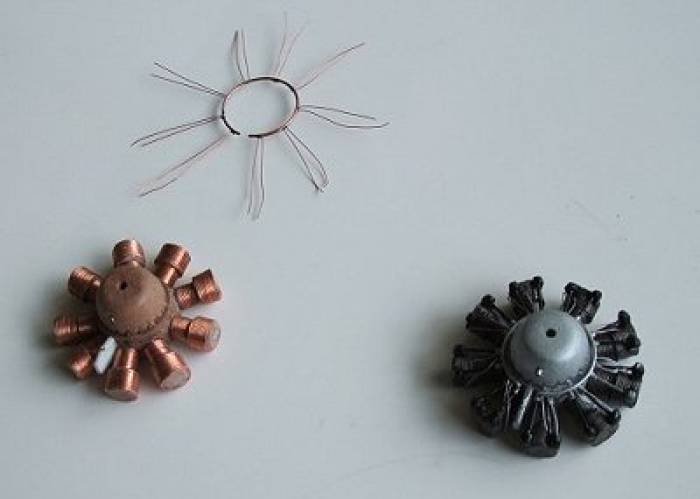
BMW BRAMO-FAFNIR 323 Engine
Editorial Note
This entry shows how Fukuda made the BMW BRAMO-FAFNIR 323 engine.
The crankcase, gearbox, and cylinder blocks were made from artificial wood, while fine enamel wire was used to represent the cylinder detail. Rather than fully reproducing the actual mechanical structure, this was work aimed at creating the density necessary for the part to read as an engine at model scale.
Fukuda’s expression that he made it “look convincing” should not be read simply as omission. It indicates a judgment about what needs to be shown in a scale model.
[July 19]
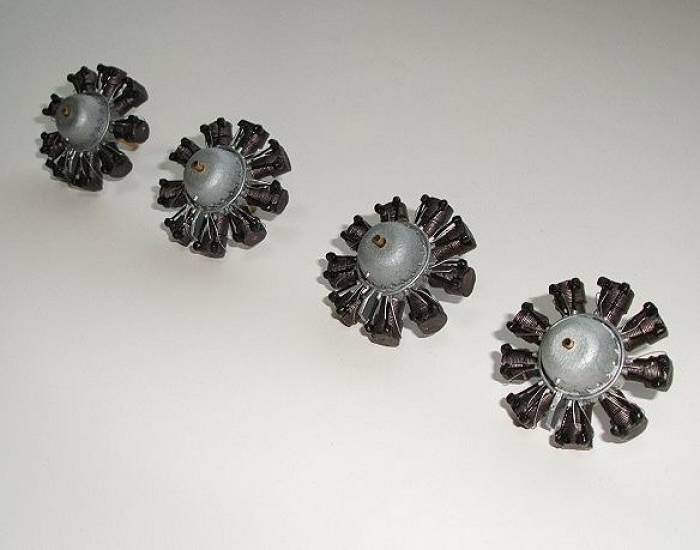
Four BMW BRAMO Engines Completed
Editorial Note
Because the Fw 200 C-3 is a four-engined aircraft, the engines support the overall impression only when all four are present.
Here, push rods, cylinder heads, plug wiring, and other parts have been added, and silver, black, and burnt iron colors give the engines a mechanical appearance.
Making four matching engines involves a difficulty different from making a single part. If the shapes and density do not match, the sense of unity as a four-engined aircraft becomes weaker in the completed model.
[July 20]
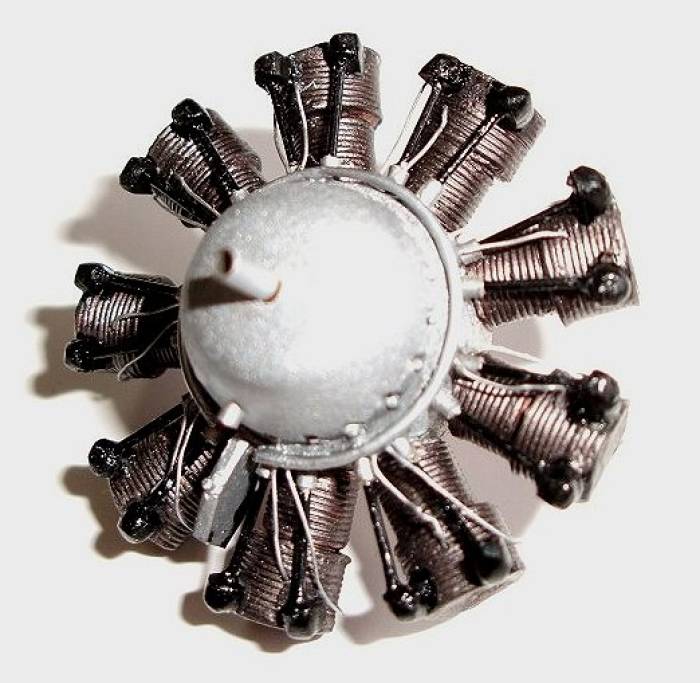
Detailed Work on the BMW BRAMO-FAFNIR 323
Editorial Note
This entry explains the detailed work on the engines more specifically than the records of July 14 and July 19.
Artificial wood, brass wire, enamel wire, and pipe were combined to represent cylinders, bolts, ignition plug wiring, push rods, and other elements.
What is important here is not that every part was reproduced exactly as on the actual engine. Rather, Fukuda judged which elements needed to be included in order for the engine to be visually convincing within the limits of scale and material.
His modest phrase that the engines “somehow became presentable” reveals an experienced judgment about how to make the part read correctly to the eye.
[July 22]
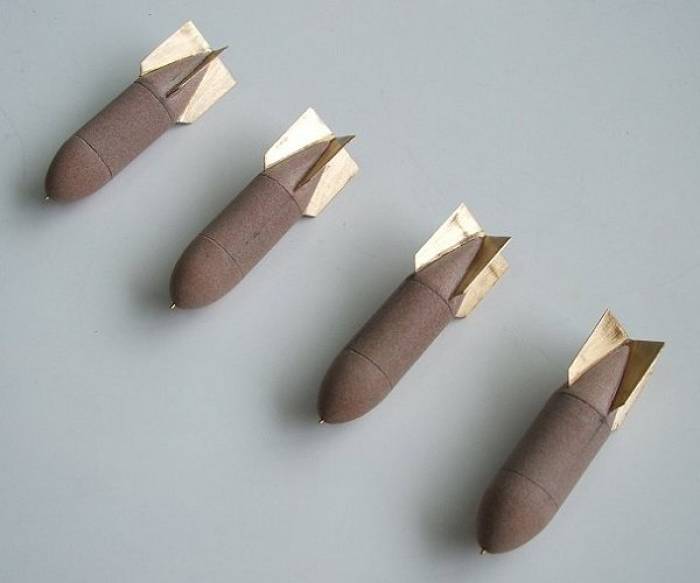
Construction of the SC 500 Bombs
Editorial Note
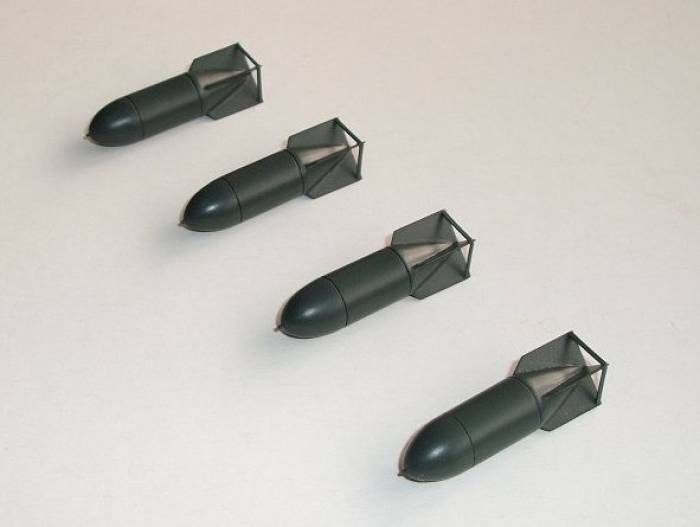
This entry records the construction of four SC 500 bombs.
The bombs suspended under the No. 1 and No. 4 engine nacelles and on the outer bomb racks are important parts for presenting the Fw 200 C-3 as a patrol bomber.
A particularly important point in this record is Fukuda’s decision not to proceed immediately to surfacer painting after the accessory parts were finished.
He notes that he will allow enough drying time in order to prevent shrinkage or cracking in the putty-shaped areas. This should not be understood as a mere interruption of work. It is an active judgment made to protect the surface condition of the completed model.
[Date Unconfirmed]
Fin Braces and Painting of the SC 500 Bombs
Editorial Note
The date of this entry has not been confirmed, but it can be positioned as the finishing record corresponding to the fin braces and painting mentioned in the July 22 entry.
The bombs are small parts, but once attached under the nacelles and to the racks, they greatly change the impression of the underside of the aircraft.
Therefore, this finishing process is not merely the completion of accessory parts. It can be read as a process that shows the role and character of the Fw 200 C-3 as a patrol bomber within the model itself.
Summary of This Page
This page has covered the construction of accessory parts that support the completed impression of the Fw 200 C-3.
Main Focus of This Stage
- Making the BMW BRAMO-FAFNIR 323 engines from artificial wood, brass wire, enamel wire, and other materials
- Completing the four engines required for a four-engined aircraft
- Adding density through cylinders, ignition plug wiring, push rods, and related details
- Making four SC 500 bombs
- Finishing the fins and braces of the bombs
- Waiting for the putty to dry instead of proceeding immediately to painting after the accessory parts were completed
What is important at this stage is that the engines and bombs are not merely additional parts.
The engines support the presence of the aircraft as a four-engined machine. The bombs indicate the character of the Fw 200 C-3 as a patrol bomber. And the decision to wait after the accessory parts had been completed shows an attitude that gives priority to surface stability rather than rushing toward completion.
This page is an important record because it shows that Fukuda’s construction involved not only active handwork, but also the judgment to stop and wait.
Toward the Next Stage
The next record moves to painting and markings, including surfacer, national markings, unit codes, underside color, and small parts on the underside of the wing.
Archival Note
This page preserves the construction of engines and bombs, accessory parts that strongly affect the completed impression of the aircraft.
In the engine work in particular, Fukuda combined artificial wood, brass wire, enamel wire, pipe, and other materials, making repeated judgments in order to create a convincing appearance.
The July 22 record also shows that after completing the accessory parts, he did not proceed immediately to painting, but waited for the putty to dry. This was an important process judgment intended to avoid later shrinkage and cracking rather than rushing toward completion.
For analytical organization, see:
Navigation
← Fw 200 C-3 Construction Record | Chronology | ← Original 04 | Original 05 | Original 06 →