Fw 200 C-3 Construction Record — Original 04
Spinners and Propellers
Note
This page preserves Kazu Fukuda’s original forum-based construction record as closely as possible to its original source structure.
It covers the construction record of the spinners and propellers.
The text of each entry is shown in a highlighted box in order to make clear that it is based on Fukuda’s original post text.
For a chronological reconstruction of the whole record, see:
Source Information
- Original format: forum post archive
- Period covered on this page: May 20, May 21, and an undated finishing record
- Main contents: spinner material blocks, shaft-hole drilling, propeller blades, rotating shaft, painting and assembly
- Original post text: Kazu Fukuda
- Page organization: Japanese Solid Model Archive
Original Record Navigation
Fw 200 C-3 Construction Record | Chronology | Original 01 | Original 02 | Original 03 | Original 04 | Original 05 | Original 06 | Original 07
Previous: Original 03 — Nacelles, cowlings, and attachment to the wing | Next: Original 05 — Engines, bombs, and accessory parts
Position of This Page
This page deals with the construction of the spinners and propellers of the Fw 200 C-3.
Although the propellers and spinners are small parts, they are important elements that strongly affect the impression of the Fw 200 C-3 as a four-engined aircraft.
What deserves attention here is that the work is not limited to shaping the outer appearance. The center axis of the spinner, the rotating structure, the pitch of the propeller blades, and the way the blades are attached to the spinner are all considered.
Some of these processes are not very visible after completion. However, they support the persuasiveness of the engine area.
[May 20]
Processing Material Blocks for the Spinners and Propellers
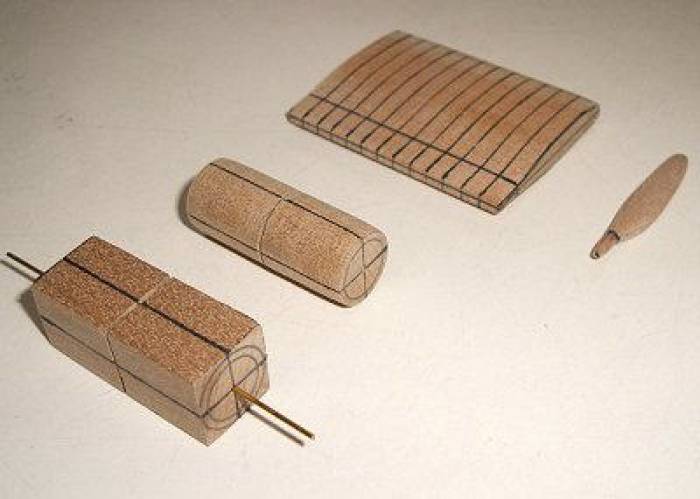
Editorial Note
This record shows the first stage of making the spinners: scribing centerlines on the material block and drilling the shaft hole.
What is important here is that the spinner is not treated merely as a bullet-shaped part. It is treated as a part that must have a rotating axis.
Accurately establishing the axis is essential for later attachment of the propeller and for the rotating condition of the part. For that reason, the scribing and drilling at this stage contain an important construction judgment.
[May 20]
Shaping the Spinner into a Bullet-Like Form
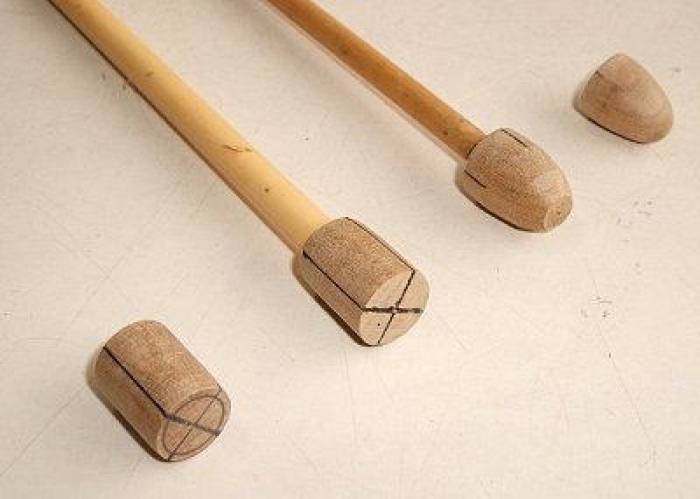
Editorial Note
Here, the cylindrical block is divided into two, and the handle of an old brush is used as a temporary handle while shaping the spinner into a bullet-like form.
By using the brush handle, a small part can be rotated and filed without directly gripping it. This is a practical method for maintaining symmetry during handwork.
It is also worth noting that Fukuda judged which side should become the tip by observing the condition of the divided surface. This reveals a fine level of observation within the making process.
[May 20]
Spinner with Rotating Shaft
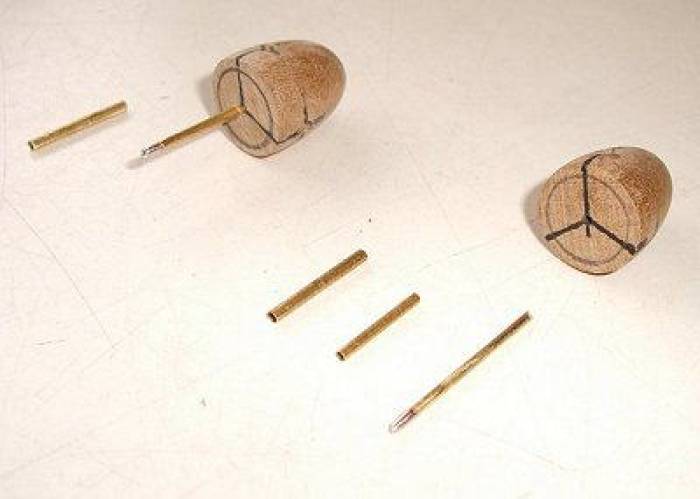
Editorial Note
In this entry, an actual rotating shaft is incorporated into the spinner.
By combining 1.0 mm brass wire, a brass pipe with an inner diameter of 1.1 mm, and another brass pipe with an inner diameter of 1.4 mm, Fukuda created a structure consisting of shaft, bearing, and sleeve.
This process is not very conspicuous after completion. However, it is an important construction judgment because the propeller is treated not merely as a fixed decorative part, but as a structure capable of rotation.
[May 21]
Trial Assembly of the Propeller Blades
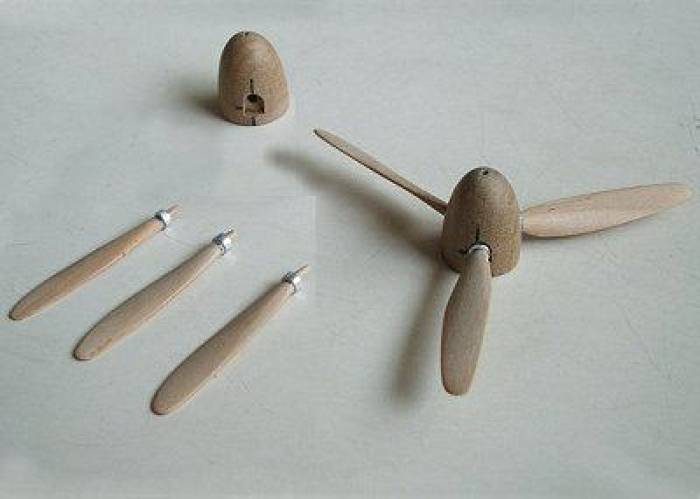
Editorial Note
Here, the propeller blades after pitch shaping are temporarily attached to the spinner.
A propeller blade is not only a front-view outline. It is a three-dimensional part with twist.
For that reason, trial assembly is important in order to check both the blade shape and the angle at which it attaches to the spinner.
Through trial assembly, it becomes possible to confirm whether the four propeller units will present a consistent impression.
[Date Unconfirmed]
Painting and Assembly of the Propellers and Spinners
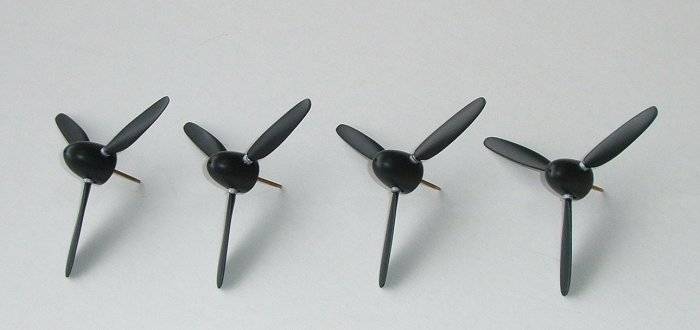
Editorial Note
The date of this entry has not been confirmed, but in terms of the process it belongs after the shaping and trial assembly of the propellers and spinners.
At this stage, the rotating shaft, spinner, and propeller blades become a single group of parts.
In the later final assembly, these parts will be attached to the engine cowlings and will help determine the expression of the Fw 200 C-3 as a four-engined aircraft.
Summary of This Page
This page has covered the construction process of the spinners and propellers.
Main Focus of This Stage
- Scribing centerlines on the material blocks for the spinners
- Drilling the shaft hole from both ends and establishing the axis
- Shaping the cylindrical block into a bullet-shaped spinner
- Making a rotating shaft using brass wire and brass pipes
- Shaping the front-view outline and pitch of the propeller blades
- Temporarily assembling the blades to the spinner for checking
- Painting and assembling the propellers and spinners
What is important here is that the propellers and spinners are made not merely as exterior parts, but as parts with a center, axis, rotation, and pitch.
In particular, the drilling of the spinner shaft hole and the rotating structure are not very visible after completion. However, they support the precision and persuasiveness of the part.
This record shows that Fukuda’s construction paid attention not only to visible form, but also to less visible structure and work sequence.
Toward the Next Stage
The next record moves to the construction of accessory parts that help establish the Fw 200 C-3 as a large patrol bomber: engines, bombs, and landing gear-related parts.
Archival Note
This page preserves the construction process of small parts: the spinners and propellers.
It contains many judgments that become difficult to see after completion, including scribing to establish the center axis, drilling the shaft hole, creating a rotating structure, and shaping pitch into the propeller blades.
For analytical organization, see:
Navigation
← Fw 200 C-3 Construction Record | Chronology | ← Original 03 | Original 04 | Original 05 →