Fw 200 C-3 Construction Record — Original 02
Fuselage Interior, Cockpit, Canopies, Machine Guns, and Gondola
Note
This page is an original record page reconstructed as closely as possible in chronological order from Kazu Fukuda’s Fw 200 C-3 construction record.
On the existing site, these records were preserved separately under categories such as “mock-up” and “machine guns & interior fittings.” In this archive, they have been arranged chronologically, based on confirmed dates, so that the construction process can be read more clearly.
This page covers work on the fuselage interior, cockpit, canopies, machine guns, interior equipment, and underside gondola.
The text of each entry is shown in a highlighted box in order to make clear that it is based on Fukuda’s original article text.
Source Information
- Original format: record published on an existing site based on forum posts
- Reconstruction policy: chronological rearrangement based on dates and construction process
- Dates included on this page: March 30, April 8, April 15, April 24, May 9, May 27, June 3
- Original article text: Kazu Fukuda
- Page organization: Japanese Solid Model Archive
Construction Record Navigation
Fw 200 C-3 Construction Record | Chronology | Original 01 | Original 02 | Original 03 | Original 04 | Original 05 | Original 06 | Original 07
Previous: Original 01 — Material preparation and the emergence of the overall form | Next: Original 03 — Nacelles, cowlings, and attachment to the wing
Position of This Page
This page deals with the work on the fuselage interior and nose area that began after the trial assembly of the main blocks.
The Fw 200 C-3 was a large aircraft, and many elements supported the persuasiveness of its outer form: the fuselage interior, cockpit, canopies, machine guns, and underside gondola. At this stage, the model had not yet reached the appearance of a completed aircraft.
However, as the interior, openings, transparent parts, armament, and underside gondola were added, the model began to move beyond a simple set of outer blocks and take on the character of a specific aircraft.
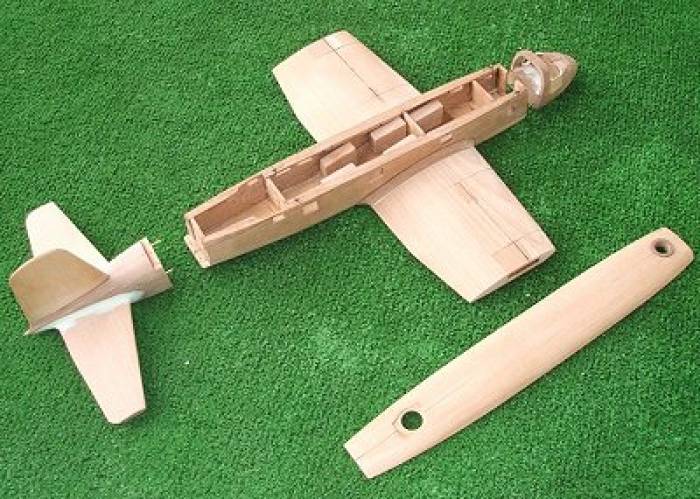
March 30 — Detailed Work on the Fuselage Interior
Editorial Note
In this entry, the work shifts from shaping the outer form to constructing the fuselage interior.
Even though the interior will become difficult to see after completion, parts corresponding to fuel tanks and an oil tank were installed. This shows that Fukuda paid attention not only to the external appearance of the completed model, but also to the sense of internal structure within the aircraft.
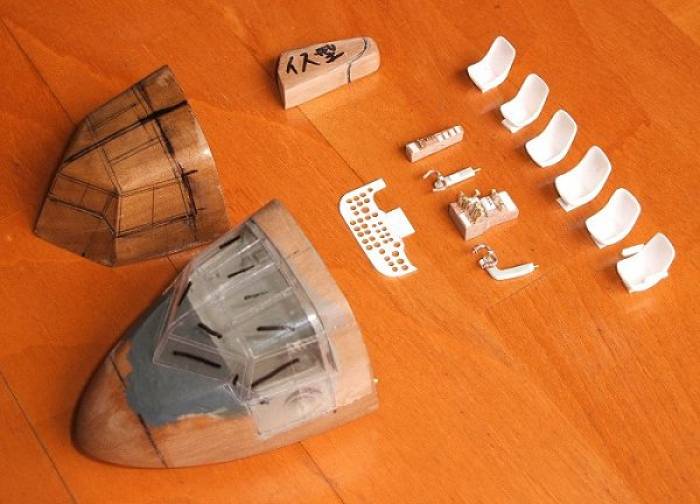
April 8 — Trial Fitting of the Cockpit Canopy and Nose Section
Editorial Note
Here, the nose section and cockpit area are being checked in an unglued state.
What is important at this stage is not only the canopy itself. The seats, instrument panel, control column, and console parts that will be visible inside the canopy are being prepared at the same time.
Because transparent parts reveal the interior, the density of the interior work directly affects the impression of the completed model.
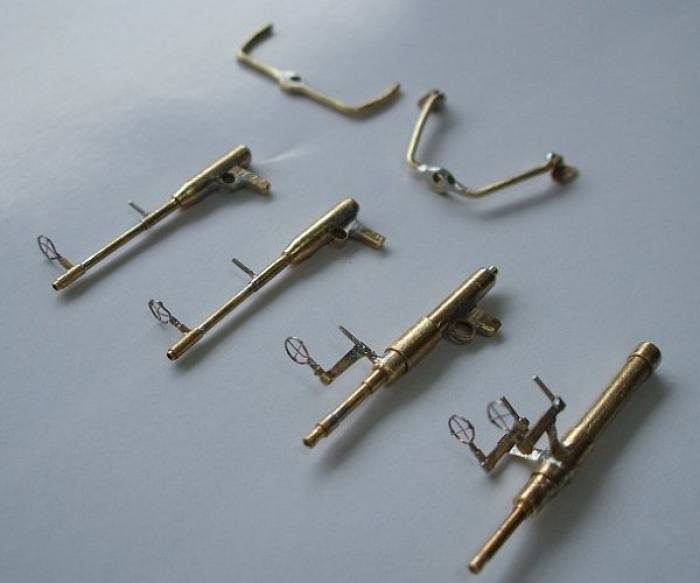
April 15 — Construction of Machine Guns and Accessories
Editorial Note
On the existing site, this item was included under “machine guns & interior fittings,” but by date it belongs after the April 8 work on the nose section and cockpit.
The machine guns made here will later be installed in the upper nose position, the rear fuselage position, and the underside gondola. Therefore, this is not merely independent small-part work. It is preparation for the later interior equipment and exterior character of the aircraft.
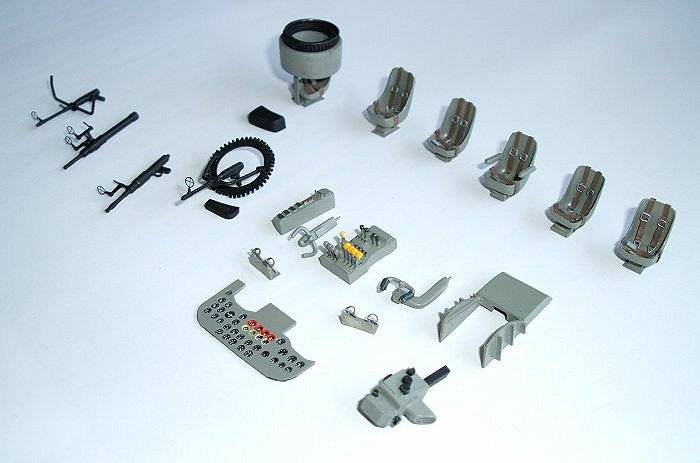
April 24 — Painting and Finishing of Interior Equipment
Editorial Note
The machine guns made on April 15 and the cockpit-related parts are now gathered together as a single group of interior equipment.
With the LOTFE 7D bombsight, instrument panel, console, control column, foot bar, machine guns, seats, and powered turret placed together, the density of the interior that will later be installed in the fuselage becomes visible.
May 9 — Installation of Parts in the Nose Section and Fuselage Interior
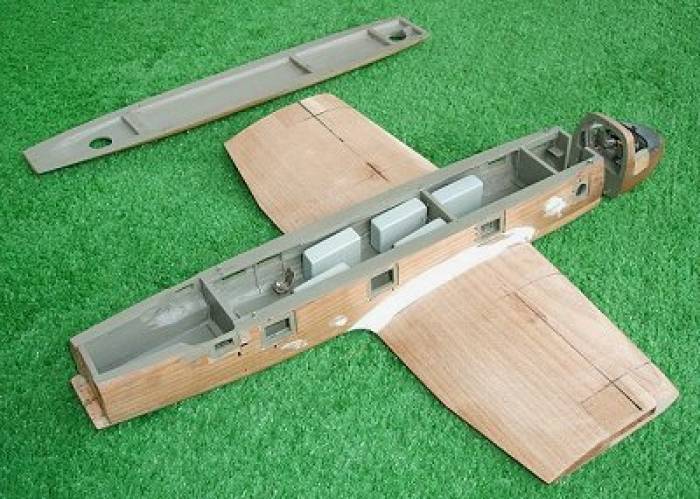
Editorial Note
Here, the cockpit parts and fuselage interior parts prepared in April are actually installed in the aircraft.
Fukuda was aware that once the ceiling part was attached, the interior would become dark and difficult to see. Nevertheless, he still constructed the interior.
This is one of the important points of this record. The interior supports the sense of reality of the aircraft not only in the completed appearance, but also within the making process itself.
May 27 — Installation of the Ceiling Part, Side Windows, and Cockpit Canopy
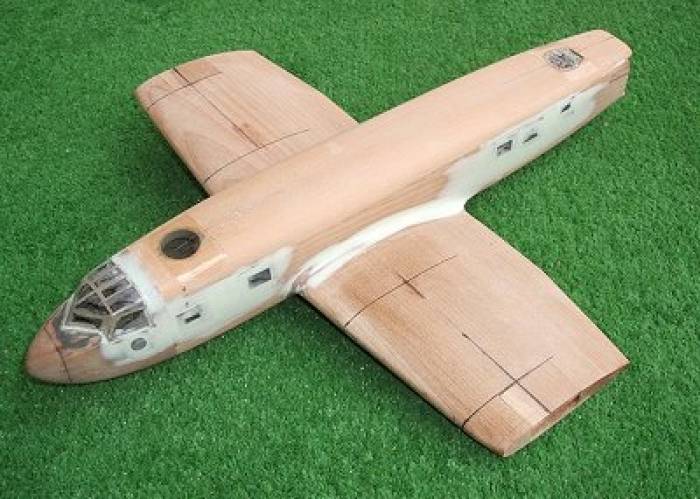
Editorial Note
In this entry, the fuselage interior is closed, and the side windows and cockpit canopy are installed.
The interior work is now contained within the outer form. The correction of gaps with polyester putty also shows that fitting the transparent parts to the wooden outer form was not merely an attachment task, but also involved adjustment of the exterior shape.
The next stage moves to the underside gondola.
June 3 — Installation of the Underside Gondola
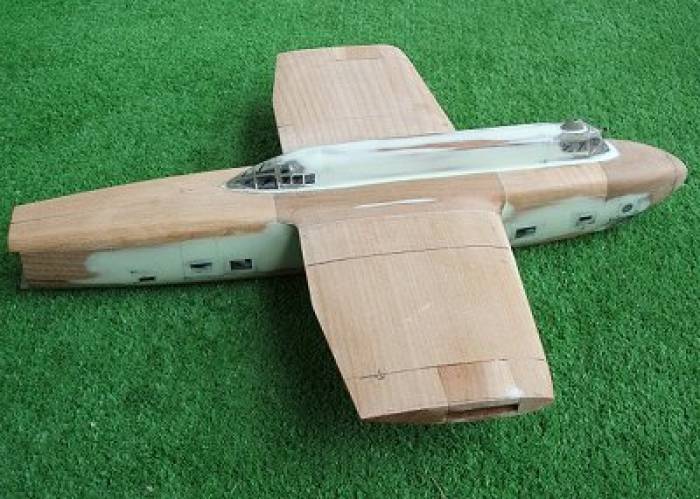
Editorial Note
In this entry, the machine guns and bombsight prepared on April 15 and April 24 are installed inside the underside gondola.
The decision not to attach the double gunsight for the MG FF at this stage is also important. It shows that Fukuda did not rush toward the completed state, but adjusted the order of attachment so that later work would not be hindered.
At this point, the difficult work around the fuselage was almost complete, and the next process would move to the engine cowlings and their attachment to the wing.
Summary of This Page
This page shows how the construction of the Fw 200 C-3 moved from a trial assembly of outer blocks to a more aircraft-like structure that included interior work and transparent parts.
The following points are especially important.
Main Focus of This Stage
- Cutting out the side windows of the fuselage
- Installing fuel tanks, an oil tank, and seats inside the fuselage
- Making the cockpit, instrument panel, control column, console, and seats
- Preparing machine guns, bombsight, and powered turret
- Installing the ceiling part, side windows, and cockpit canopy
- Installing the underside gondola and incorporating armament and bombsight
What becomes clear at this stage is that Fukuda’s construction did not proceed only through the outer form.
The fuselage interior, hard-to-see tanks, cockpit, machine guns, bombsight, windows, canopies, and gondola were made in sequence and then enclosed within the fuselage.
Some of these areas would become difficult to see after completion. However, they remain preserved in the construction record.
For that reason, this page is an important record for understanding the internal formation of the Fw 200 C-3, which cannot be understood from completed model photographs alone.
Toward the Next Stage
The next record moves to the engine cowlings, parts around the nacelles, attachment of the nacelles to the wing, and installation of the tail section and tail surfaces.
Navigation
← Fw 200 C-3 Construction Record | Chronology | ← Original 01 | Original 02 | Original 03 →