6 Final Painting
6-1 Accessories
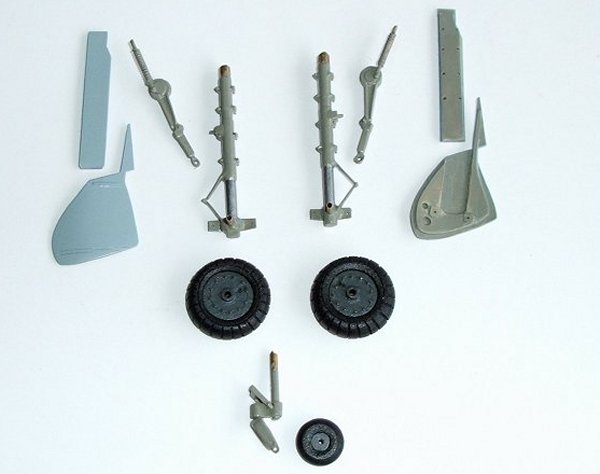
Landing gear components.
 |
|---|
| Fig. 6-1-1 Finishing coat on landing gear parts |
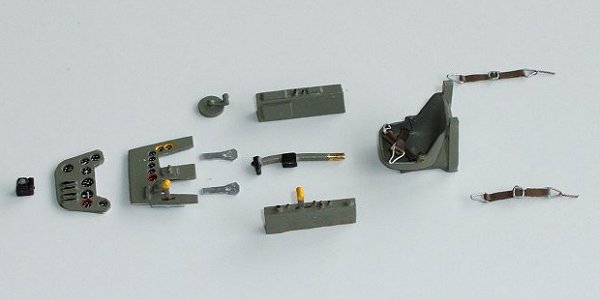
Cockpit interior parts were painted and finished. From the left: gunsight, instrument panel, canopy slide handle, rudder bar, control stick, left and right consoles, seat with lap belts, and shoulder harnesses.
 |
|---|
| Fig. 6-1-2 Finishing coat on cockpit interior |
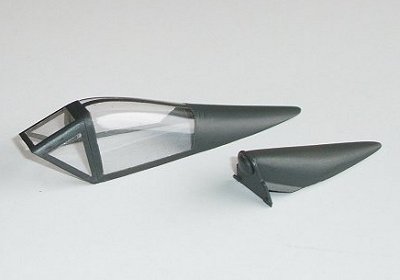
The Galland hood (canopy) and the armor plate support frame were painted and finished.
 |
|---|
| Fig. 6-1-3 Finishing coat on canopy |
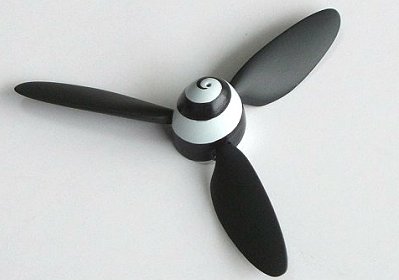
While waiting for the upper-surface paint on the main body to dry, work was done on the propeller assembly. The spiral on the spinner was sketched in pencil and then hand-painted in black.
 |
|---|
| Fig. 6-1-4 Finishing coat on propeller |
6-2 Fuselage and Main Wing
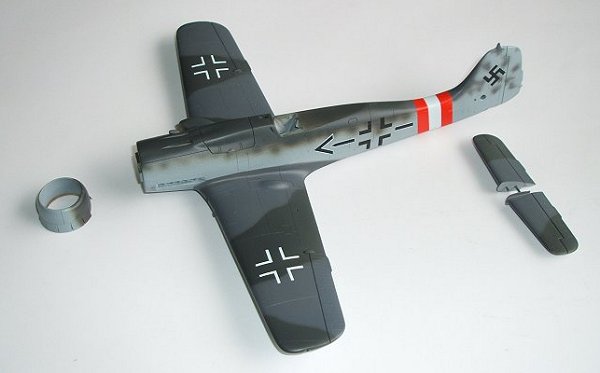
The Fw 190 D-type appeared during the chaotic final stage of World War II, so unlike the colorful A-type versions, few aircraft displayed vivid unit markings or victory score decorations on the vertical stabilizer. Instead, many home-defense fighters featured bright RVG (Reichsverteidigung) bands and spiral patterns on their spinners. In this build, the paint scheme replicates the aircraft of Major Gerhard Barkhorn, commander of Jagdgeschwader 6 (JG 6). A red-white-red RVG band is wrapped around the fuselage extension, and the commander’s emblem is painted on the fuselage sides.
First, the white undercoat was sprayed for the national insignia on the wings, the RVG band, and the spinner’s white sections. Mr. Color paints were used.
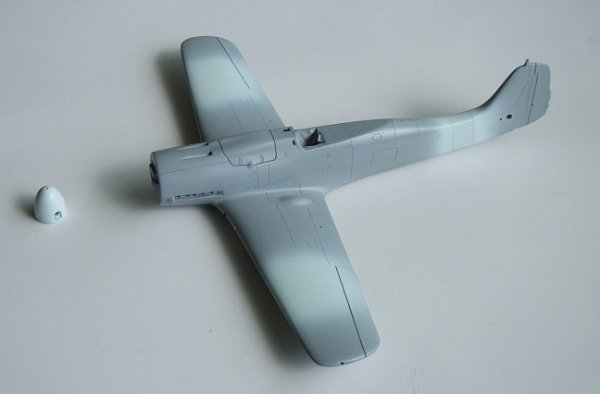 |
|---|
| Fig. 6-2-1 White base for markings |
These are the marking templates for the Hakenkreuz, Balkenkreuz, and the commander’s emblem. They were precisely drawn on the back of a business card and cut out with a design knife. After spraying the white or black base coat, cellophane tape with reduced adhesion is applied to the correct position, the template is placed over it, and the shape is traced in pencil.
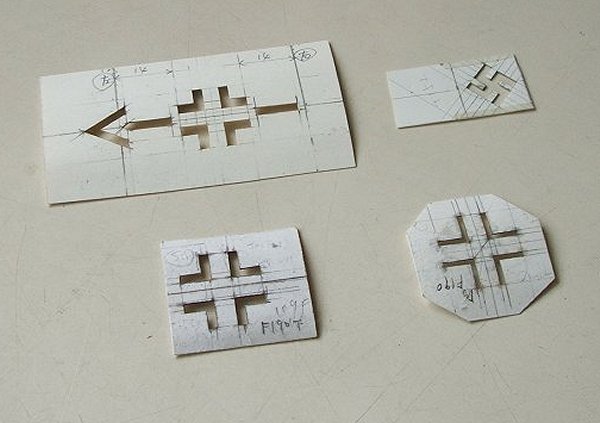 |
|---|
| Fig. 6-2-2 Templates for markings |
The template is shown positioned on the left upper wing surface. The right wing has already been traced using the template.
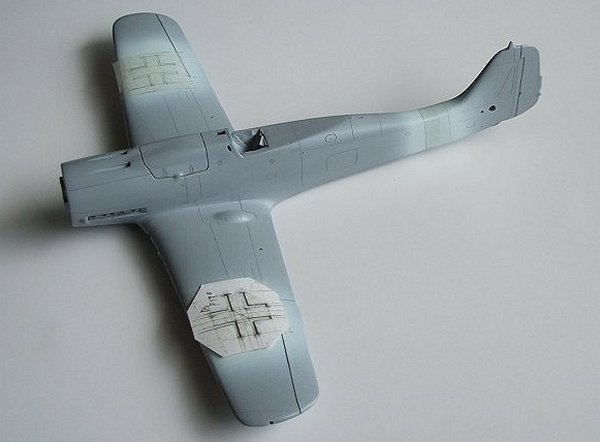 |
|---|
| Fig. 6-2-3 Tracing the Balkenkreuz |
The traced Balkenkreuz on the upper wing was carefully cut out and masked using a design knife. For the RVG band on the fuselage extension, 6 mm-wide strips of cellophane tape were applied over the white-painted sections.
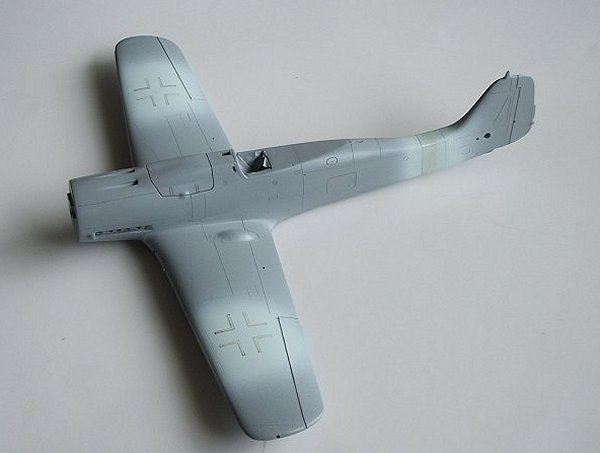 |
|---|
| Fig. 6-2-4 White base for Balkenkreuz |
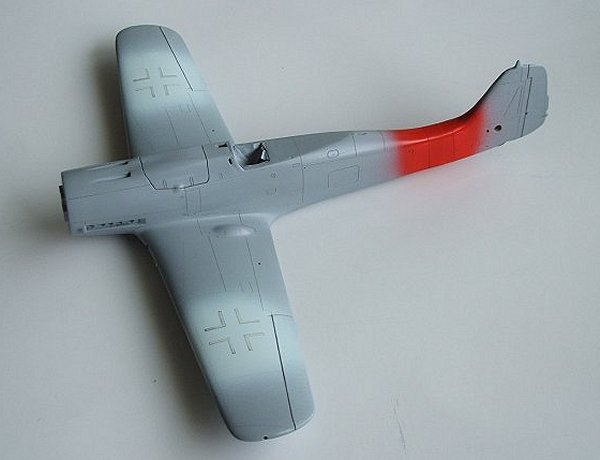
Next, the red sections of the RVG band were sprayed. In other words, after painting the white first and masking it, both sides of the white stripe are painted red.
 |
|---|
| Fig. 6-2-5 Red coat on RVG band |
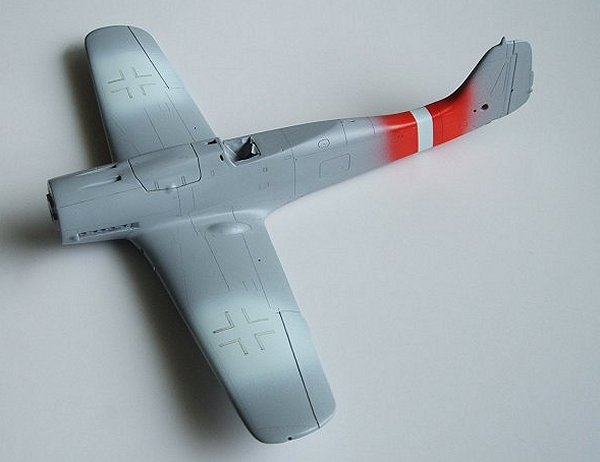
After the red paint dried, the masking tape was removed.
 |
|---|
| Fig. 6-2-6 Removing masking |
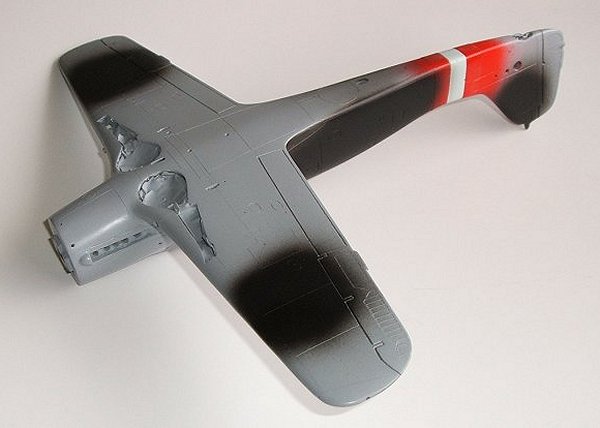
Then, masking was reapplied with 6 mm-wide tape so that the red-white-red stripes of the RVG band are equal in width. Next, the black paint was sprayed over the areas for the national insignia on the fuselage, vertical tail, lower wing surfaces, and the commander’s emblem.
 |
|---|
| Fig. 6-2-7 Black coat for insignia |
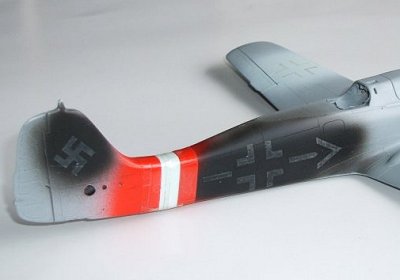
After the black paint dried, the Balkenkreuz on the lower wings and fuselage, the commander’s emblem, and the Hakenkreuz on the vertical stabilizer were masked. As before, low-tack tape was applied, and the templates were traced and cut out with a design knife.
 |
|---|
| Fig. 6-2-8 Masking of national markings |
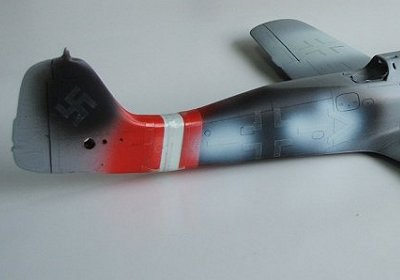
The commander’s emblem has a white border, so the masked area was sprayed white. For reference, the upper wing Balkenkreuz has only a white border, while the lower wing and fuselage markings have black borders. The Hakenkreuz on the tail is plain black without any border.
 |
|---|
| Fig. 6-2-9 White base for commander’s emblem |
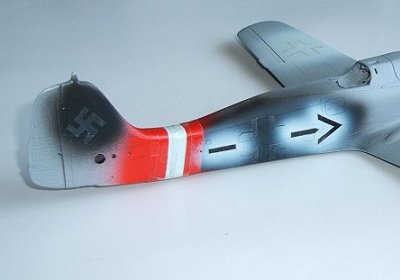
After the white dried, the masking was removed, revealing crisp black wedges and bars. Next, low-tack tape was again placed over the emblems, and fine border lines were carefully cut with a design knife to create masking for the outlines. With all national markings, commander’s emblems, and RVG bands masked, painting of the camouflage could finally begin.
 |
|---|
| Fig. 6-2-10 All markings masked |
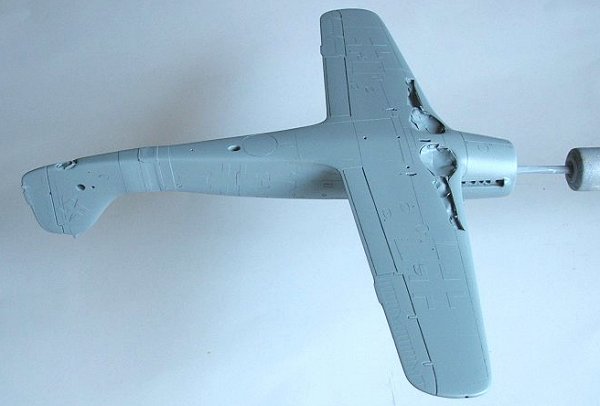
First, the underside color RLM 76 was applied—not only to the lower wing surfaces, but also extended onto the fuselage and upper wings.
 |
|---|
| Fig. 6-2-11 Underside painting |
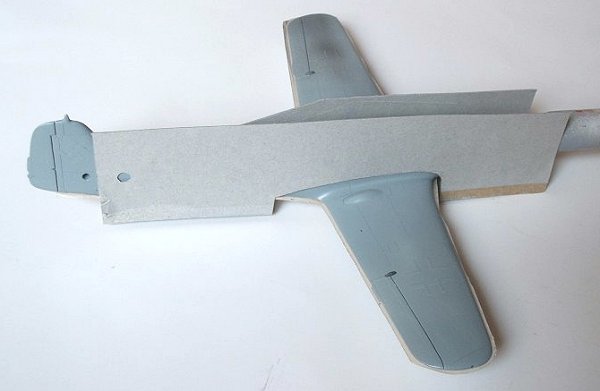
The upper surfaces were painted in a two-tone camouflage of RLM 75 Gray-Violet and RLM 74 Gray-Green, with soft, feathered demarcations. A thick paper mask cut to match the wing fillets prevented overspray onto the fuselage sides while RLM 75 was applied. The lower surfaces of the wings and fuselage were masked with tape. Once RLM 75 dried, additional masks were cut from paper according to the camouflage pattern, slightly raised using double-sided tape, and RLM 74 was sprayed over the remaining areas. RLM 75 and 74 were then carefully blended on the fuselage top, and RLM 75 mottling (“ink spots”) was added along the fuselage sides and vertical stabilizer.
 |
|---|
| Fig. 6-2-12 Upper surface painting |
Finally, all masking was removed.\
 |
|---|
| Fig. 6-2-13 Removal of all masking |