Introduction
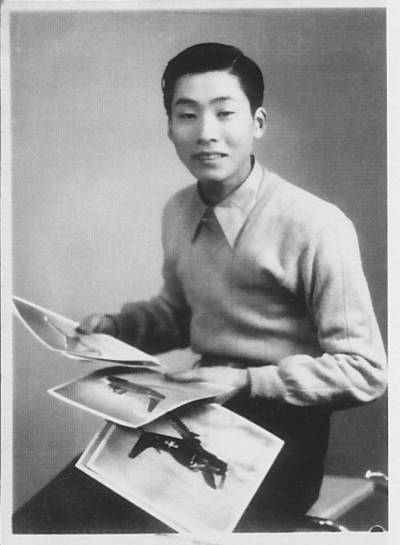
Masami Ōmachi is remembered as a legendary figure in Japan’s hand-built aircraft modeling culture. Although he died at the age of twenty-six, his reputation endured because of both the number of works he completed and the distinctive character of his making.
He completed approximately 140 solid scale models during his short life, and his work established a standard of precision, speed, and stylistic clarity that remained influential. He was also known by the nickname “Clown of the Sky,” a phrase that suggests the unusual combination of playfulness and technical seriousness in his models.
Why Ōmachi matters
Ōmachi matters because his work can be read at more than one level. On one level, he was a prolific and highly skilled maker of aircraft models. On another, he belongs to the cultural history of Japanese solid modeling: a history in which the model is not merely a miniature object, but a way of stabilizing interpretation and transmitting knowledge through making.
He should therefore not be treated only as an exceptional craftsman. He should also be understood as a figure through whom an entire way of seeing becomes visible. His works help us understand that solid modeling is not only about accurate reduction, but about selecting and clarifying form.
The “Clown of the Sky”
The phrase “Clown of the Sky” is memorable because it captures the dual character of Ōmachi’s work. His models were not merely exact in a mechanical sense; they also carried a sense of liveliness, imaginative force, and expressive clarity.
In this respect, Ōmachi is an especially revealing figure. He demonstrates that solid model making cannot be reduced to technical replication alone. It always includes interpretation: what kind of form is being pursued, which aspects of the aircraft must be emphasized, and how fidelity and expressiveness are to be balanced.
Paper-based solid models
One of the most striking aspects of Ōmachi’s work is his development of paper-based solid models. At a time when wooden solid models dominated the field, he pioneered a method using thick card and celluloid to create 1/50-scale fully movable models.
This matters not merely as a technical curiosity. He did not simply substitute paper for wood; he extended the logic of solid modeling into a different material field. In doing so, he preserved the mentality of solid modeling while transforming its means.
Publication context
Ōmachi’s work was not confined to private making alone. It circulated through magazines and print culture, where models, diagrams, aviation knowledge, and hobby practice met one another. That publication context is essential. It shows that his work belonged to a broader postwar media environment, not merely to a private workshop.
The magazine image used on this page is important precisely because it shows more than the model itself. Even without a surviving step-by-step build record, it preserves the relation between author, object, and publication context. In that sense, it is not just an illustration but an archival document.
Ōmachi as a cultural figure
Ōmachi should therefore be read not only as an individual modeler, but as a cultural figure. His short life, prolific output, unusual material experiments, and enduring reputation make him central to any attempt to describe the history of Japanese solid modeling.
He represents a moment when model making, historical interest, technical understanding, and expressive craft came together in unusually concentrated form. For that reason, he continues to serve as a point of orientation for later readers and makers alike.